
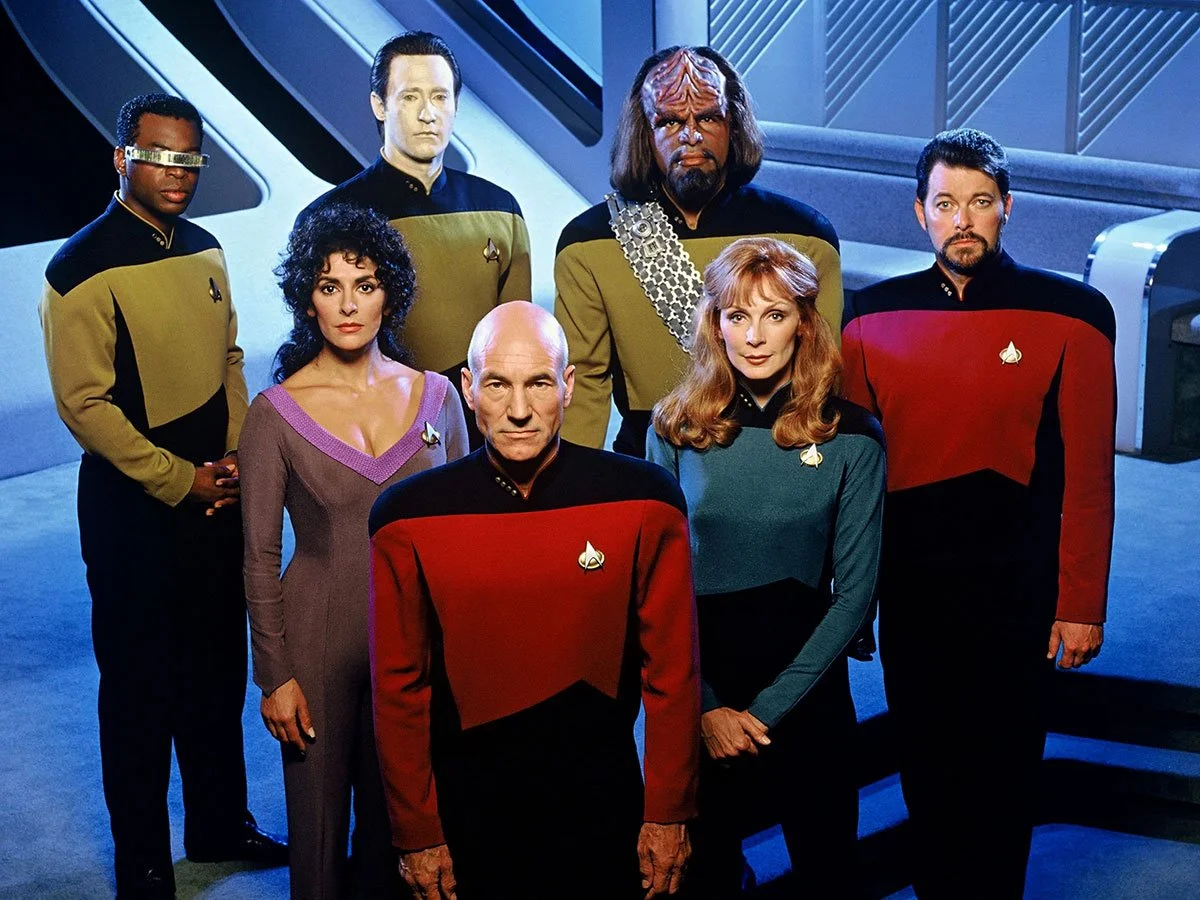
Last month Sir Patrick Stewart passed away after battling Alzheimer's disease and Lewy body dementia. Stewart had a long and accomplished career, but to many of us his most iconic role was that of Jean Luc Picard, captain of the U.S.S. Enterprise on Star Trek: The Next Generation. The series, spanning almost 200 episodes, took us across time and space, and the character of Jean Luc Picard navigated perilous situations as his crew explored the galaxy. There can be much said about Stewart as a comrade, but what I want to convey to you is how Star Trek, and science fiction as a whole, can invigorate our socialist imagination as in our theory and practice we boldly go where no one has gone before.
End of history?
Capitalist realism, a term coined by the late Mark Fisher, is a subject that has been in vogue on the left in recent years. To take a quote from his book, capitalist realism describes "the widespread sense that not only is capitalism the only viable political and economic system, but also that it is now impossible even to imagine a coherent alternative to it." As a young man who grew up after the collapse of the Soviet Union and in the midst of a neoliberal reality, I felt this sentiment in my bones. I engaged any interaction I had with socialist thought or theory not with antagonism but with apathy. Socialism had failed; We had reached the end of history.
Star Trek offers (and offered me) a parting in the clouds of capitalist reality even to those who might not realize it yet. There have been numerous TV shows and movies in the Star Trek canon, but let’s focus in on Star Trek: The Next Generation. The show follows a space crew of the United Federation of Planets in the 24th century on an exploratory mission to discover new worlds and civilizations. Thanks to the capability of “replicators” to produce any material food or good, the show lives in a post-scarcity setting. This means that the characters aren’t going about their duties on a Federation spaceship due to a need for a wage to provide for food and shelter, but are doing it because they believe in their mission.
In an episode of the show, “The Neutral Zone”, the crew discovers several people cryogenically frozen from the 20th century on an abandoned vessel. After reviving them and helping them navigate the shock of waking up four centuries in the future, Captain Picard says this regarding humanity’s past:
A lot has changed in the past three hundred years. People are no longer obsessed with the accumulation of things. We've eliminated hunger, want, the need for possessions. We've grown out of our infancy.
Ralph Offenhouse, one of the cryogenically frozen characters, was a successful capitalist in his past. He is disturbed by this brave new world he has stepped into. After an escalating argument with the Captain they arrive at this conversation:
Captain Picard: This is the 24th century. Material needs no longer exist.
Ralph Offenhouse: Then what's the challenge?
Captain Picard: The challenge, Mr. Offenhouse, is to improve yourself. To enrich yourself. Enjoy it.
Communist reality of Star Trek

The episode is a prime example of the—dare-I-say—communist reality of Star Trek. The show explores themes of leadership, empathy, interacting with different cultures and an optimistic view of humanity’s future in a post-capitalist setting where class comes in as an almost disturbing contrast.
There is a vulgar marxist tendency I have had in the past to focus so much more on the economic analysis of current events (what some may refer to as the cold stream of marxism) that it eclipses the other parts of our reality that brush up against the economics. Because if we are to engage with materialism as a dialectic, we shape the world and the world shapes us in turn. Star Trek and science fiction that prods and challenges our preconceived notions of capitalism are part of this process. We interact with this media and it helps shape us until the breaking point when we are able to shed the capitalist realism that veils our view.
Unfortunately, watching Star Trek is not praxis and will not bring about socialism or even bring about the world it imagines. We have to do the work. Fortunately, the Democratic Socialists of America acts in a similar way to Star Trek by challenging what people think is possible. I have talked to new comrades coming into DSA and they have had strikingly similar stories about what brought them to our organization. They were disillusioned by the Democratic Party, and after seeing the wins DSA achieved, they were inspired to go out and get organized. So if you have any friends or family that you think are ready for transformative politics, have them watch Star Trek and then afterwards show them what a DSA socialist horizon looks like.