After the Party: Dorothy Healey, Radio Days, and the Reinvention of the Los Angeles Left
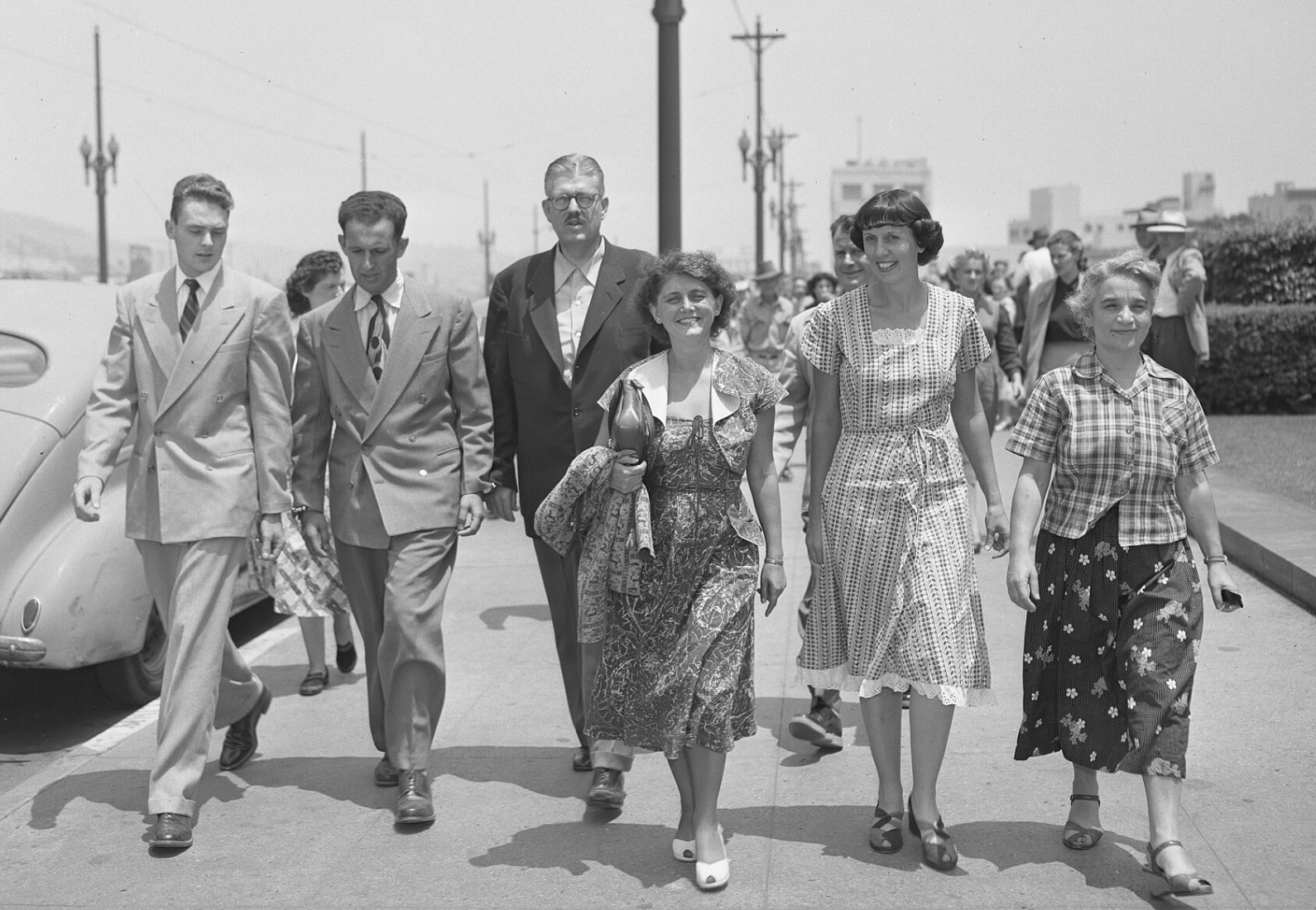
Dorothy Healey (third from right) and other Communists arrested by U.S. Marshals for violating the Smith Act, 1951 (L-R): Unknown, Henry Steinberg, Philip Connelly, Healey, Unknown, Rose Chernin.
PART ONE OF TWO
On July 9, 1973, Dorothy Healey sat behind a microphone at KPFK in Los Angeles and ended a political commitment that had consumed nearly her entire adult life. She had joined the Young Communist League at 14, organized farmworkers and cannery workers, gone to jail, rose through the ranks of Communist Party leadership, and for two decades led its Southern California district. Now, at 58, she told her radio audience that she was resigning from the party.
The immediate cause was almost painfully characteristic of the organization she was leaving. The national party had denounced Al Richmond, the former editor of its West Coast newspaper, the People's World, for his memoir A Long View from the Left. Southern California Communists were instructed to uphold national leaders’ judgment whenever they discussed the book publicly. Healey refused.
Her resignation was anything but a renunciation of radical politics. "My hatred of capitalism," she told her listeners, remained as intense as when she had joined the YCL in 1928. She described herself instead as "a communist ... without a party."
That distinction would define the rest of her life.
Dorothy Healey's political history is often told as a journey from Communism to democratic socialism. The description is accurate but flattens a much, much more interesting story. Beginning with the crisis of world Communism in 1956, Healey spent decades trying to salvage the radicalism, working-class politics, and organizational seriousness of the Communist tradition while discarding authoritarianism, sectarianism, and toeing the party’s foreign policy line.
Much of that reinvention happened right here in Los Angeles. From the late 1950s through the early 1980s, Healey occupied an unusual position amongst successive generations of the city's left: the Communist Old Left, the civil rights and antiwar movements, Black and Chicano radicalism, socialist feminism, the New American Movement and finally Democratic Socialists of America.
Her story is therefore less about leaving the Communist Party than about the harder question that flowed from it: What do you build after it?
The Earthquake of 1956
For American Communists, 1956 was an earthquake.
At the 20th Congress of the Soviet Communist Party, Nikita Khrushchev exposed a portion of the crimes committed under Joseph Stalin. Healey later remembered hearing the secret speech in New York and being devastated by its revelations. That autumn Soviet tanks crushed the Hungarian uprising, generating debate through out Communist parties around the world.
Thousands of Communists in the US responded by voting with their feet and leaving the party. Healey did not. Instead, she became an advocate for democratizing the Communist Party USA from within.
That decision made Los Angeles unusually important. Under Healey and her longtime comrade Ben Dobbs, Southern California became a center of dissent, sufficiently independent that the national leadership repeatedly tried and failed to dislodge them.
This was not an insignificant backwater club. Healey had been brought into LA’s leadership after World War II and eventually headed what the Los Angeles Times described as the party's second-largest district after New York.
The old Popular Front had been broken by the Cold War. Communists had been driven from unions, prosecuted under the Smith Act, blacklisted, surveilled and pushed toward the margins of public life. Healey herself had been convicted under the Smith Act in 1952 before the Supreme Court reversed the California convictions in 1957.
Yet Southern California radicalism was already beginning to regenerate outside the party. Civil rights organizers, peace activists, students and young radicals were creating their own political networks. Healey's great post-1956 wager was that the surviving Old Left could enter into conversation with this new one.
LA became one of the laboratories.
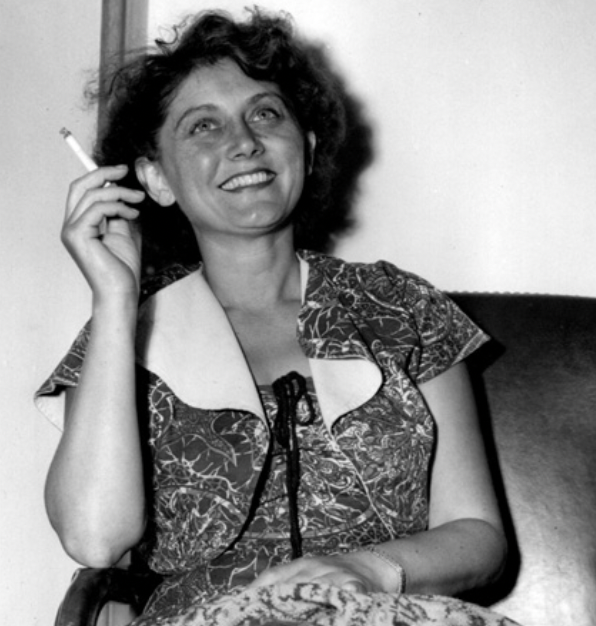
Cover photo from Dorothy Healey’s memoir, California Red, 1990
A Communist on the FM dial
In 1959, the same year KPFK began broadcasting in Los Angeles, Dorothy Healey went on the air.
The new Pacifica station was itself an experiment. Commercial-free and listener-supported, KPFK gave airtime to an extraordinary range of political opinion, from conservatives such as William F. Buckley and Howard Jarvis to the Communist leader of Southern California. Healey's program, Communist Commentary, gave an avowed Communist a regular voice on the Los Angeles airwaves at the height of the Cold War.
Radio suited her. Healey could be ferociously political without sounding mechanical, and she possessed little patience for the wooden language that often passed for Communist public communication. Even critics of her politics encountered something difficult to fit into the stereotype of the obedient party hack: a funny, combative, recognizably local political personality.
The program also gave Healey something increasingly important: a political identity larger than the institution she led. As her disagreements with the national Communist Party widened, Angelenos could encounter Dorothy Healey directly, not merely as a representative of the CPUSA. By 1963 her presence at KPFK was prominent enough to become an issue in congressional attacks on Pacifica's broadcasting license.
More importantly, KPFK placed Healey inside a rapidly changing Los Angeles political culture. The station became one of the spaces where the Old Left, pacifism, the New Left, feminism, Black radicalism, antiwar activism and the counterculture could collide with one another. Healey no longer had to wait for those movements to enter the Communist Party; she was already talking to them over the radio.
That convergence was happening elsewhere in the city as well.
Despite the party's losses after 1956, Healey worked to restore relationships with liberals and peace activists and to open the Southern California organization toward younger radicals. Communist youth participated in southern Freedom Rides, and the party's Black membership later developed the Che-Lumumba Club, which became an important political base for Angela Davis. Mike Davis and Jon Wiener have argued that this continuing interaction between Los Angeles's Old and New Lefts distinguishes the city's 1960s history from the familiar national story in which the Communist movement simply disappears before the New Left arrives. Healey became one of the human bridges between those worlds.
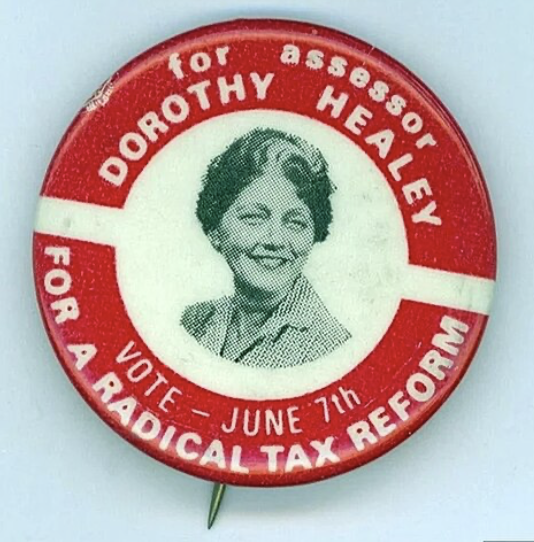
1966 Healey campaign button when she ran for Los Angeles County Assessor.
Eighty-three thousand votes for a Communist
Her peculiar place in Los Angeles politics became visible in 1966, when Healey ran for Los Angeles County Assessor.
She made no attempt to disguise her politics. This was a Communist running openly for countywide office less than 15 years after the height of McCarthyism. She received 83,891 votes, 5.4 percent of the total.
The result was politically meaningless if measured by winning (and by current DSA LA standards). But it was remarkable as a measure of survival. After blacklists, prosecutions, loyalty investigations and years of official anticommunism, more than 80,000 LA County voters deliberately marked their ballots for Dorothy Healey.
The campaign also tells us something about the politics Healey was trying to construct. She was not retreating into a purified revolutionary subculture. She was attempting to make socialism visible within the ordinary political life of Southern California.
That strategy put her increasingly at odds with a national party whose instincts remained tied to Moscow and to an increasingly insular organizational culture. Los Angeles Communism had survived the catastrophe of 1956, but the contradiction at its center was becoming harder to contain. Healey wanted the party to open itself toward the new movements; the party leadership continued to demand political reliability.
In 1968, the contradiction broke open.
Socialism with a Human Face
In August 1968, Soviet and Warsaw Pact forces invaded Czechoslovakia and crushed Prague Spring and Socialismus s Lidskou Tváří (Socialism with a Human Face).
Healey had visited the country the previous year and had close connections with Czech communists like Edward and Marta Goldstucker. She condemned the invasion, while Communist Party general secretary Gus Hall and the national leadership defended it. Healey resigned as head of the Southern California district.
For Healey, Prague brought the argument that had begun in 1956 to its conclusion. Could socialism exist without democracy? Could a communist movement possess an independent political judgment, or was its loyalty to the foreign policy interests of the Soviet Union ultimately stronger than its commitment to democratic change initiated by other communists?
But she still didn’t quit.
Healey had spent 40 years in the Communist movement, and a political organization built over a lifetime is not simply a bundle of positions from which one unsubscribes. It was comrades, marriages, campaigns, jail cells, organizing drives, friendships and a way of understanding one's own place in history.
So Healey remained inside for another five years, stripped of her old leadership role and increasingly alienated from the national organization. KPFK gave her somewhere else to stand.
The microphone allowed Healey to remain a public Marxist while becoming steadily less identifiable with the party hierarchy. A 1972 KPFK recording preserved by the Pacifica archive, for instance, has Healey giving an extended discussion of Rosa Luxemburg, the revolutionary Marxist who had famously battled the bureaucratic and authoritarian tendencies of her own movement and criticized the Bolsheviks even while joining the Spartacists in Germany.
Then came July 1973.
When the Southern California party instructed its members to repeat the national leadership's attack on Al Richmond, Healey refused one final demand for obedience. She announced her resignation not in a private letter or internal meeting but over KPFK, before the Los Angeles audience she had cultivated for 14 years.
The symbolism is almost too neat. Dorothy Healey left the Communist Party through the microphone.
[Stay tuned for Part Two in the October California Red.]