
Rolling Back Surveillance Capitalism: Get the Flock Out of Your City
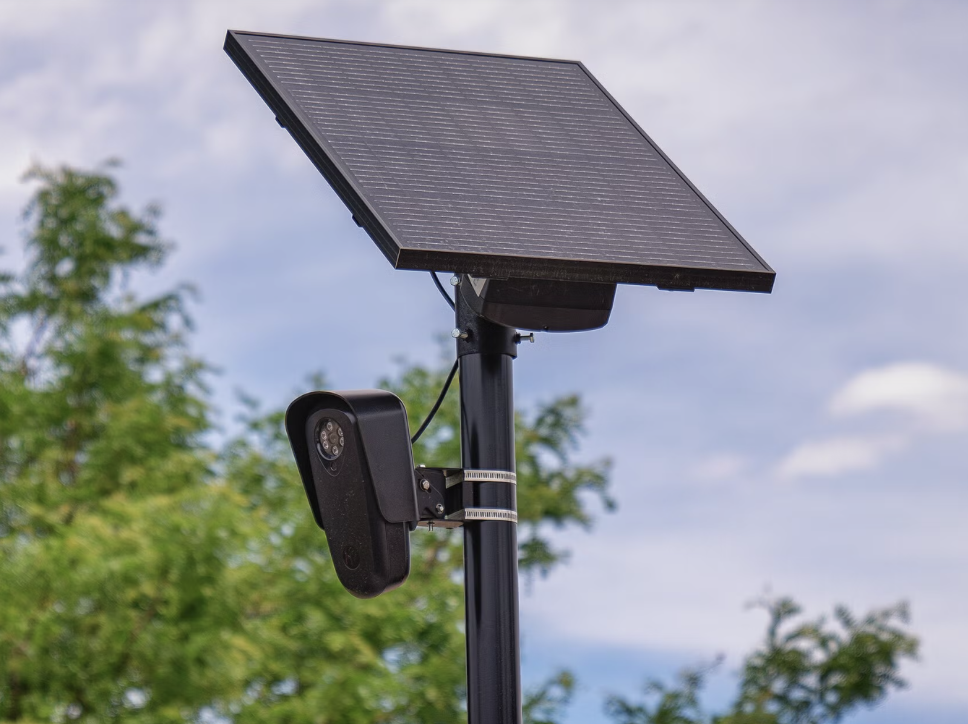
A Flock camera
Living under capitalism, we are all used to the enshittification of everything it touches. One of the worst contemporary examples is the increasing expansion of the surveillance state. Cautionary tales about the dangers of mass surveillance and building a panopticon like Orwell’s 1984 have instead been taken as instruction manuals. The most glaring case study is automated license plate readers (ALPRs) represented by Flock Safety, the largest purveyor of the technology. As socialists, we must organize to oppose those who would seek to turn a profit at the expense of human needs.
Contrary to what proponents of ALPRs claim, mass surveillance is a major threat to public safety rather than an effective tool to support it. These unblinking cameras create a massive 24/7 surveillance dragnet that provides time-stamped location data of every vehicle that drives by regardless of whether they are involved in a crime or not. Based on data from May 5 for the Flock transparency portal for the city of Palo Alto, less than 0.5% of captured vehicle data was related to previously designated ‘hot lists’ involved with a crime. The number of arrests or cases closed per ALPR recording of innocent passersby is guaranteed to be even lower. Since data is typically stored for 30 days or more, police have the ability to recreate your movements over the past month without a warrant, finding out where you live, where you work, where your children go to school, and where you organize even without any articulable suspicion that you have been involved in a crime.
The threats to our collective safety are not simply hypothetical. Police have used nationwide ALPRs to hunt down a woman seeking abortion. They’ve violated First Amendment rights by searching for people engaged in peaceful protest. The countless examples of ICE and CBP illegally accessing ALPR data show that the prohibition on sharing data out of state (illegal for a decade in California) is insufficient to protect our privacy. After ICE shot Marimar Martinez five times, they used historical ALPR data to trace her movements over the previous month to find support for their baseless claim she was a domestic terrorist. Repeated cases show police officers using Flock to stalk former partners. Flock employees have accessed video feeds pointed at a children’s gymnastics center, showing these cameras are not just about license plates but instead are part of a broader surveillance network. It was just earlier this year Amazon paid for a Super Bowl ad to announce their ultimately aborted partnership between Flock and Ring. Data from multiple streams including and beyond ALPRs get integrated into regional intelligence fusion centers where democratic oversight is limited and there is no guarantee local policies will be adhered to.
All of these violations of our rights and threats to public safety are enabled by a tool for which claims of efficacy are dubious at best. False positive hits from ALPRs are a consistent problem. A Black woman in San Francisco was pulled over and held at gunpoint due to a mistaken ALPR hit. Police handcuffed a 12-year-old in New Mexico when an ALPR misread a “2” as a “7”. A Black man in Toledo was mauled by a police dog after an erroneous notification (this time a “7” read as “2”). A man in Colorado can no longer use his vehicle because he keeps getting pulled over after police recorded both “O” and “0” in a data entry error mandated by policy. Even if the cameras were 100% accurate all the time, they would still be ineffective - swapping license plates is enough to fool the cameras despite claims of creating a “vehicle fingerprint”. Police pulled over a woman in Oakland in March after her license plates were swapped despite the fact that she had a silver Honda Fit and the crime-involved car was a black Honda Civic. After the mass shooting at Brown University, the killer swapped license plates on his vehicle and was able to murder a professor in Massachusetts. Police in San Diego had a specific car and license plate to search, but could not act in time to prevent murders at an Islamic center even with ALPRs. The claim ALPRs support public safety is not supported by the data; in fact the contrary is the case - they harm public safety.
Within California, SB 34 requires ALPR operators implement a usage and privacy policy in addition to forbidding sharing of data with out of state agencies. Even private entities are required to publish such a policy at risk of $2,500 per violation. Time and again, carefully crafted policies are violated by ALPR vendors. The city of Mountain View required written approval from the police chief and agreement to the city’s policies before sharing data, but unauthorized federal and statewide agencies gained access. Flock turned on an illegal nationwide lookup tool without telling local agencies, resulting in ALPR data sharing with out of state agencies in multiple cities. At an April 2026 council meeting in Sunnyvale, city staff revealed that Flock only just implemented two factor authentication to access ALPR data after the press reported on data breaches in Mountain View at the end of January. Although Flock Safety is the largest vendor of ALPRs and therefore has the most information available on data breaches, it is not a company-specific problem. Motorola Solutions provides cameras for UC Merced and allowed CBP to illegally access ALPR data. Many California cities grant access across jurisdictions, so if your city is currently sharing or has previously shared with El Cajon PD then your local data has also been accessible to out of state agencies due to their flagrant violation of California law and is at risk of multi-million dollar lawsuits.
Effective tools?
Proponents of ALPRs claim they are effective tools for preventing crime locally. The reality of data access undercuts that claim. From August 2024 to December 2025, the Mountain View Police Department performed approximately 25,000 searches of the city’s ALPR data while outside agencies performed more than 3,000,000 searches. In other words, only 0.8% of searches were done locally and the overwhelming majority were from external and mostly unauthorized entities. Proponents also claim that anyone concerned with privacy should turn their focus to the location tracking data provided by smart phones. This argument fails to take into account that there is a difference in kind with the type of data. One can opt out of smart phone location tracking but cannot opt out of ALPR data collection. Furthermore, a private company having data is also different from it being collected by the State and accessible to law enforcement. Police require a warrant before they can access your location data but no warrants are needed to search ALPR data. The persistent Fourth Amendment violations have led to numerous lawsuits against private entities, vendor Flock Safety, and local cities, including Los Angeles, Oakland, and several lawsuits against San Jose.
Mass movement required
The Tech Bro Dystopia we already inhabit can only be effectively opposed if we organize together in a mass movement. You can start the fight in your local chapter by submitting FOIA requests regarding ALPRs for local cities in your area. Ask for all communications between city officials and any ALPR vendors, but don’t be surprised if it takes longer than allowed or if you get back files with redactions that would make the editors of the Epstein files blush. If you have Flock as a vendor like most cities in California, your city may have got a sales pitch from Flock employees and illegally eschewed a competitive bidding process in the same style as Trump. Make requests for data access logs that disclose agencies who searched your local data and reasons for the search. Just know that police are told to be “as vague as permissible” and Flock recently restricted responses to a pre-approved dropdown menu of reasons. Don’t be surprised if you find federal and out of state agencies on the access list in violation of state law, but do use that knowledge in your fight against surveillance capitalism. Also know that absence of ICE in data access logs does not mean the agency never accessed your data - a 2021 Biden era DHS policy mandates that ALPR operators leave no trace of ICE in audit logs except for the logs available only to ICE.
The standard Flock contract you can get from a FOIA request contains several objectionable provisions in the fine print your elected representatives may not have realized when approving it (assuming that Flock didn’t change the contract language from what the city proposed as they have been shown to do). Despite claims that only the city controls the data, Flock reserves the right to grant access without a warrant if they have a good faith belief it supports a legitimate law enforcement purpose. Even though Flock claims they just capture license plates and a vehicle fingerprint, their patent claims ability to identify people by personal or immutable characteristics like age, clothing, gait, gender, height, race, and weight. Although Flock claims cities own all data, the company reserves an exclusive, worldwide license to keep a fraction of everyone’s data to train their AI models. They need a worldwide license because they exploit workers in the Global South for model training. The real business model for Flock is to sell fear to our local police departments so taxpayer dollars are used to lease cameras to let Flock get the thing it actually cares about: our data. WE are the product; Flock cares about making a profit, not public safety. That became abundantly clear when the company installed two unauthorized cameras in Cambridge, MA before being kicked to the curb for the violation of trust.
To force the surveillance state out of your local city, get ready to mobilize to a city council meeting when the ALPR contract is up for renewal. Build a coalition with allied organizations and be prepared to pursue an inside/outside strategy. Set up a letter writing campaign to send messages to the relevant body (this is relatively easy with dues-funded tools each chapter gets from National). Some organizers should seek meetings to lobby council members. That approach can let you assess their position, defuse any pro-surveillance talking points, and find allies to raise questions during the meeting that you submitted in advance with your letters. If an ALPR contract is not up for renewal anytime soon, repeatedly mobilize for public comment on non-agendized items to demand a contract discussion until the topic can no longer be ignored.
At the same time, we must apply pressure to make supporting ALPRs politically intolerable. Write op-eds for your local publications. Create a document with talking points for public comment (our coalition can help you, see contact details at the end of this article). Hold a rally before the ALPR contract or surveillance use policy meeting and invite the media with a press release articulating your position. Balance speakers on the topic with chants from the crowd (my personal favorite: MOVE Flock, Get out the Bay!), then hold a public comment training session right before the meeting starts.
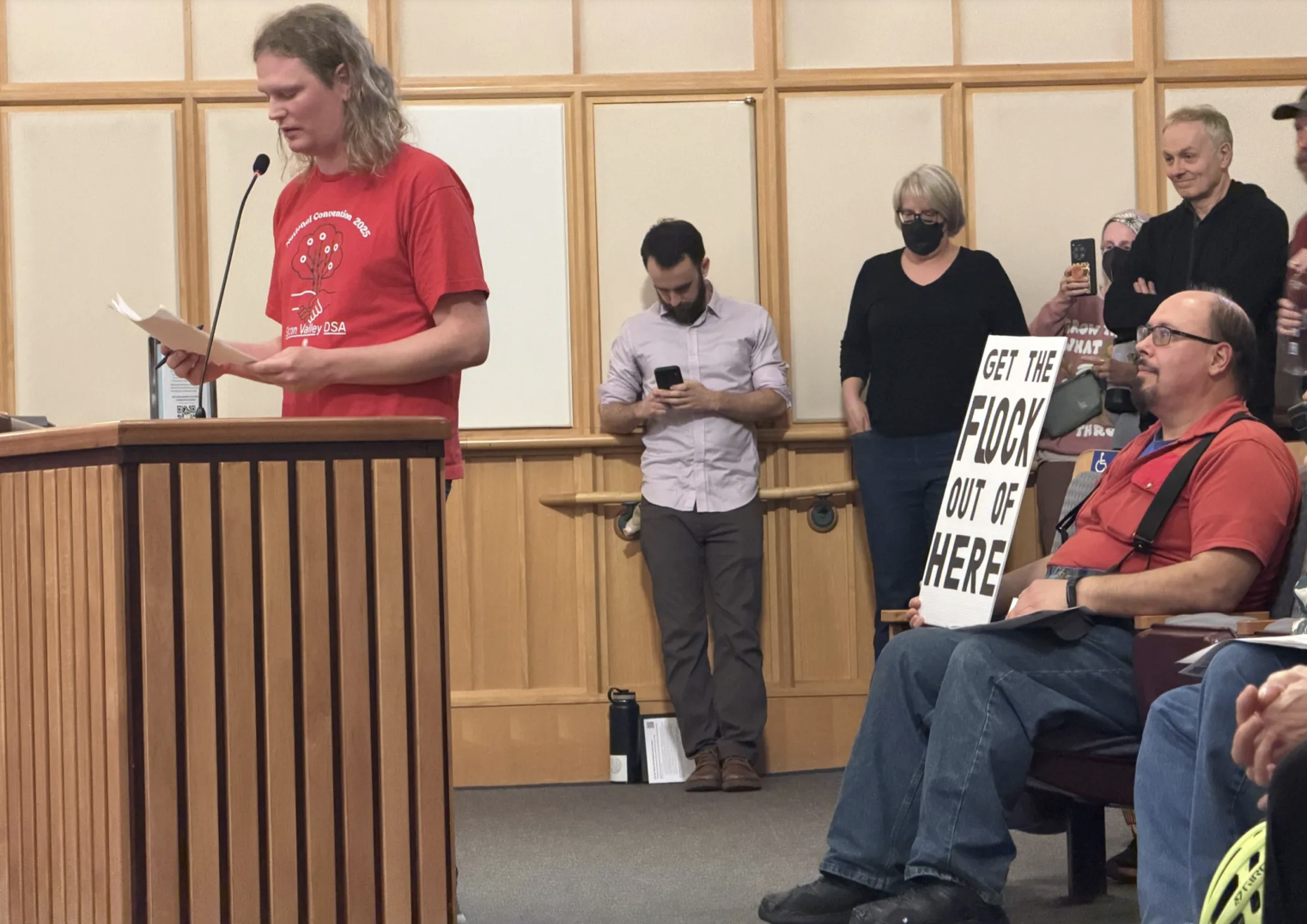
Tim MacKenzie tells the Mountain View City Council in February to end its contract with Flock Safety
Track record: successes and setbacks
In Silicon Valley, we’ve seen success and setbacks. At the Santa Clara County Board of Supervisors, we used our one minute of public comment time to introduce ourselves and read as much of the coalition letter as we could, with the next person picking up where the previous one left off. In Mountain View, we had speakers pool time to give ten minutes each to two coalition members to read through our entire letter at the head of a marathon public comment session. We are fighting to remove Flock ALPRs from Stanford University, the largest landowner in Silicon Valley. The County Supervisors set a surveillance use policy to remove Flock as an ALPR vendor and had two votes that were in favor of forbidding the technology entirely. Mountain View unanimously canceled the Flock contract and said it would not pursue other ALPR vendors. Just before those decisions, Los Altos Hills chose not to renew their Flock contract. Our neighbors to the south in Santa Cruz were the first in California to terminate their Flock contract in January. On the other hand, in April the city of Sunnyvale unanimously voted to keep the Flock contract and East Palo Alto decided against changing the Flock contract after it was brought up for reconsideration. The City of Santa Clara received an informational report on ALPRs without any action and Palo Alto is trying to sweep massive data breaches under the rug.
If your city doesn’t seem ready to cancel its ALPR contract, fight for stronger guardrails in the surveillance use policy. You can push for a shorter data retention period - San Jose dropped from one year to one month of data retention, and ALPR data in New Hampshire is deleted within three minutes if the vehicle is not on a pre-approved hot list. The demands in our coalition letter pushed San Jose to prohibit cameras near sensitive areas like abortion clinics, places of worship, consulate offices, and health care facilities providing gender affirming care. Demand a surveillance use policy that requires any ALPR vendor to meet all your guardrails for public safety, including the requirement for a judicial warrant for any search of data.
A better world is possible, but only if we organize to build it together. A National Week of Action against ALPRs is planned for August 16-22. You can access an organizer’s toolkit our coalition has built if you want to start anti-ALPR organizing in your chapter by emailing ca@stopalpr.org.
Despite the use of dashes in the body of the text, every word was chosen by a human mind and no generative AI was used for this piece.