
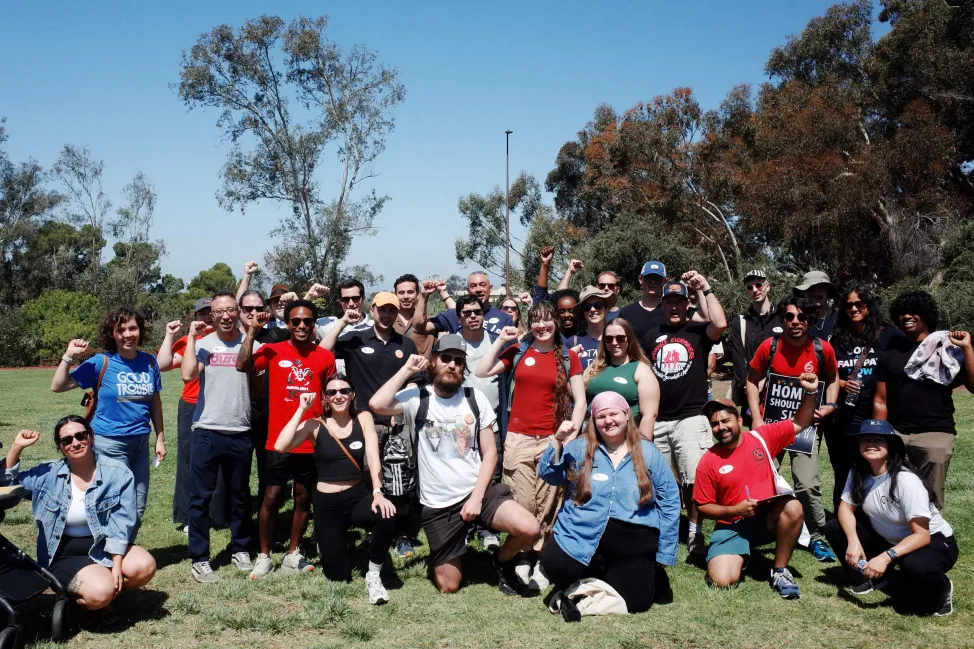
DSA-SD's canvassers at the Measure A kick-off in Golden Hill on May 9
This spring, DSA San Diego engaged in its largest electoral mobilization to date in an effort to pass Measure A, a tax on the over 5,000 vacant second homes in the City of San Diego, that the City Council placed on the ballot. The measure, which would have levied an $8,000 tax in the first year and $10,000 per year thereafter (plus a surcharge for corporate-owned vacant homes of $4,000 the first year and $5,000 per year thereafter), was proposed by City Councilman (and recently joined DSA comrade) Sean Elo-Rivera, and was inspired in part by the pied-à-terre tax on high-value non-primary residences in New York City that Mayor Zohran Mamdani championed and New York enacted, effective July 1, 2026.
Uphill climb
From the outset, Measure A faced an uphill climb. Initially, it was intended as an “Empty Homes and Short-Term Rentals tax,” but after Airbnb literally paid busloads of protesters from Los Angeles to flood a City Council committee hearing in January, the effort died in committee, despite vocal support for the measure from organized labor and community groups. The idea was subsequently resuscitated as simply an “Empty Homes Tax” (letting Airbnb and VRBO off the hook) and the Council placed it on the June primary ballot at the last possible date in March. However, making the ballot at such a late date and after a false start meant that there was no campaign already up and running to get Measure A passed, and time was fleeting to stand up such an effort. Enter DSA San Diego.
First, though, a detour is in order to review the recent growth in DSA San Diego’s electoral capacity. Over the years, our chapter had on multiple occasions chartered an Electoral Working Group, only to see it collapse or go dormant without engaging in much, if any, actual electoral activity. Starting in 2024, however, this began to change. That year, our chapter participated in California DSA’s “Affordable Rent-Controlled Housing (ARCH)” campaign, with 16 comrades filling 38 canvassing shifts and knocking on 1,112 doors in support of Propositions 5 and 33 on the November 2024 ballot.
The following year, our chapter made a deliberate choice to lean into California DSA’s campaign for Prop 50 as a vehicle to channel the visceral hatred of MAGA rule into effective electoral activism. We organized 69 canvassing shifts across eight different canvasses over four weeks, knocking on 1,906 doors with California DSA’s “Fight Fascism! Yes on 50!” doorhangers – representing a nearly 100% increase in our electoral strength from the year before.
Subsequently, at our chapter’s 2026 convention in February, our members voted to make electoral activity one of two chapter-wide priorities in 2026. We then voted to launch a “Tax the Rich” campaign centered around the Billionaire Tax and the measure to permanently extend Prop. 55, and our chapter once more mobilized to fill 66 signature-gathering shifts which collected 520 signatures to place the Billionaire Tax on the ballot. A modest contribution to the overall effort, but an important step forward for our electoral capacity.
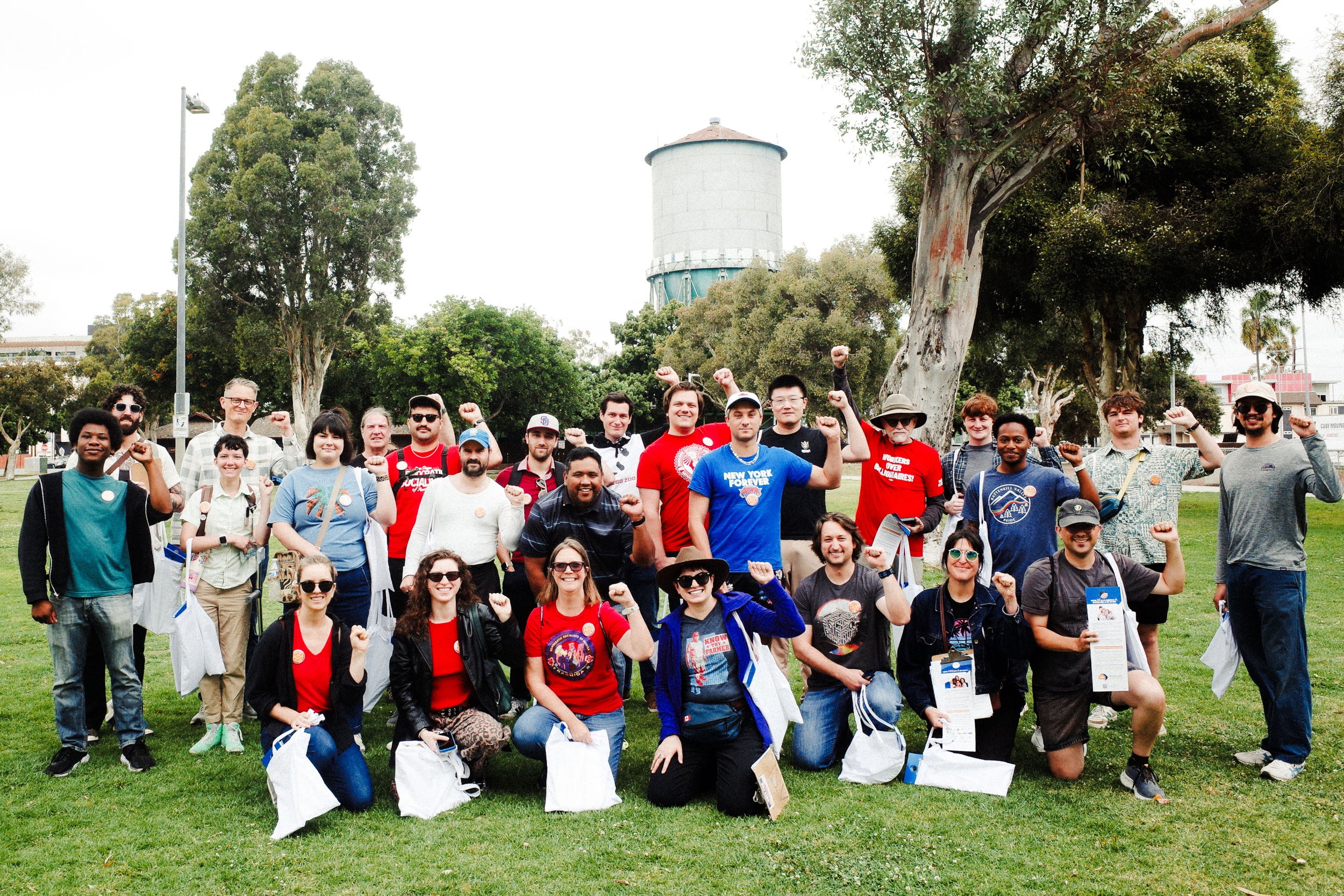
DSA-SD's canvassers for Measure A in North Park on May 24.
Measure A endorsement and mobilization
It was in this context that, in April, DSA San Diego voted to endorse Measure A and mobilize for its passage. Partnering with the Alliance San Diego Mobilization Fund (ASDMF), which ran the Yes on A campaign, we organized 100 canvassing shifts across three separate canvasses and knocked on 2,831 doors (nearly tripling our electoral capacity from the ARCH campaign in 2024). Our chapter, by itself, was responsible for 15% of the doors knocked for Measure A, and 17% of the Yes IDs.
Unfortunately, though, Measure A did not pass. Once all the votes were counted, it narrowly failed, receiving 47% of the vote. Why did Measure A fail? There are a number of factors. First and foremost: capitalism. Real estate interests spent over $1.5 million dollars to scare voters against Measure A, whereas the Yes on A campaign was able to raise $300,000 in the ten weeks available to run a campaign.
The second factor was clearly timing. Not only did the truncated campaign period make it hard to build a sufficient head of steam to win this measure and counter the effects of capital arrayed against us, but placing a tax measure on a primary ballot of a midterm election, during a time of economic uncertainty, created too many headwinds to overcome. Despite that, the closeness of the election demonstrates that, even in the least favorable terrain possible, there was a mass audience for this message. In addition, the fact that the late votes broke so heavily in favor of Measure A (every batch of votes released after election date had Measure A either tied or passing, with the eighth batch of votes counted on June 10 favoring Measure A 64%-36%) shows that, with a longer period in which to campaign, Measure A might well have passed.
Unfortunately, there was also clearly a third factor at play – too few organizations prioritized campaigning for (not just endorsing) Measure A. DSA may have accounted for 15% of the doors knocked for Measure A, but we accounted for a full 96% of the doors knocked by volunteers (the remainder were knocked as part of a paid field program by ASDMF). Had there been more left-of-center organizations committed to knocking doors for Measure A, it could have passed, despite all the odds.
Credibility among allies
Despite these obstacles, we in DSA San Diego threw ourselves into the breach. In the process, we gained considerable credibility among community allies and grew our chapter’s membership and electoral capacity. Our campaign in support of Measure A demonstrated to the community the value of having DSA on your side, and it demonstrated to us the urgency of building our electoral capacity so that we may effectively contend for power, because this moment demands it.
As DSA San Diego said in a statement on election night:
Moneyed interests spent over a million dollars fighting against us, spreading lies and fear before Measure A even made it on the ballot. As we wait for every vote to be counted, it is clear that Measure A’s performance is proof of a seismic shift in San Diego. Working people are tired of a status quo that offers austerity instead of bold solutions while the wealthy hoard resources. Win or lose tonight, San Diegans have shown that they’re ready to fight for an economy that works for all of us, to ensure that all of our neighbors can live in dignity in housing they can afford, and to make the rich pay their fair share.
Measure A is just the beginning. Across the country, from New York City to San Diego, DSA is proving that not only are democratic socialist policies popular, but democratic socialists should govern. Join us in the fight, we have a world to win!