
Let’s Tax the Rich This Year: A California Red series

In the February issue of California Red we ran a background article on the California DSA campaign we call “The Fair and Responsible Tax Plan for California’s Wealthy”, which embraces both measures currently gathering signatures to qualify for the November state ballot. That was the first in a series we are running between now and the election. Here is the next installment.—Editor
The unfathomably vast yet still growing level of California’s economic inequality
Our East Bay DSA crew of five had planted ourselves in the parking lot of a supermarket in North Berkeley on a warm mid-March afternoon. We were collecting signatures for the Billionaires Tax and the Protecting Education and Health Care Act. During our three-hour shift we did not do badly, gathering several dozen for each measure. Even better were the conversations, which ranged from informing voters about the nuts and bolts of the proposals to broader questions about economic inequality: how much money do billionaires have, anyway? What share of the total income of California, the fifth largest economy in the world, goes to the one percent? What would be the right amount of taxes for them to pay? And how do we get them to pay their fair share?
We explore a few of these ideas and numbers below.
A cool million
It used to be hard for the typical working class stiff to imagine what a million dollars looks like. A million dollars? That’s what millionaires have, and I’m not even close to being one of those, we would say. But that was before a million dollars or thereabouts became the average price of a house in Los Angeles. It’s slightly below that statewide, and slightly above that in San Francisco. But you get the idea. Generally speaking, if you can afford a home, you know what a million dollars looks like—it looks like your house. (If you’re a renter, it looks like that house.)
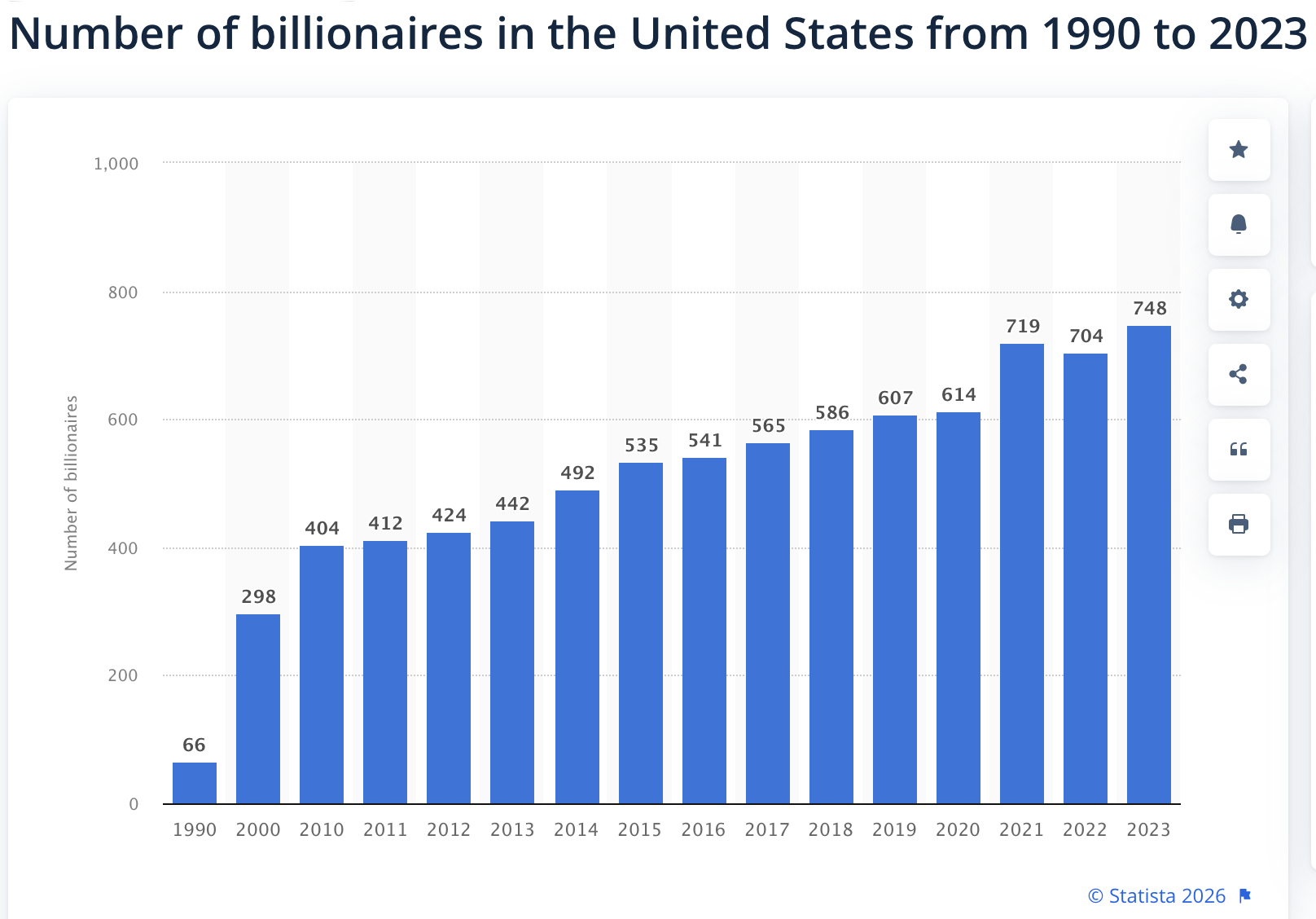
A billion dollars was even more unfathomable. We didn’t have many in the United States until relatively recently; as late as 1990 there were just 66 of them. Now there are close to a thousand, and we’ve got 213 right here in the Golden State. Since we know that a million dollars looks like a house these days, we can imagine that since a billion is a thousand millions, it would look like a thousand houses.
No one needs a thousand houses to live in, so most billionaires scrape by with just ten or twelve. Of course, being billionaires, they need somewhat larger houses than most people, so they might spend five or ten million dollars or even more—fifty million! A hundred million!—on their humble abodes. If they owned ten of those, that could put a pretty big dent in their billion dollar fortune. But guess what? The average wealth of a billionaire is not a billion dollars. It’s currently around 8.6 billion dollars, according to inequality.org. So that would be 8,600 houses.
Minus the dozen they “live” in, that would leave them with enough money to purchase 8,588 more houses. I don’t know about you, but as the numbers climb my ability to translate the million dollar house into a clear image of the wealth of billionaires is beginning to get somewhat unequal to the task. And that’s before we try to imagine what the total wealth of 213 billionaires looks like.
Trillions
It is reliably estimated that thanks to the ginormous growth of their fortunes during the past ten years (Trump I’s tax cuts, pandemic economy when there was nothing to invest in except stock buybacks, Trump II’s continuing tax cuts, massive AI bubble, and outright looting of public resources) our couple hundred California billionaires collectively own (hold onto your “tax the rich” baseball cap) two trillion dollars’ worth of assets. In California they’re doing a little better than the average 8.6 billionaire; they’ve each got around 9.4 billion.
Although I just said I’m having trouble wrapping my mind around the houses when they added up to the average 8,600 houses each (adjusted now to 9,400), let’s try it out with trillions. That’s a thousand billions. So collectively our 213 ultra-rich people with their two trillion dollars would have, let’s see, carry the one, a bit over 1.8 million houses, at a million dollars each.
You might think that that’s enough for anyone, and these individuals must be looking around for philanthropies to unload to. But no, according to a recent New York Times article, billionaire giving has fallen precipitously in the last few years as their ‘uneasy accommodation with fascism’ (fascism scholar Robert Paxton’s formulation describing the initial response of economic elites to the uncouth new political rulers) has grown considerably less uneasy—more like downright comfortable. The 213 billionaires in California have seen their total wealth grow by nearly a third in this period as the rest of us have been essentially running in place—and that’s not enough for some of them.
If you listen to one of their loudest mouthpieces, tech mogul Ron Conway, the proposed billionaire tax is not only bad for his 212 other peeps; it’s way worse than that. He was recently quoted in a New York Times article with a sentiment that inadvertently revealed how that kind of bank account can warp one’s perspective: According to Mr. Conway, referring to the billionaire tax, “This is the greatest tragedy this state has ever felt.” Hmmm. I wonder whether the families of dozens of people who lost their lives and thousands who lost homes in the Eaton and Palisades fires in 2025 agree? Or if Japanese-Californians, 93,000 of whom were incarcerated during World War II, share that view? Or if Native Californians, whose population fell from a third a million people in 1800 to about 15,000 by 1910 during the genocide that did them in, would agree with Conway’s historical research?
On the other hand
At the other end of the economic spectrum, California’s borders contain about 7 million people below the official poverty line, or 18% of its roughly 40 million people. But the official federal poverty line ($33,000/year for a family of four) is laughably (that’s probably the wrong word) below an actual ability to live. One measure of how many people are barely getting by in California is the number of MediCal recipients, dependent on the federal Medicaid funding stream for most of their care costs. Although California is a net donor to the federal treasury, it does rely on $20 billion per year from the feds to support MediCal. Some 15 million Californians are enrolled in MediCal.
Let’s move on from the tiny extremely rich and the very large poor slices of the state and look at the condition of the merely rich, the top 1% income earners, which includes the billionaires but extends downward to the merely well-to-do. Although calculations vary, the bottom rung of the ladder for a one percenter is just about a million dollars a year in income; the median merely rich, right in the middle of the one percent, is $3.6 million a year. Here’s chart to help us visualize how their share of total California income has grown over the past half century.
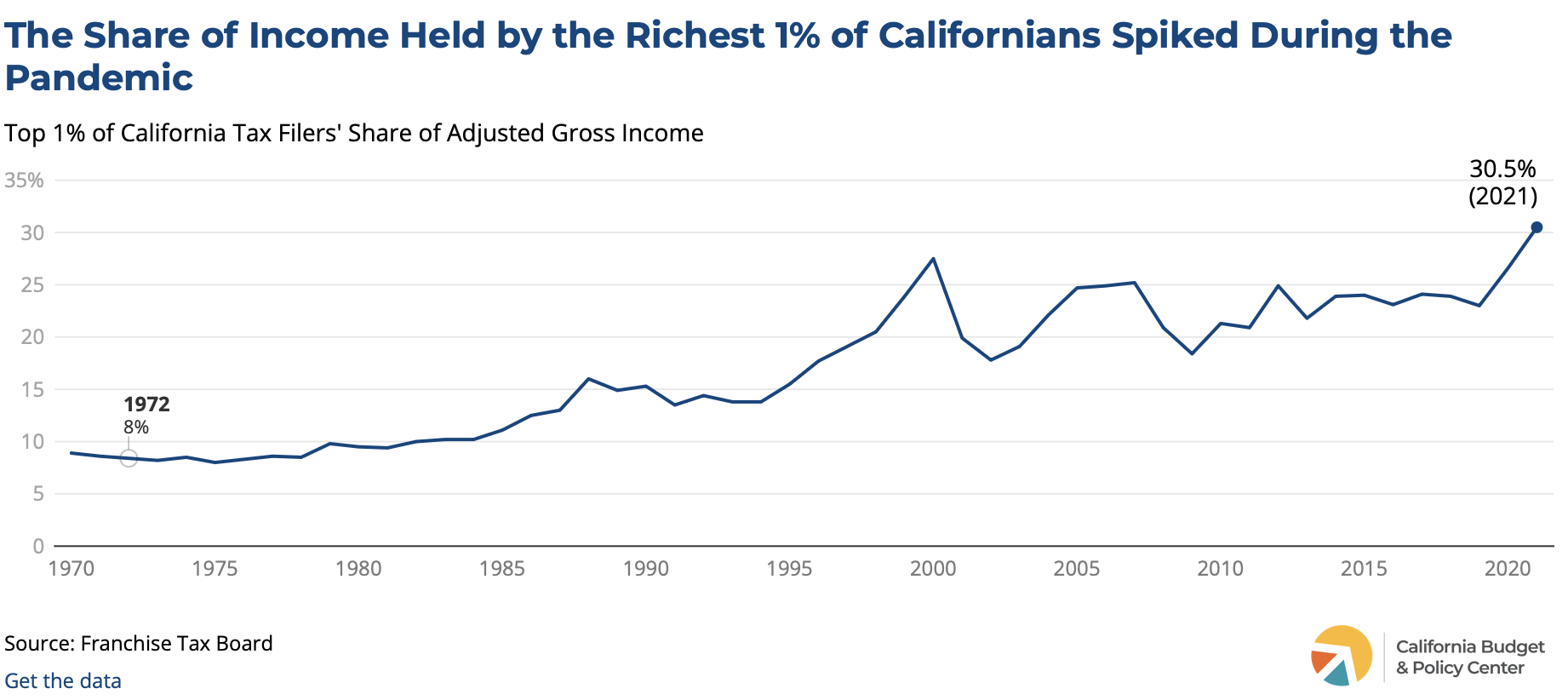
That’s right, believe your eyes. The top 1%’s share of income in the Golden State has grown over the past half century from about one twelfth of total income to almost one third. Richest state in the richest country in the world? Yes, but a vast chunk of the riches seems to have ended up in the pockets of people who didn’t need the transfer.
On the third hand, if all of the state’s total income had been divided up equally, every person in California in 2024 would have received around $80,000—which means that for a family of four, combining their incomes, the household would have had $320,000—just a little under ten times the official poverty line.
“But that would be socialism!” cry the billionaires, the Howard Jarvis Taxpayers’ Association, the Chamber of Commerce, and probably quite a few temporarily embarrassed millionaires. Well, sort of. We’ll get into that some other time. One thing is clear: it would certainly be different from what we’ve got.
