
Trump Red Scare, DSA Beware!

Red scares often attack teachers and public schools with threats of censorship and assaults on academic freedom. NEA graphic.
As the Trump Administration continues to blame its failures on anyone left of the far-right, the federal Department of Education (DoED) has just taken another step towards what can only be called a new Red Scare. In late May, the DoED unveiled a press release that proposed several critical changes to how institutions of higher education are accredited. If implemented, these reforms would force universities to, among other mandates, hold “policies that support, promote, and appropriately prioritize intellectual diversity” and implement “academic freedom protections.”
The overwhelming majority of universities already insure intellectual diversity and academic freedom. Conservatives just want to use universities as platforms to push their anti-intellectual, anti-science, anti-democratic, and socially backwards ideas to the next generation. They despise these “woke propaganda factories" because they promote critical thinking skills and intellectual diversity which empower students to question the systems and ideas their ideology relies on.
DSAers must acknowledge that these reforms will not just be used to deny funding from universities who refuse the DoED’s demands, they will make campus organizing much harder. As the largest and most successful socialist organization of the century, we cannot pretend that these developments won’t affect DSA and the broader left.
The last two administrations have had mixed success legally compelling colleges to bend the knee to its policies. Some colleges like Brown and Columbia have capitulated while others like Harvard and UCLA are still resisting. At the state level, MAGA activists have been increasingly hacking away at public education, with some states funding “hostile takeover[s]” of entire universities. The Trump White House is now looking to change the rules completely (again), and (Y)DSA must be ready to organize with students and faculty against them, or risk losing momentum.
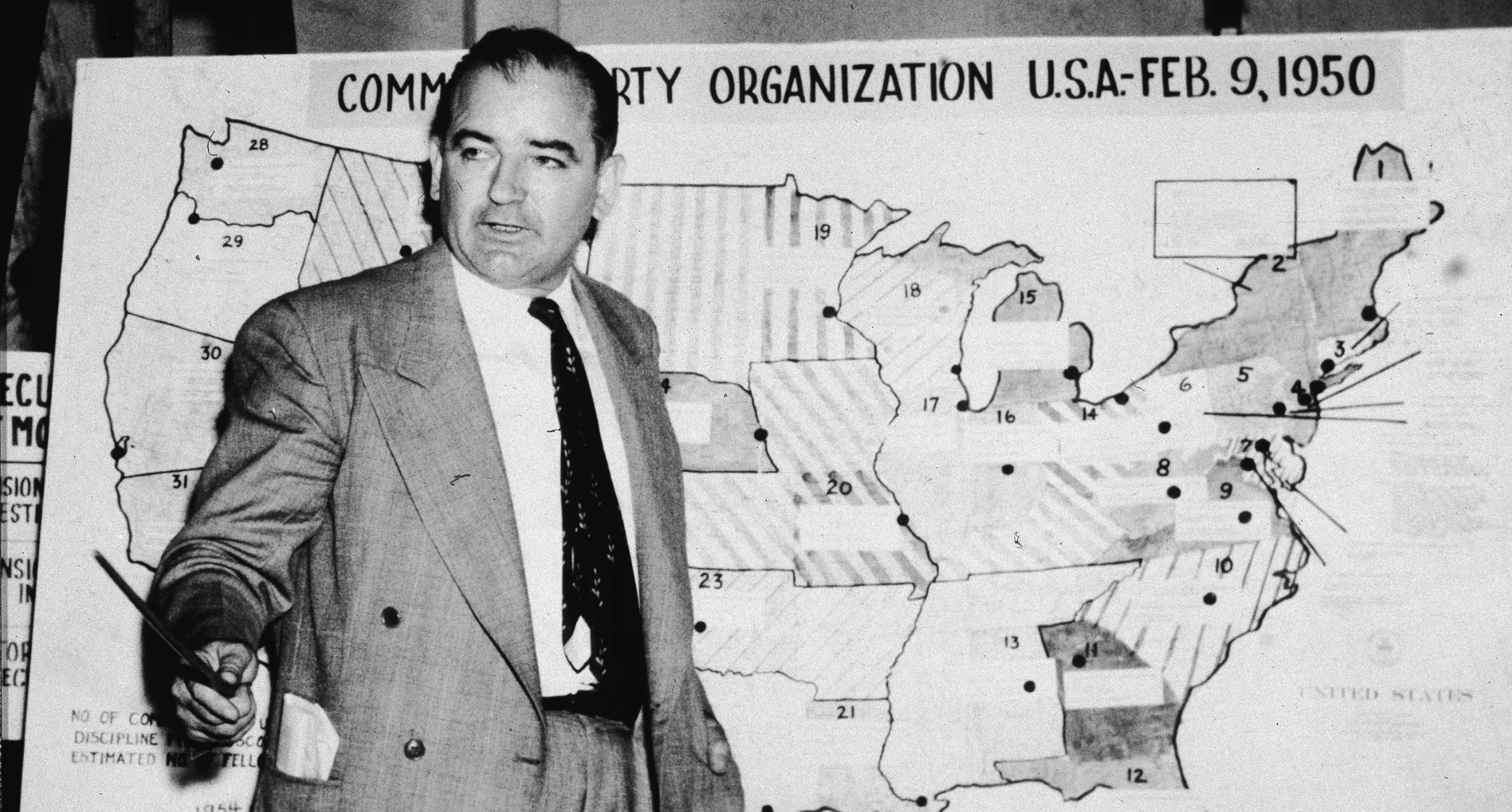
Red Scare exhibit number one is Joe McCarthy in the late 1940s and early 1950s, who lent his name to the phenomenon, but there have been other red scares in US history, including the one unfolding today.
Not Out of Nowhere
These proposed reforms did not come out of nowhere. Far-right discourse around higher education has saturated social and national media for decades. Conservatives have long tried—and failed—to build institutional power from within public universities. In recent years, the rapid spread of Turning Point USA has created magnets for the most racist and hateful students on campus; even without Kirk, they remain one of the fastest-growing fascist youth orgs in the country.
However, astroturfed campus organizing hasn’t afforded conservatives much institutional power inside higher education. Many of the noted Youtube college campus crusaders have burned out—or gone cold—since the first years of Trump 1.0. Now with unchecked power over the government, conservatives are opting for a sweeping, top-down approach to higher education reform.
This is a scary reminder that the long held conservative tradition of discrediting and dismantling higher education never truly dies. With the certainty of capitalism’s boom-bust cycle comes the recurring fear of its logical solution. When we look at the history of Red Scares in the United States, it can be hard to tell when one begins and one ends. Historians are undecided on exactly how many distinctive Red Scares there have been, but there can be no doubt that the current scare we face has the potential to be more consequential than that of the McCarthy-era.
The chill of McCarthyism
During the Red Scare you probably learned about in school, the chill of McCarthyism was felt across many industries, especially in higher education. The general anti-communist paranoia amongst post-WWII U.S.A. was exploited and catalyzed by McCarthy and the Eisenhower administration. McCarthyism would go on to plague leftist organizing in the United States for generations.
But even McCarthy’s Republican party eventually turned on him when they grew tired of his aggressive rhetoric and interrogation tactics. His reign ended with a whimper because the president was forced to step in to save the “decency” of the Republican party. But what about the GOP of today? They’re in a much better position to engage in McCarthyism than McCarthy. Trump 2.0 has a trifecta control over the government, with his cult following stretching across his cabinet, congress, and supporters. McCarthy was lambasted by his party for having “no sense of decency,” but the MAGA movement has proudly solidified itself and the GOP as ardent defenders of pedophilia, abuse of power, and treasonous corruption. Let's be real: do we expect the feckless Democratic party to step in and defend higher education?
DSA demographics
DSA appeals heavily to the working class, but an overwhelming majority of our membership still comes out of higher education. In a 2021 Growth and Development Committee survey, a resounding 80% of members held a bachelor's degree while one of every ten members worked in academia. This correlation between attaining higher education and holding more progressive views has not only been known for decades, it is increasingly getting stronger. Conservatism relies on servile minds that are unwilling to question boogeyman narratives, and willing hold multiple contradicting positions. Leftists, and even progressive liberals, are more often skeptical of systems and the status quo in large part due to their critical thinking skills. This is not to say that uneducated workers are not or cannot become leftists, but data consistently shows they are not flocking to the cause.
Even among our most recent growth spurts, new membership continues to be young and educated. DSA Ventura County doubled their membership during the 2025-26 academic year after committing to a college campus recruiting campaign; this resulted in a radical revitalization of the chapter and the sprouting of at least one YDSA club. With over 150 YDSA chapters currently leading campus organizing efforts, it is safe to say academia remains one of the most reliable pipelines for DSA growth.
These campus organizers have already demonstrated their importance in recent electoral campaigns, providing volunteers, chapter leadership, and long-term organizational capacity. Recent electoral gains—including multiple citywide wins in L.A., and mayoral wins in NYC and D.C.— underscore the growing organizational capacity of DSA across the country. These victories would not have been possible if not for the thousands of volunteers who were recently activated and empowered by our growing coalition of lefty organizations.
College students have far more free time than other demographics, especially if they are privileged enough to remain solely focused on school. As they contend with the uniquely bleak country they are inheriting, several political avenues beckon to them at the crossroads of alienation, disenfranchisement, and radicalization. They can keep their head down and hope the world fixes itself, join a democratic club and hope the status quo prevails, succumb to fascist grievance politics, or courageously believe a better world is possible.
The proposed accreditation reforms are more than another policy dispute. If passed, they would inflame a new Red Scare that would threaten the left’s most effective recruiting and organizing institutions. If DSA chapters want to continue building on our current momentum and build capacity, defending higher education cannot remain a secondary concern.