
The Revolutionary Cocktail: Why DSA Needs Electoralism, Direct Action, and Mutual Aid to Win
[Reprinted from Geese]
Too often, mutual aid, direct action, and electoralism are treated as exclusive contrasts. Reflecting on his work in the San Diego chapter of DSA, Aldo B. argues that each tactic is part of a necessary whole and that any of them, taken individually, are ineffective as a revolutionary strategy.
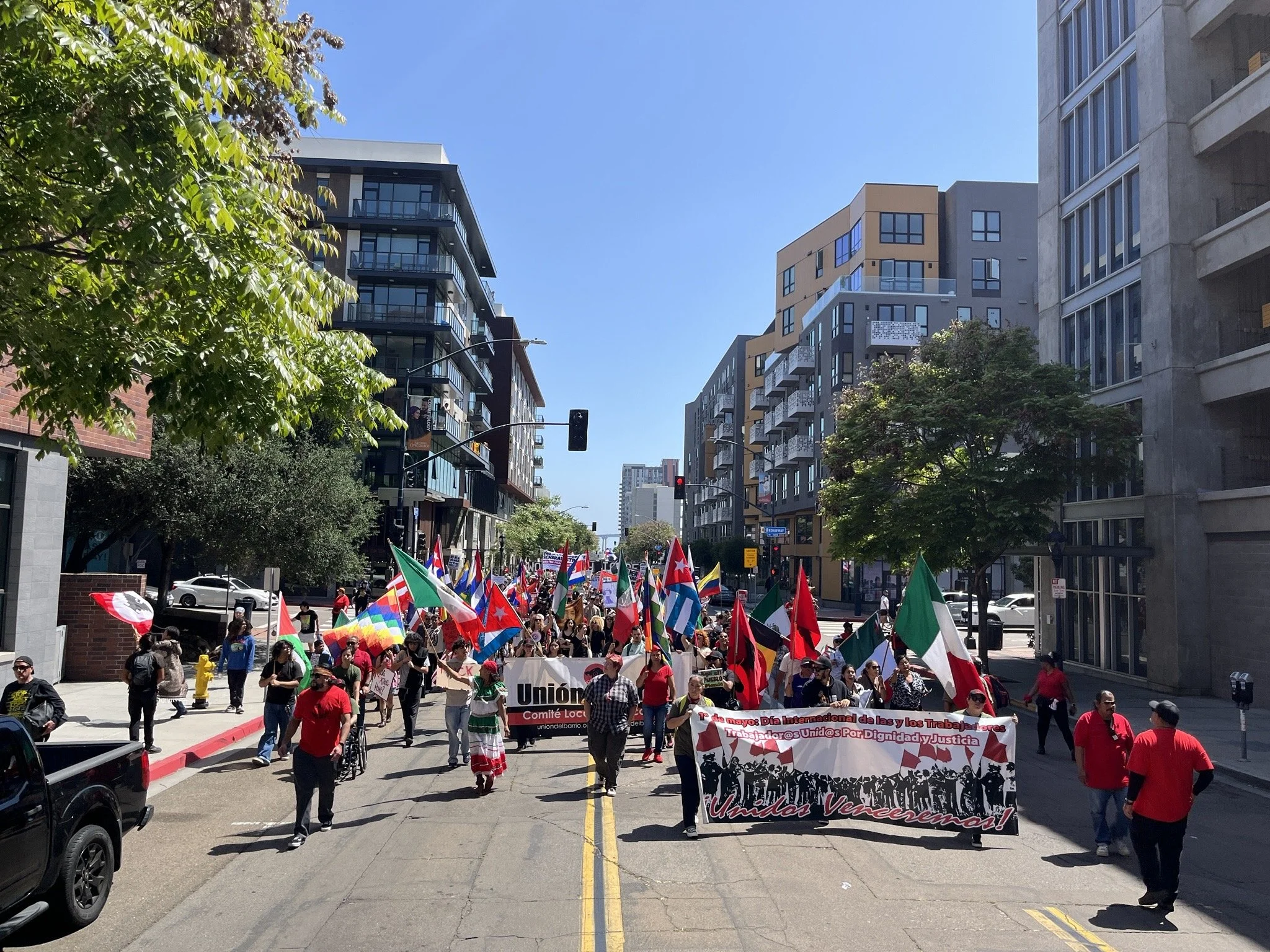
Abolish ICE May Day 2026. Edgar Ramirez photo
A colleague of mine once said that his revolutionary cocktail for the systemic change we needed as a movement entailed three key elements; direct action, mutual aid, and electoralism. This concoction has stuck with me and rolled around in my head since he said it over a year ago in his millennial-style car vlog that he posted on Instagram. I've since expanded these three components into conceptualized processes:
Direct Action is the means by which existing conditions are confronted head on to the point of rupture in the mode of production.
Mutual-Aid is the logistical metric for satisfying the consumption of a community by an organized grassroots network of distribution and production.
Electoralism is the competition between politically organized factions over the attention economy of the electorate, aka, the 30-60% of the population that is allowed to vote.
With the recent primaries across the country, my own personal hajj to NYC, and of course the lovely DSA discourse on X the Everything App, this revolutionary cocktail has only come to sit evermore in the front and center of my thinking about how to organize internally around a variety of issues my comrades feel passionately about—especially in light of those issues seemingly being at odds with one another.
I’ll state explicitly now that I fundamentally disagree with the framing of these three tactics as being antagonistic towards each other. In fact I would go as far to state that the distilled critiques which a proponent of direct action or mutual aid might level against electoralism and a staunch electoralist against the proponents of mutual aid or direct action, are all the same. None of these tactics are an end in and of themselves.
Standing alone, Mutual-Aid is mere charity at best, or bandaids for bullet holes at its worst; Direct Action is frankly adventurism at best, or in the worst case acts as a revolutionary release valve; and Electoralism may demonstrate a shift in the Overton Window, but at the expense of cooptation and complacency with a tepid reformism. It is only together, united by a coherent and democratically decided strategy, that its potency for revolutionary change can be actualized.
That's enough theory for now, but I want this conceptual engine to be humming in the background as you read this piece.
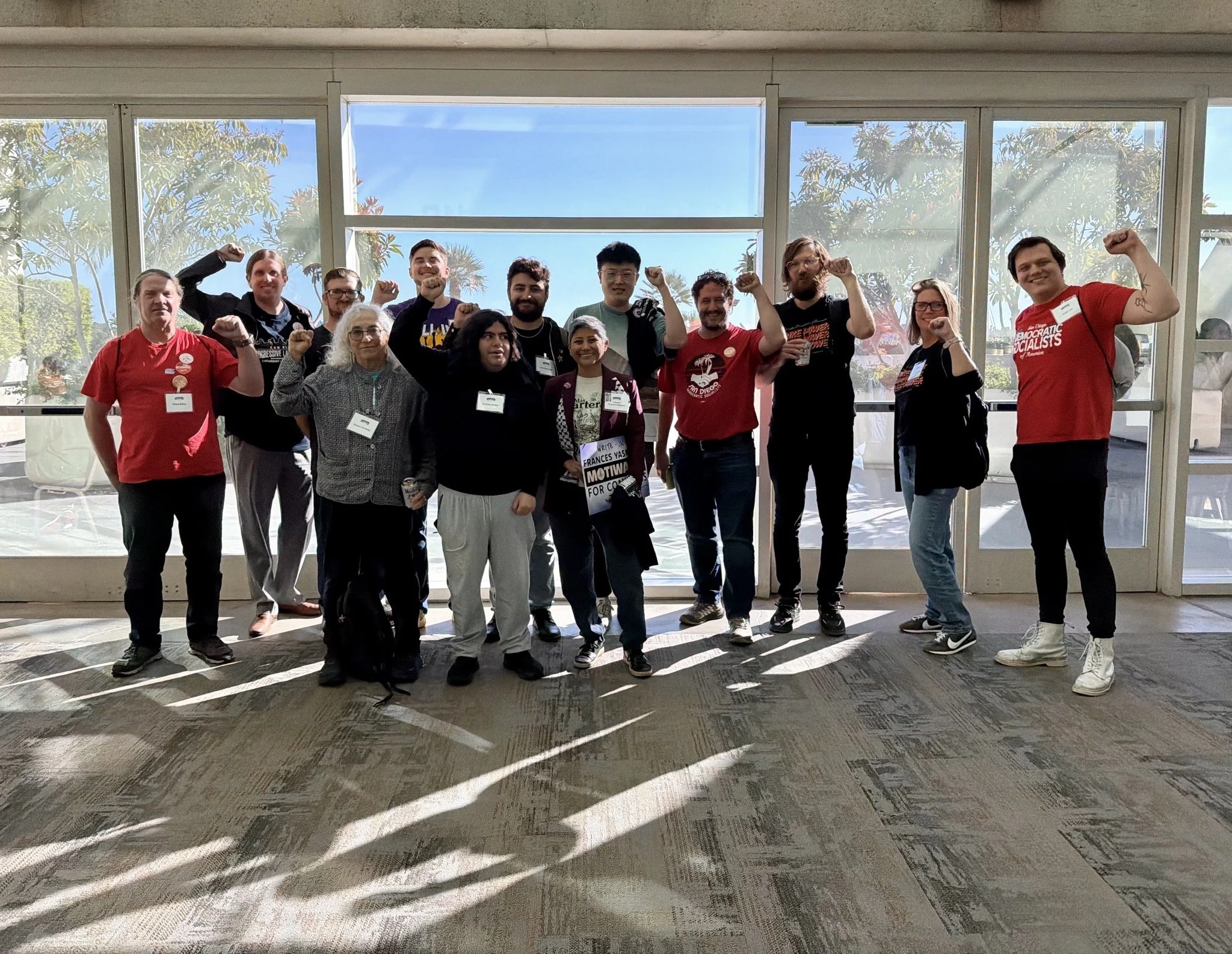
DSA contingent at Progressive Labor Summit 2026. Random attendee photo
Personally, since I was a young man, I have always strived to be a well-rounded organizer, a Jack of All Trades if you will. My mother would call me a metiche (nosey?), but that's neither here nor there. The way that manifests in my organizing today is that I have a tendency to stick my fingers in every pie within arm’s reach. I run the political education committee as an elected leader in my chapter, founded and am an active participant of our migrant rights subcommittee, am the former mentor for the electoral working group and current campaign manager of a chapter cadre campaign, a proud member of the Springs of Revolution network championing our national priority Labor for an Arms Embargo locally in conjunction with our Palestine Solidarity and Labor working groups; and last, but certainly not least, my day job is as an organizer for a statewide non-profit that leans towards tenant organizing. All that to say is, six years into my organizing journey, I have yet to pigeonhole myself into just one avenue of organizing. I may not have done it consciously initially, but I try to embody the concoction of this revolutionary formula in my day-to-day organizing projects.
Through my experience, I believe there is something to be abstracted from the overlaps in these tactically diverse projects and campaigns.Allow me to explain.
I will start with direct action as it is probably the most contentious and certainly the most volatile element of the cocktail. I want to clarify now that I am not necessarily talking about the high-risk civil disobedience operations of a Palestine Action or of a civil uprising nature; though assuredly those too have their place in the cocktail. The primary methods of direct action organized by DSA San Diego are pro-Palestine banner drops, anti-ICE community defense, and strike line support.
In my opinion, banner drops are a sort of guerrilla political education and agitation. Of the near dozen banner drops we have organized or supported in the last year, they have proven to be opportunities for some of the most frank organizing conversations amongst the membership and with the general public. I recall one instance during a banner drop in the South Bay, a predominantly Latine working class community, where a woman began to lightly criticize us; not for being pro-Palestine, but genuinely interrogating us as to how hanging a piece of painted cloth over a bridge helps the Palestinian people. The working group cochair and I explained to her that our intentions were to keep Palestine in the public’s mind. Nearly three years into the genocide and almost a year into Trump’s regime, it almost feels as though, with the onslaught of tragedy after tragedy domestically, people might forget or deprioritize Palestinian liberation in order to deal with the struggles we have to overcome at home. What we were really trying to do was emphasize that the struggle in Palestine was the same struggle we faced here.
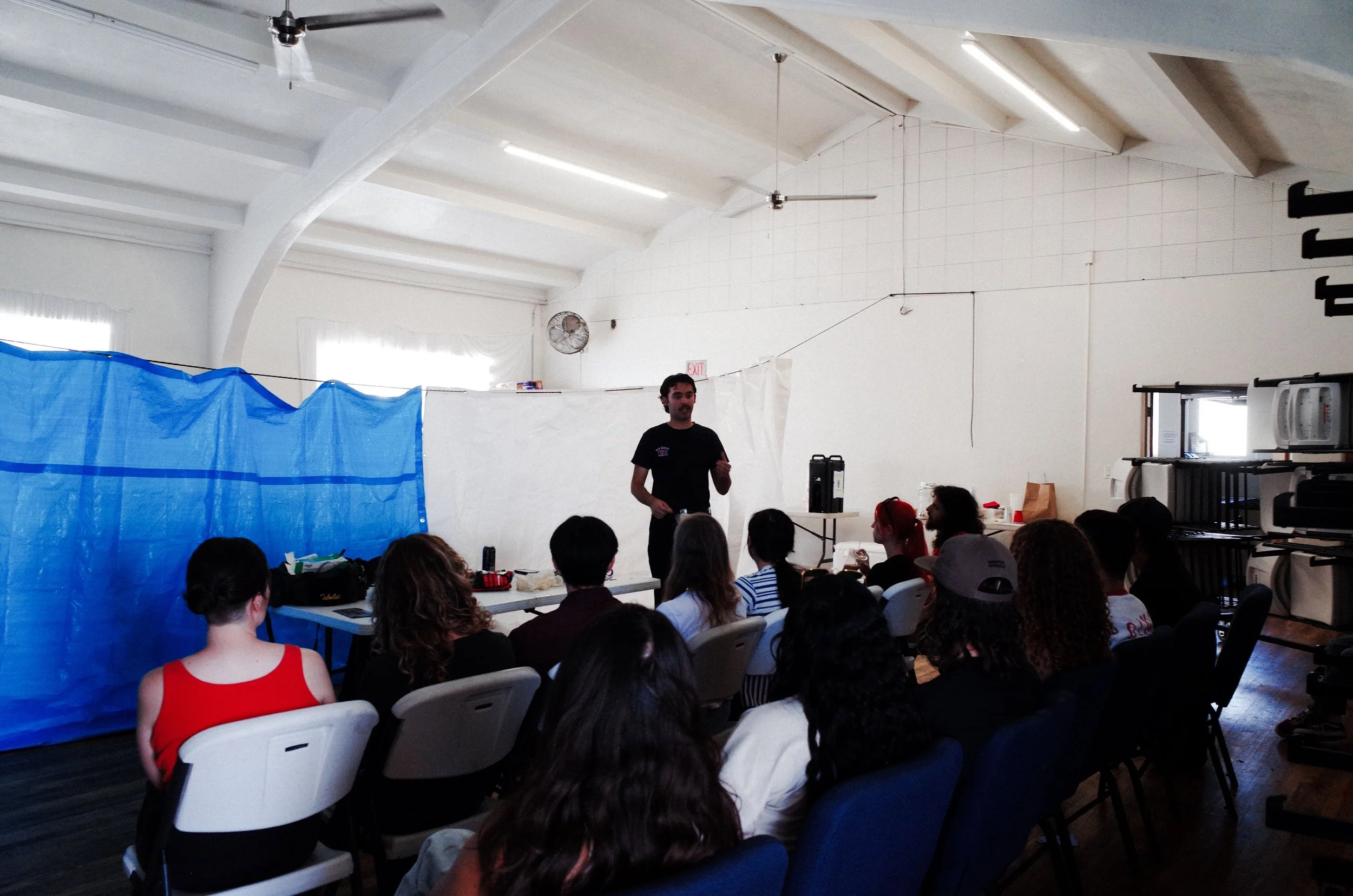
ICE Rapid Response First Aid Training. Antonio Raass photo
In the same vein, our anti-ICE community patrols are another form of direct action. Just as in Palestine the genocide was result of a century of development by the Zionist entity, experimenting with different methods of occupation and disenfranchisement, Trump and the Department of Homeland Security are fomenting the early stages of an ethnic cleansing of working class black and brown people from our communities. When I motivated to prioritize community self-defense in the chapter, I was met with some well-intentioned pushback. The main worry was the high-risk nature of the work and associating with organizations like Union del Barrio (which had just been the target of a congressional investigation for their role in the LA resistance to ICE occupation). Ultimately, enough members of the working group reasoned that, if DSA defending migrant communities was unlawful, then that long arm would eventually come for us anyway.
We spent the first three months investigating how radical projects like this had been executed in the past. We examined the Black Panthers and engaged with the plethora of resources that organizations like CrimeThinc, SiempraNC, and Front Line Defenders had compiled on ICE tactics and strategy. We read historical and contemporary pieces of theory on how a ragtag group of socialists could even stand a chance at hampering in any way an imperial terror machine like the US government. As we grew and developed, we realized that patrolling the community was beginning to inspire discourse on the notion and structures of public safety. This consciousness was spreading not just among patrollers, but within the communities themselves. The patrols became prefigurative for how a community protects itself from an entity that wishes to do it harm, and our chapter was a driving force in that.
Direct action also takes the form of labor work. We are lucky enough locally to have a talented and knowledgeable labor working group chair that keeps tabs on every union in contract negotiations, prepping for a strike, or already on the strike line. By the time they have begun, we are already actively organizing in support of it. We are turning out members to the strike line, donating to strike funds, and even anchoring strike kitchens. My experience walking strike lines has displayed (and tested) the vast spectrum of revolutionary optimism that can emerge out of solidarity with militant workers fighting against unfair labor practices. It is almost a form of political education similar to what occurs during a banner drop, except no one is wondering what exactly the picketers are trying to accomplish—it’s right there on the signs!
Most recently, on a 24-hour Teamsters picket line, I got to talk to workers about everything from the world cup to the Iran war. But the most consistent topic the workers brought up was that, in spite of the risk they were taking, they felt deeply convinced that they could win this fight. It was deeply inspirational and to my mind demonstrated the potency of direct action as not just a tactic for fighting the good fight, but as a method for motivating workers that a better world was in fact possible. All they needed was to take the risk to fight for it.
[Stay tuned for Part Two in the October California Red]