
The returns are (mostly) in, and DSA-endorsed candidates for elected offices from local school boards to the U.S. Congress have been elevated throughout California. A ton of hard work went into this critical election cycle, boosted on the one hand by DSA’s swelling membership, which is now numerically the largest of any socialist organization in the country’s history, and on the other hand by the understanding that in order to stop the march of fascism we had to win big. A half dozen cities in the Golden State are now led by DSA mayors, including the largest one. DSA has become a recognized political force, drawing praise from our coalition allies and dismay from our opponents. Below are reports from ten California DSA chapters on their local election efforts.
Humboldt
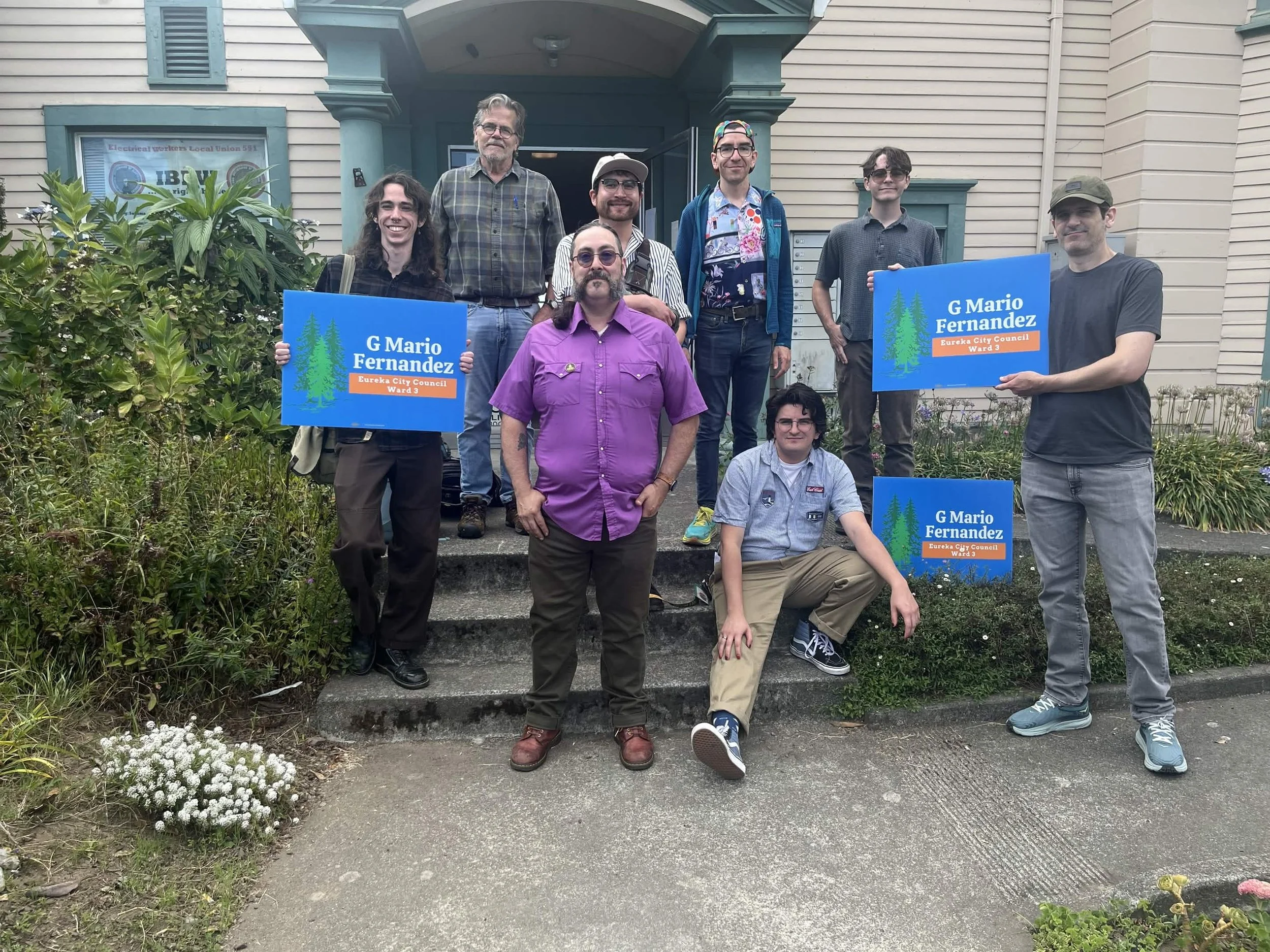
Humboldt DSA endorsed cadre candidate G Mario Fernandez for his re-election bid for Eureka City Council. We were keen to emphasize the contrast between Mario—a DSA member and self-described anarchist—and his opponent, a Republican police officer noted for participating in violent suppression of the local pro-Palestinian student movement.
We mobilized our chapter members as well as Mario's supporters among local trade unionists for a grassroots-focused ground game. Between door knocking and phone banking, we banked an estimated 1000 voter interactions. We are proud to report that Mario is currently more than 100 votes ahead at the time of writing, November 17, although results are not yet certified.

Sonoma County
In February 2026, Sonoma County DSA endorsed our first-ever electoral candidate, Joanna Paun, for County Board of Supervisors. This process reactivated leaders in our chapter who had figured in other electoral victories, such as the Green Party majority in Sebastopol, Omar Fateh’s Minnesota State Senate race, and door-knocking for Prop 50. It also activated a passionate, largely new membership base who believed in the power of ordinary people to challenge the capitalist class.
Our opposition was well-funded by real estate, Big Ag, the Sheriff, and corporate consultant Rob Muelrath, who is behind four of the five sitting County Supervisors and numerous City Council seats. We knew it would be near-impossible to get representation for workers when the candidates for office were already beholden to corporate interests.
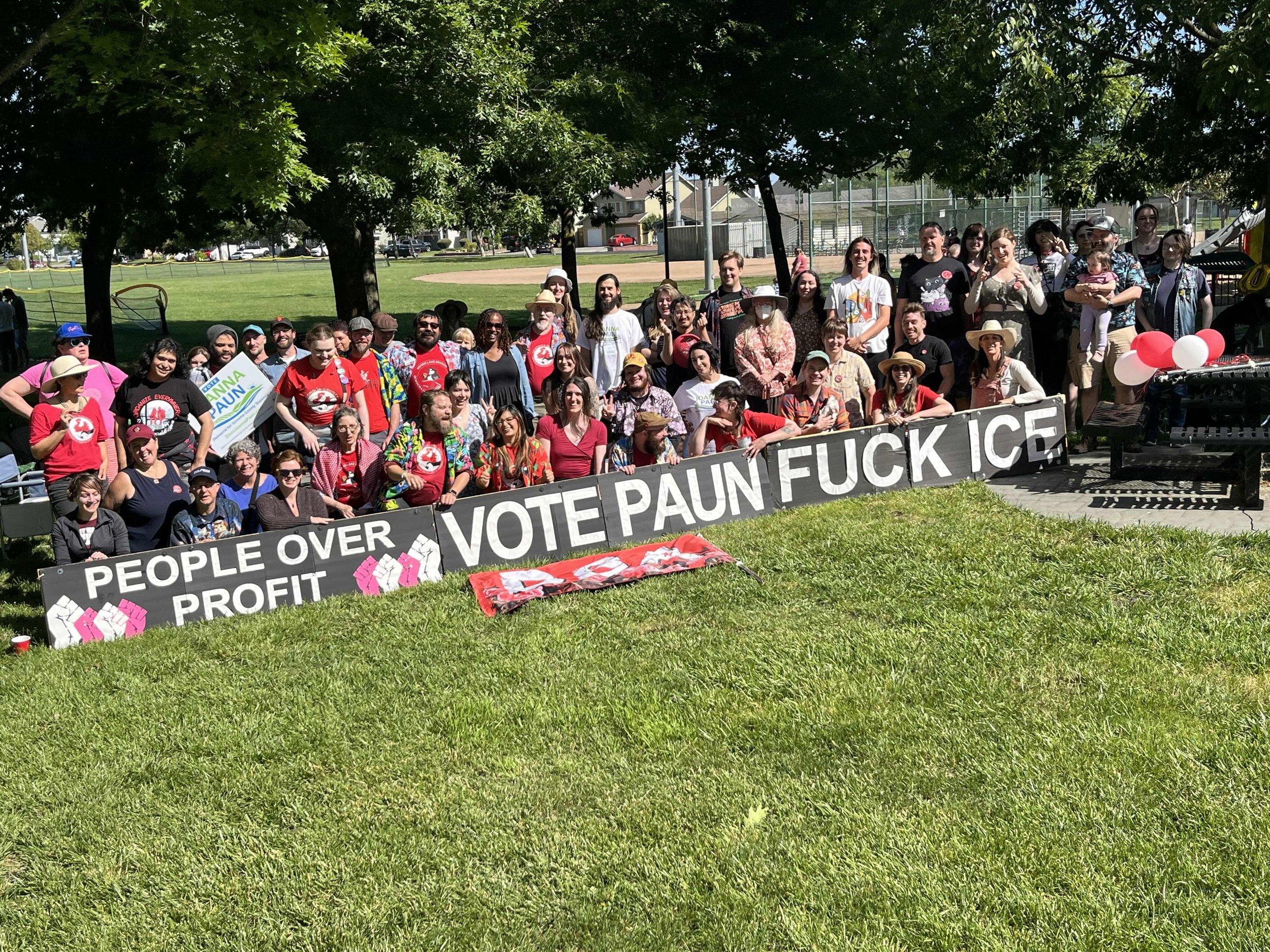
With not a moment to waste, we mobilized our members. We organized weekly weekend door knocks that saw Joanna win 42% of the primary vote—and defeat her main opponent in their home precinct. We organized phone and text banks, made in-house video and graphic content, posted regularly on social media informing locals about the election, and continued activating members to join the campaign. We also released our first-ever Voter Guide in just our second year, in which our Electoral Committee analyzed our county’s races beyond just Joanna’s. This voter guide, combined with our presence in our communities, helped show Sonoma County residents that politics don’t start with expensive campaigns, but with them.
Many of our members had never knocked doors or helped run an electoral race that actually aligned with their principles, let alone whose victory could shape the terrain they live in. For example, Joanna ran with the explicit angle of ending county cooperation with ICE, a major chapter priority we adopted in January. She garnered the support of SEIU 1021 and the North Bay Labor Council, along with over a dozen unions and progressive organizations. During our time on this campaign, our chapter forged a tighter bond with rank-and-file union members and impressed upon local leaders that we are a serious, united force in the county.
After the primaries, we took a small break to celebrate our wins and mount our strength. During our primary campaign, we activated over seventy of our members and trained several who would become Field Leads. We proved that the DSA difference is indeed real—that when we unite, we can defeat opponents taking six figures from police and oligarchs with people power, union support, and buy-in among those who feel alienated from the system. We proved that a socialist agenda delivers on funds for schoolchildren, public infrastructure, affordable housing, union empowerment, and human rights for all, not just some.
By late summer, we once again hit streets and doors for the general election. By then, we had become involved with our close ally, Teamsters 665, in supporting winery workers organizing a new union in an industry that hasn’t had one in over 40 years. We also organized our local No Kings IV, and our members joined numerous community initiatives to block Flock and other automated license plate readers (ALPRs). The groundwork we laid through our labor support and community connections enabled us to keep pushing in-house content that laid bare the corruption of our opponents while simultaneously showing our candidate’s vision.
Our opposition scrambled. They couldn’t find an angle of attack that could stick. Ultimately, no amount of spam texts or shady mailers could overcome our members doing what they do best: talking to neighbors, friends, and family; getting active in our communities; and laying out the real stakes of the race. Money talks, but our voices were louder.
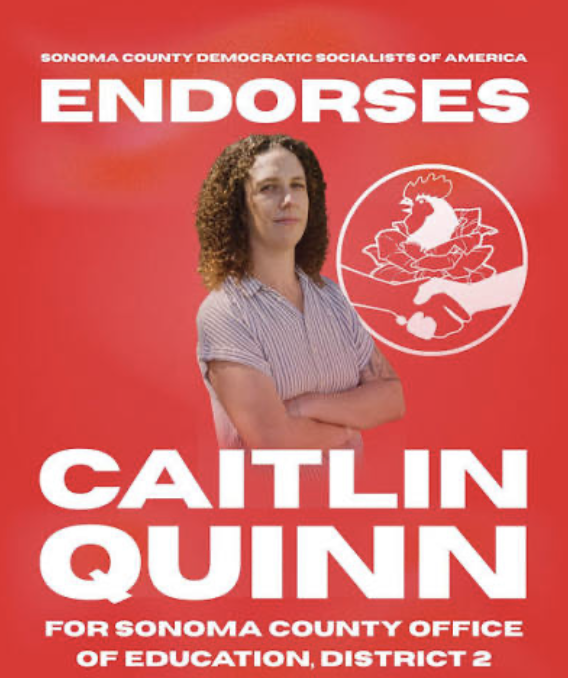

As the general election drew nearer, we endorsed two more chapter members in their respective races: Sarah Seitchik Sebastian, a community organizer running for Petaluma School Board, and Caitlin Quinn, a union president running for County Board of Education Area 2. Our chapter conducted joint knocks for these candidates’ campaigns, assisted with communications, shared their literature, and proudly promoted them to our community.
When all was said and done, we won. Our unity with unions and community networks overcame half a century of corporate domination in District 2. Joanna maintained a 22-point lead from the first ballot drop, and her opponent conceded within the week. Caitlin’s opponent has also conceded, Sarah is maintaining her lead, and we believe our slate will fully sweep soon.
Altogether, we delivered a win not only for the socialist movement, but for the workers and families of Sonoma County—those who call this place home, who raise their children here, who have to move due to the cost of living, who wonder why their services are being cut while developers take public property, who wonder why their government is unresponsive. They won’t have to keep wondering. Now, they will have a progressive majority on the highest body in Sonoma County, allies in office to fight for their interests, and a future that belongs to them.
Joanna Paun for County Board of Supervisors: Won by 22% (called)
Caitlin Quinn for County Office of Education: Leads by 1% (opponent conceded)
Sarah Seitchik Sebastian for Petaluma School Board: Leads by 4% (not yet called)
East Bay
This sprawling chapter, the second largest in the state and encompassing two counties, played an important role in several municipal elections and state ballot measures, charting ten wins and four losses.
On the state ballot measure front, we formed a tax the rich working group at our annual convention in the spring as one of the chapter’s three priority campaigns. The working group met biweekly forward to November. Along the way we collected signatures for what became Props 3 and 40 (won Prop 3, lost Prop 40) and led education and training efforts for the membership, and then with coalition partners Alameda Labor Council and Alliance of Californians for Community Empowerment (ACCE) similar events for the broader community. Later in the summer and fall we canvassed and phone banked with the labor council on the tax the rich campaign, together with our other jointly endorsed campaigns for Oakland School Board (we won one out of two seats we competed for) and Berkeley Rent Stabilization Board (five out of five, giving us an 8-1 majority). We lost Berkeley Measure Z, which would have provided seed funding for a public bank.

On City Council races we went two for three, electing 23-year-old student Syrak Micael in Berkeley, reelecting George Syrop to the Hayward City Council, and running a spirited campaign for Oakland District 2 with Nate Adams that fell short.

Perhaps our marquee campaign was for mayor of Richmond, where East Bay DSA has had a longstanding partnership with the Richmond Progressive Alliance. We supported two-term councilmember Claudia Jimenez in her run at the top municipal job. In winning 55-45% she became the first immigrant Latina female elected mayor of Richmond, and second DSA member, running on a strong working class-first platform of no corporate contributions, against ICE incursions and standing up to the conservative institutional elephant in the room, the Chevron refinery. Dozens of EBDSA members showed up for her canvassing and phone banking every week.
Silicon Valley
We are proud to report back on the incredible effort and growth our chapter demonstrated during this recent election cycle. While not every ballot measure went our way, the true victory for Silicon Valley DSA this year was our capacity to organize, mobilize, and build lasting power in our communities.
Silicon Valley DSA endorsed Props 3 and 40, and No on 41 and 42. We also endorsed Redwood City Measure E (Rent Control), which lost, 46.25% Yes to 53.75% No.
During the last midterm elections, our chapter simply did not have the capacity to campaign for propositions or measures in any significant way. This year, our leaders and volunteers stepped up to effectively organize our own canvasses, generate a social media campaign, and work in coalition with local organizations to reach voters directly.
Our impact:
Voter Contact: We made 783 voter contacts and knocked on 482 doors.
Mobilization: We engaged roughly 51 unique volunteers across our campaigns, with many taking on multiple shifts.
Coalition Building: We strengthened our relationships with local partners, including the Peninsula DSA, where we mobilized members to attend external canvassing opportunities. The volunteer data for those canvasses with coalition partners has not been made fully available to us at this time.
We are incredibly proud of the foundation we have built this year. Our members learned new skills, our chapter developed new leaders, and we are well-positioned to continue fighting for the working class in Silicon Valley.
Peninsula
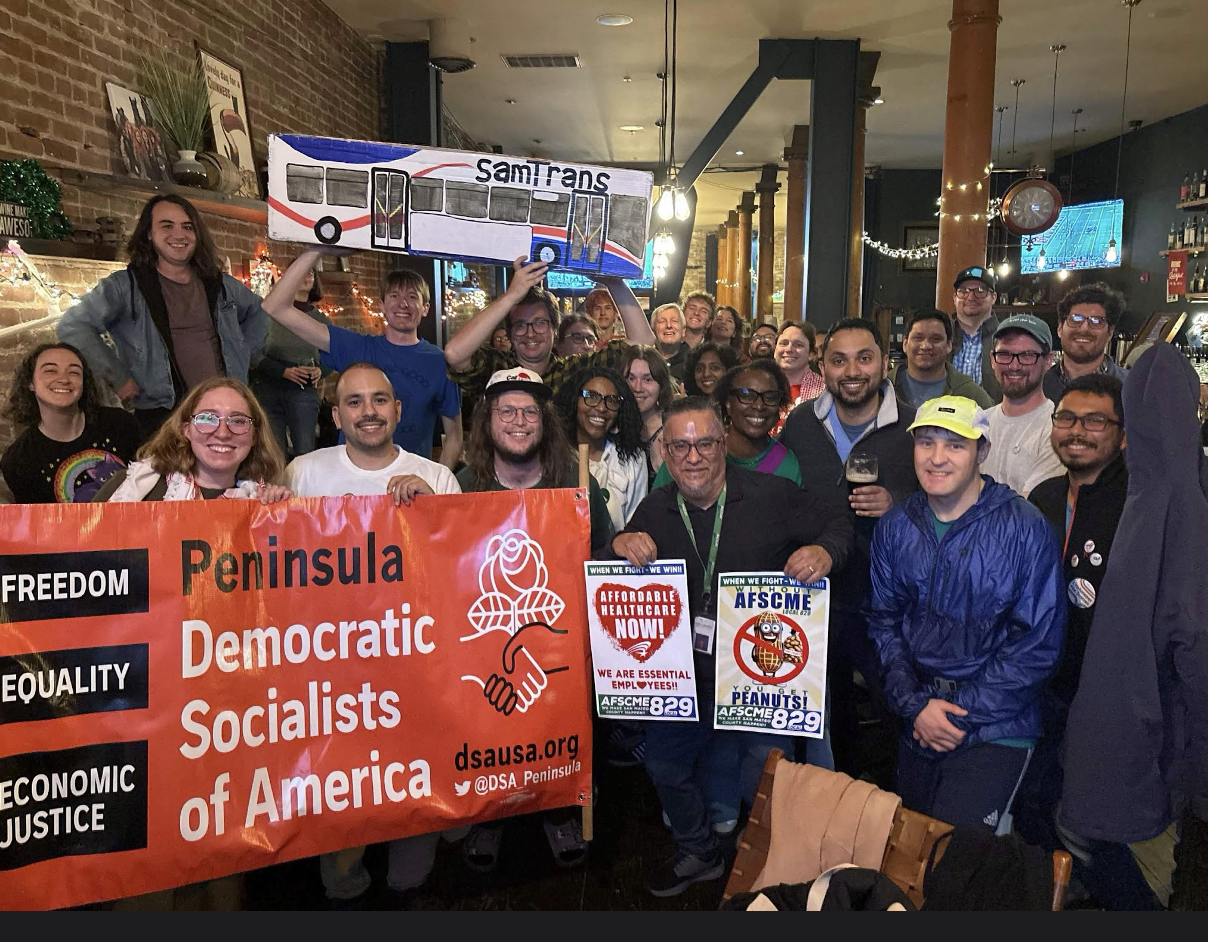
Peninsula DSA organized around five campaigns here in San Mateo County as well as a state level campaign. We endorsed three candidates for local city council: Ofelia Bello in East Palo Alto, Phoebe Venkat in Foster City, and Melanie Olson in South San Francisco. We also endorsed Measure E to establish stronger rent control and tenant protections in Redwood City, advocated for the Regional Transit Measure to fund and maintain public transportation, and endorsed the statewide Billionaire Tax through Prop 40.
Members supported these races by gathering signatures to get the measures on the ballot, then ahead of the general election fundraising, going door knocking, dropping literature, phone banking, text banking and creating and distributing our own voter guide. Earlier, in 2025 Peninsula DSA successfully convinced the SamTrans Board to opt into SB 63, ensuring that the Regional Transit Measure would be on the ballot in 2026.

We were saddened to see both Measure E and Prop 40 fail, as well as Phoebe and Melanie defeated by their corporate-backed opponents. However, we celebrated Ofelia finishing first in a crowded field and look forward to a socialist on the East Palo Alto City Council. The Regional Transit Measure also passed, keeping buses, trains and subways running throughout the Bay Area.
Central Coast
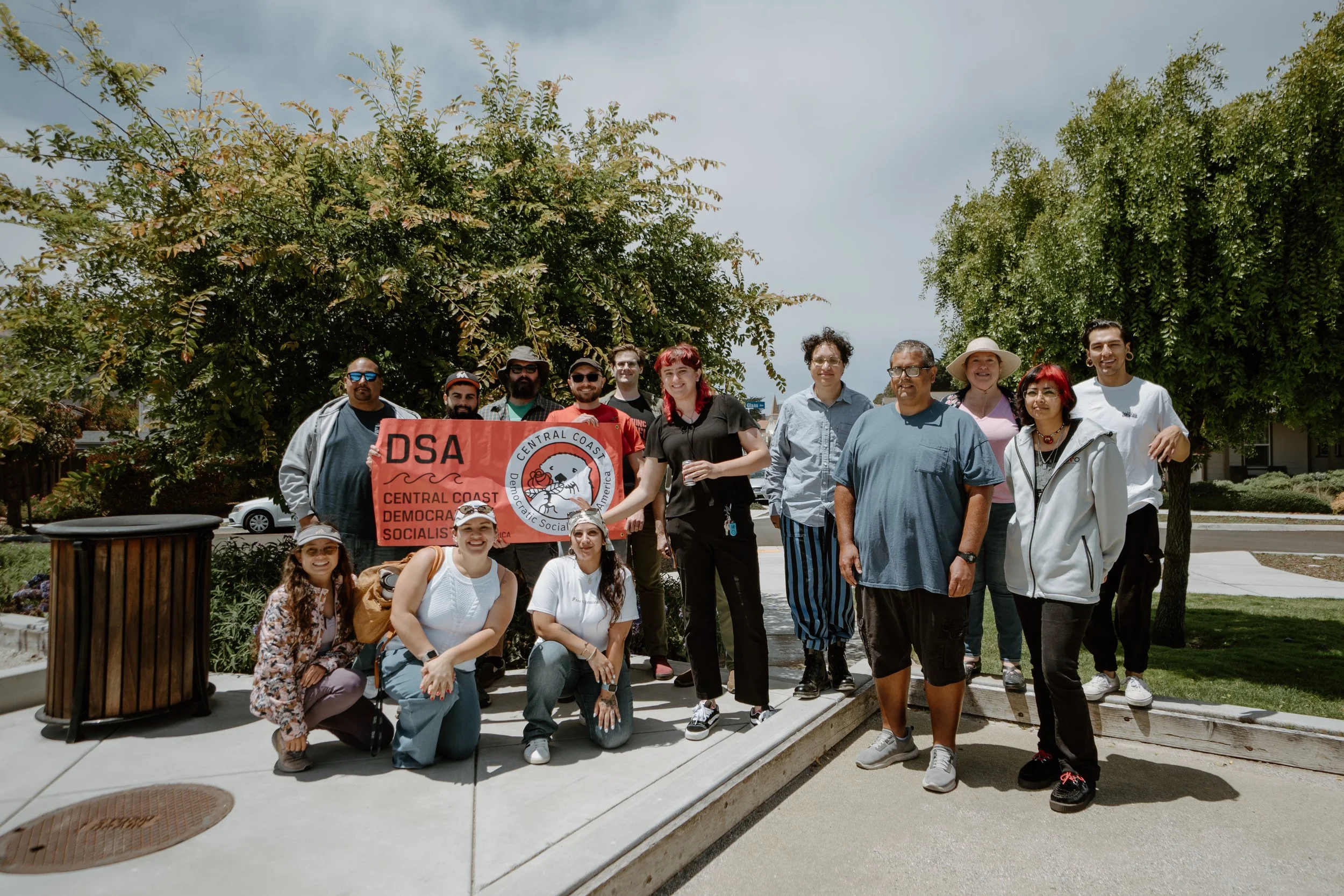
This general election cycle, Central Coast DSA went 3 for 3 on our endorsements: defeating Measure Q, a 7% utility users tax in Marina; defeating Measure H, which would have repealed several renter protection ordinances in Salinas; and electing our candidate for Marina City Council District 4.
Our chapter ran its first cadre candidate for office, chapter co-chair Athena Rita Burciaga, and won. The membership showed up: by the end of the campaign, fifteen members were turning out to canvass, out of a chapter that now has 150 dues-paying members.
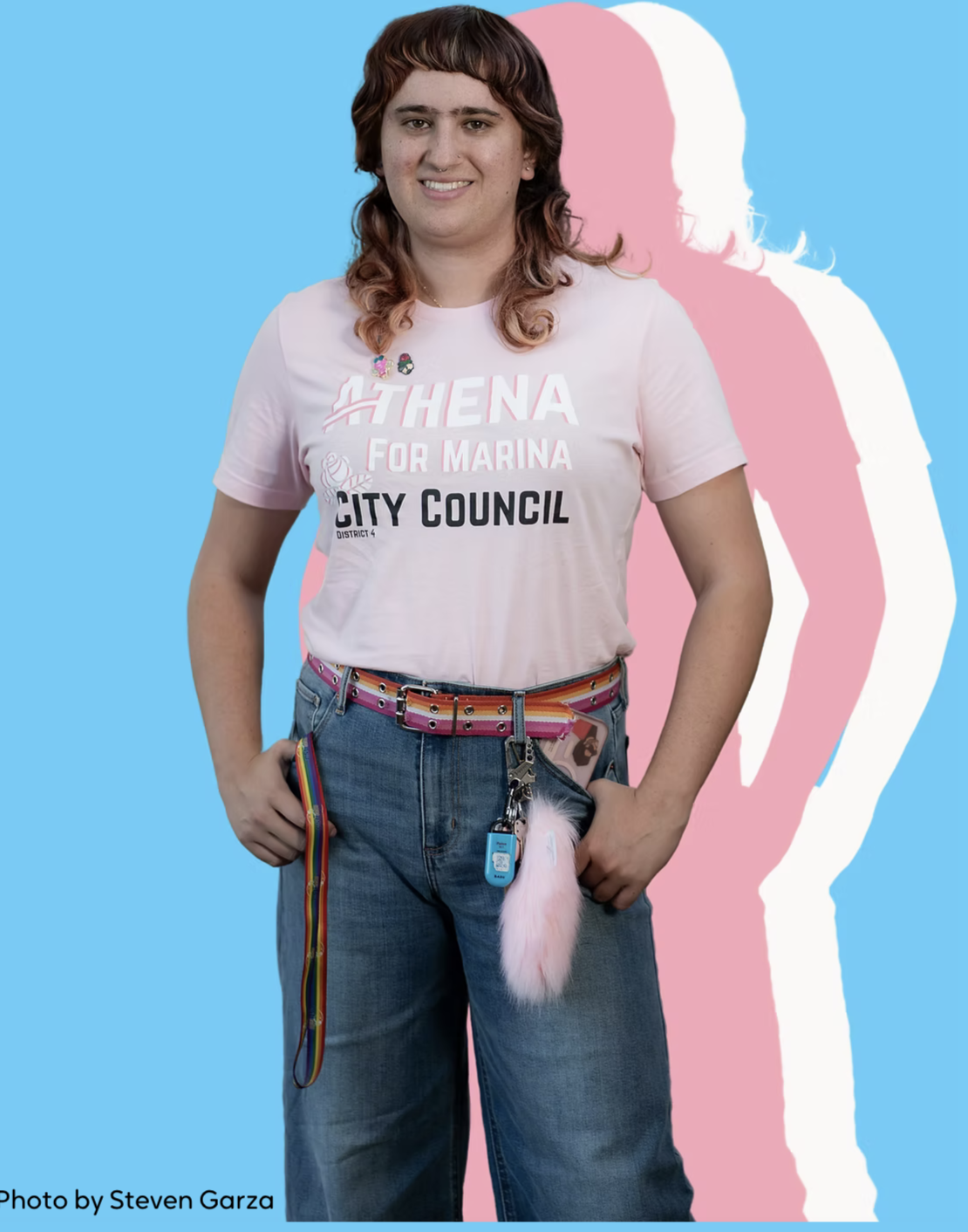
Athena’s win was a comeback. On election night she was in third place with 29% of the vote, 81 votes behind. As the late ballots were counted, she climbed into first and now leads with nearly 36% of the vote, a 54-vote margin, pending certification on November 25.
Many voters saw Mike Simmons, a moderate Republican, as a Democrat, and the results showed he was splitting Athena’s voters far more than those of the other Republican in the race, Brad Imamura. We overcame that by knocking on every door in Preston Park and Abrams Park, Marina’s renter neighborhoods, and the late ballots from those neighborhoods broke decisively our way.
We won by running an unabashedly socialist campaign: protecting renters, building a future young people can afford, and taking on the corporate interests that have held a firm grip on Marina’s local politics for too long. On December 15, Athena Burciaga will become the first transgender person to take elected office in Monterey County.
Santa Barbara
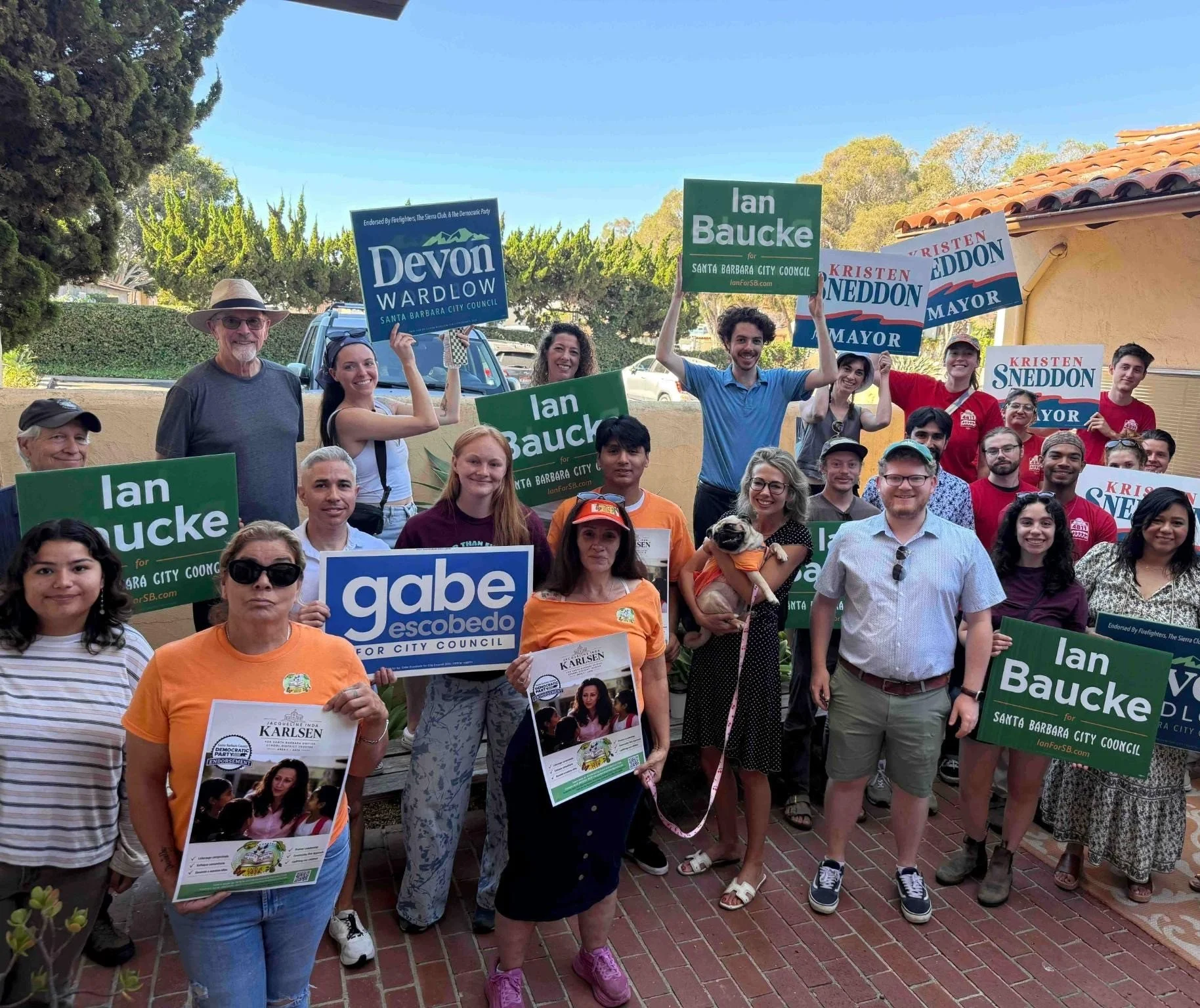
DSA Santa Barbara worked very hard this election cycle in our local city races. As a smaller chapter, we decided our efforts were best used in local elections. Santa Barbara has a city council comprising six members elected through districts plus the mayor, the only citywide representative. Three city council seats were up for election as well as the mayor’s position. In June and July, a couple members of our electoral working group decided to start meeting with the most progressive candidates to discuss their interest in receiving our endorsement. This culminated in a chapter meeting where we had all the interested candidates inform us about their positions and answer questions. At that meeting we ended up endorsing two city council candidates but postponed our decision for the other two. At a special chapter meeting, we endorsed both remaining candidates, meaning we had endorsed a candidate for every district election as well as for the mayor’s seat.
Following our endorsement process, we mobilized and canvassed hard. For the first few weeks we canvassed every Saturday morning. This was in partnership with the local Democratic Party, which in Santa Barbara is run by a democratic socialist; they had endorsed all the same candidates. We decided to participate in their canvassing efforts because of their access to voter information, including the PDI mobile app.
Around six weeks before the election we halted our biweekly electoral working group meetings in favor of weekly door-knocking campaigns. The Santa Barbara Tenants Union did the same; they are very close allies to our chapter. We abandoned the strict rules of canvassing that the Democratic Party followed and focused on apartment complexes that had worked with the Tenants Union in the past. These seemed to be our most successful efforts, especially because of the recent passage of a rent stabilization ordinance.
It’s hard to say how many doors we reached as an organization, but it is in the thousands if not tens of thousands. We averaged about three to five people every Saturday and around ten for every Wednesday canvas, including the Tenants Union members. We led canvassing events, talked to constituents about elections, posted on social media, and made a voter guide. But mainly we organized and went door to door. All of this effort resulted in all of our endorsed candidates winning their races: Devon Wardlow for City Council District 4, Ian Baucke for City Council District 5, Gabe Escobedo for City Council District 6, and Kristen Sneddon for Mayor of Santa Barbara. Sneddon was outspent by hundreds of thousands of dollars. This cycle created a six to one super majority on the Santa Barbara city council in favor of progressive politics (four of whom openly call themselves democratic socialists).
For many of our members, this was their first time canvassing. We mobilized many new members, increasing our chapter’s knowledge and abilities for future campaigns. At the same time, we built new coalitions with allied organizations which we look forward to developing further post-election.
Inland Empire

The primary effort of Inland Empire DSA in the 2026 elections was to rally support for our endorsees Joz Sida and Joe Alvanez, and to a lesser extent the campaigns for Propositions 3 and 40, and No on 41 and 42. This work was carried out by the Electoral Committee, recently formed in November 2025. In prior years the chapter had no designated space for electoral organizing. As a result, inexperience was the primary hurdle IE DSA had to overcome throughout the election season. There was a lot of learning involved, but we are happy to report victories for Joz Sida (Mayor of Fontana) and Joe Alvanez (Fontana City Clerk).
IE DSA facilitated our endorsements by the creation of a Voter Guide, phone banking, canvassing, tabling, and our Tax the Rich Rally on October 10.
The voter guide was created by the Electoral Committee's Voter Guide subcommittee in just under two weeks and was released to the public October 12. It was a tight timeline, as we wanted to have the voter guide out ASAP, as ballots were being filled and returned as early as October 1. Nonetheless, the voter guide was one of our big successes, as it filled a void left by other left leaning political organizations in the Inland Empire. We have heard many reports of non-members using and sharing it, and it has been mentioned by new members during onboarding.
Phone banking efforts focused on IE DSA membership. The goal here was to activate paper members by getting them to come out for electoral work. On this front, there was much more success with events centering Joz and Joe compared with the YES on 3 and 40/NO on 41 and 42 campaigns. The prospect of a local IE DSA elected seems pivotal here.
In-person canvassing efforts received relatively low turnout but were instrumental in developing member organizing skills and IE DSA as an electoral organization. The canvassing process did this by familiarizing members with PDI & Solidarity Tech apps, and face-to-face conversations with the public contributed to the chapter's presence in the Inland Empire.
Tabling efforts took place at voter info events in Cal Poly Pomona and a No Kings rally in downtown Riverside. IE DSA’s presence at these events was well regarded and conversations with the public were consistently positive. Throughout the election season, people were incredibly receptive to DSA politics. We made it a point to hand out lit for “Workers Deserve Better” alongside the propositions at these events.
Another success came from the Tax the Rich Rally, held on October 10th in downtown Riverside (part of the statewide “Tax the Rich Day” events with DSA and organized labor). Riverside is the center of the IE’s democratic politics. Its central location, diversity, public transportation, and overall population made it the obvious choice for the rally. We were helped by SEIU-United Health Workers organizer Gabe Montoya, who also served as a guest speaker. Our other guest speaker was recently elected assemblywoman Clarissa Cervantes, a self-proclaimed DSA-aligned progressive and major force in Inland Empire politics.
IE DSA is ecstatic to report victories in the form of our endorsed candidates Joz Sida and Joe Alvanez (we are in the process of establishing a Socialists in Office committee), relationships built between the chapter and the Inland Empire’s progressive organizing scene (namely Clarissa Cervantes, the Working Families Party, and Party for Socialist Liberation), and most importantly, the growth of the chapter Electoral Committee and development of its members as organizers. Going forward, IE DSA’s electoral goals lie in the cities of Riverside, Moreno Valley, Fontana, and Ontario, and the bulk of electoral work in the following months will happen in our newly formed research subcommittee. We are in a much stronger position than we were at the start of the year and expect that strength to continue on into 2028. We believe the Inland Empire is ripe for democratic socialism, and plan to run cadre candidates for city council and mayoral elections in the central cities.
Orange County
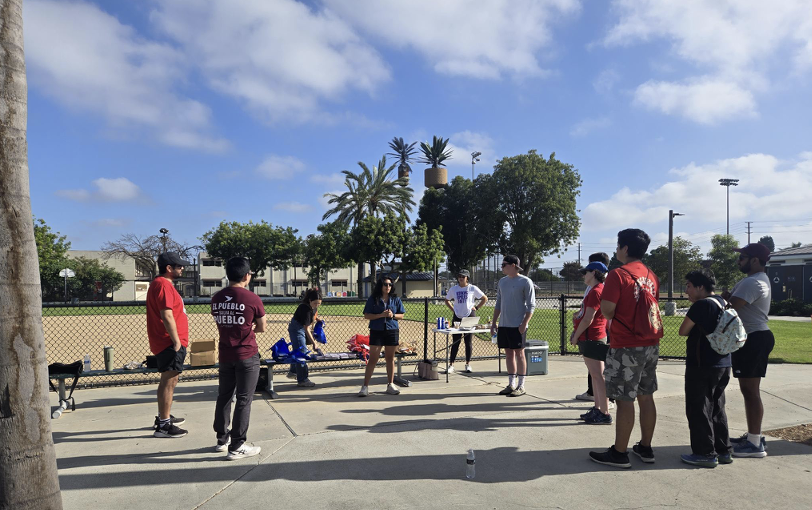
Santa Ana is a Red Zone!!!
Following successes that socialists have gained just in the last year, OCDSA has also grown to unprecedented heights with record membership numbers! To Californians, Orange County is infamous for rank conservatism and development company corruption, but at the heart of the county there are immigrant and working class communities that face brutality from the police state (alongside those other two problems). The OC chapter didn’t have an electoral committee at the beginning of this year, but the bump in membership due to the ripple effects of Zohran Mamdani’s victory gave rise to a newfound capacity within our chapter to knock 10,000 doors within three months and sweep all four endorsed campaigns: Ben Vazquez (Ward 2), Sandra de Anda (Ward 4), and Isuri Ramos (Ward 6) for Santa Ana City Council, and Measure D for ranked choice voting in Irvine!
Ballooning housing costs alongside the fascistic presence of Trump’s deportation troopers translates to the hollowing of what makes Santa Ana exceptional. Santa Ana has been a cultural hub for our immigrant communities with a vibrant art scene and inclusive night life, but it's in the midst of a housing crisis that has pushed out working families. All three candidate campaigns touched on the fight against data centers and police accountability in the midst of a very violent year for the SAPD to name a few of their common policy priorities.
Before the election, chapter organizing in the city was primarily centered around our Immigration Justice and Mutual Aid efforts. Since its creation, OC DSA's Immigration Justice Committee has engaged in direct action, organizing Know-Your-Rights canvasses and strengthening OC's ICE watch and mutual aid network, notably at day labor corners found at Home Depot and U-Haul parking lots.
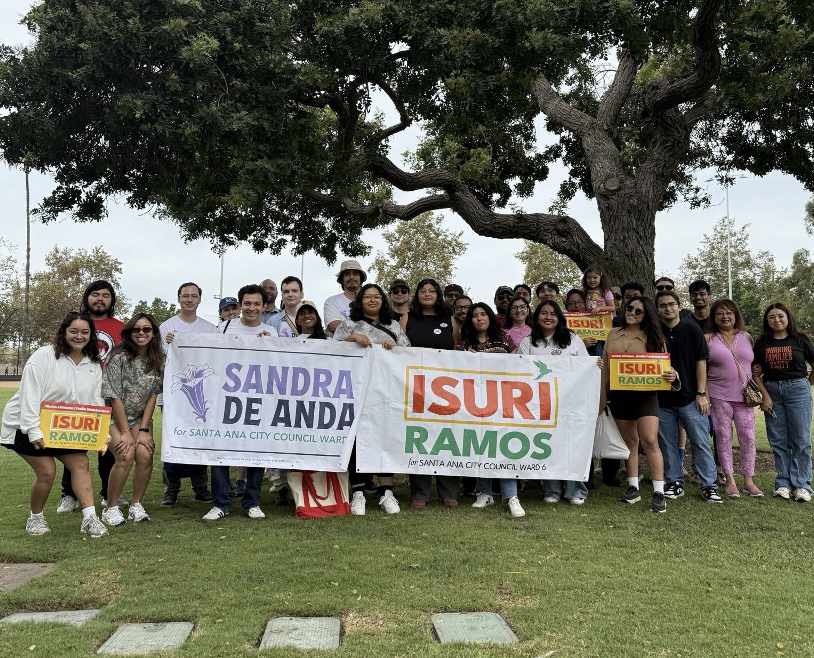
For a worker-centered alternative vision for the Orange County we deserve, local organizing based in socialist principles serves as the North star for our most powerful electoral campaigns. Council Member-elect Sandra De Anda serves as the Director of Policy for the Orange County Rapid Response Network (OCRRN), a grassroots organization rooted in a mutual aid model to center the dignity of affected community members and combat the debilitating effects of ICE actions throughout the county. De Anda has credited much of her campaign's success to DSA’s unprecedented approach to mass organizing—what she has proudly called the “DSA difference”! While De Anda has fought tirelessly for sanctuary policies from the outside of city council for years, with her local DSA chapter's backing, De Anda will soon be co-governing from inside the halls of power.
Santa Ana’s housing crisis requires a new look at city planning policies that help lower the cost of living, and councilmember-elect Isuri Ramos’s work on the Planning Commission as a supporter of rent control and a data center moratorium made our endorsement a logical decision. Her advocacy for immigrant and tenant rights will ensure a strong voice on council for communities targeted during these anxious economic and social times that Operation Metro Surge has instilled in the city. Her time as the executive director at Chispa, a local organization fostering Latinx youth political power, speaks to her depth of knowledge in the material conditions of the immigrant and working-class communities.
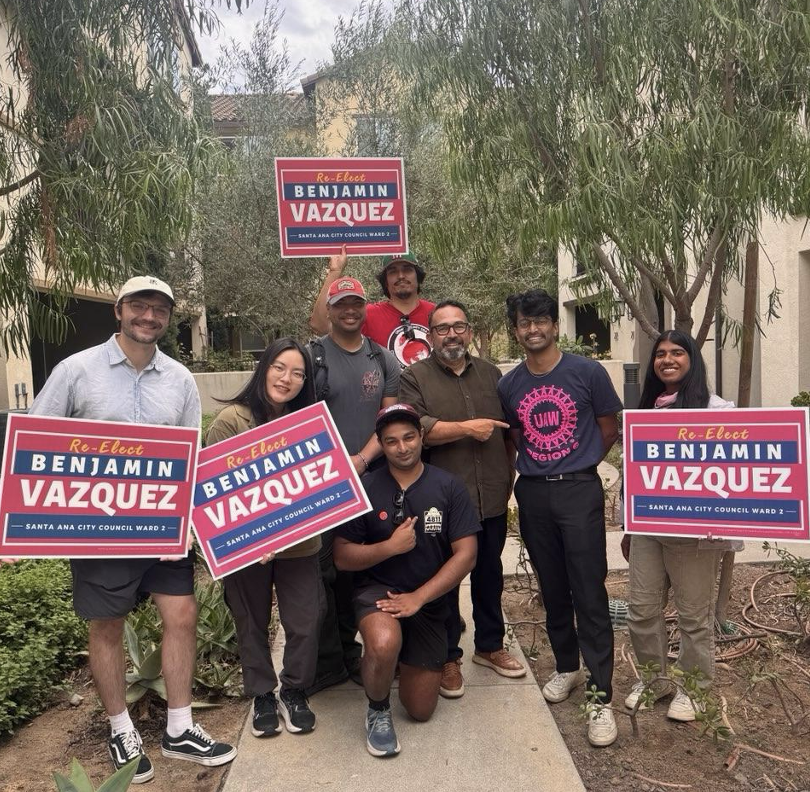
We also picked up an institutional powerhouse with Councilmember Ben Vazquez. He became a DSA member during his second run for council, and his time as a teacher and teacher’s union vice-president make him a valuable ally for the left and for Santa Ana. As a teacher, he ensured that students received a history education that helps students reflect on society down to the material realities of their day to day. His expertise in city council politics and time in labor organizing provides the language and mechanics of governance for our socialist majority’s toolbelt along with a political compass in line with our values and mission. These skills will provide incoming councilmembers with the tactics to match their passion alongside the remaining city council.
On top of these great wins in Santa Ana, Irvine's Measure D for ranked choice voting won in part by activating our local YDSA chapters to get them acclimated to campaign organizing. This ensures that incoming membership has the people power and working-class organizing skills needed to upend the previously entrenched establishment in city governments across the county.
These victories are a stand against the police unions that collude with I.C.E. and the surveillance state that inflates city budgets for the oligarch class. Although important, these council victories are not the end of the organizing work. The Trump administration’s recent appointment of Stephen Miller to Chief of Staff doubles down on domestic policy like Operation Metro Surge. With a new, progressive mayor in Dan Shimell replacing conservative mayor Valerie Amezcua, change has come, and DSA members are in a position to carve a new vision for Santa Ana at the heart of Orange County.
San Diego
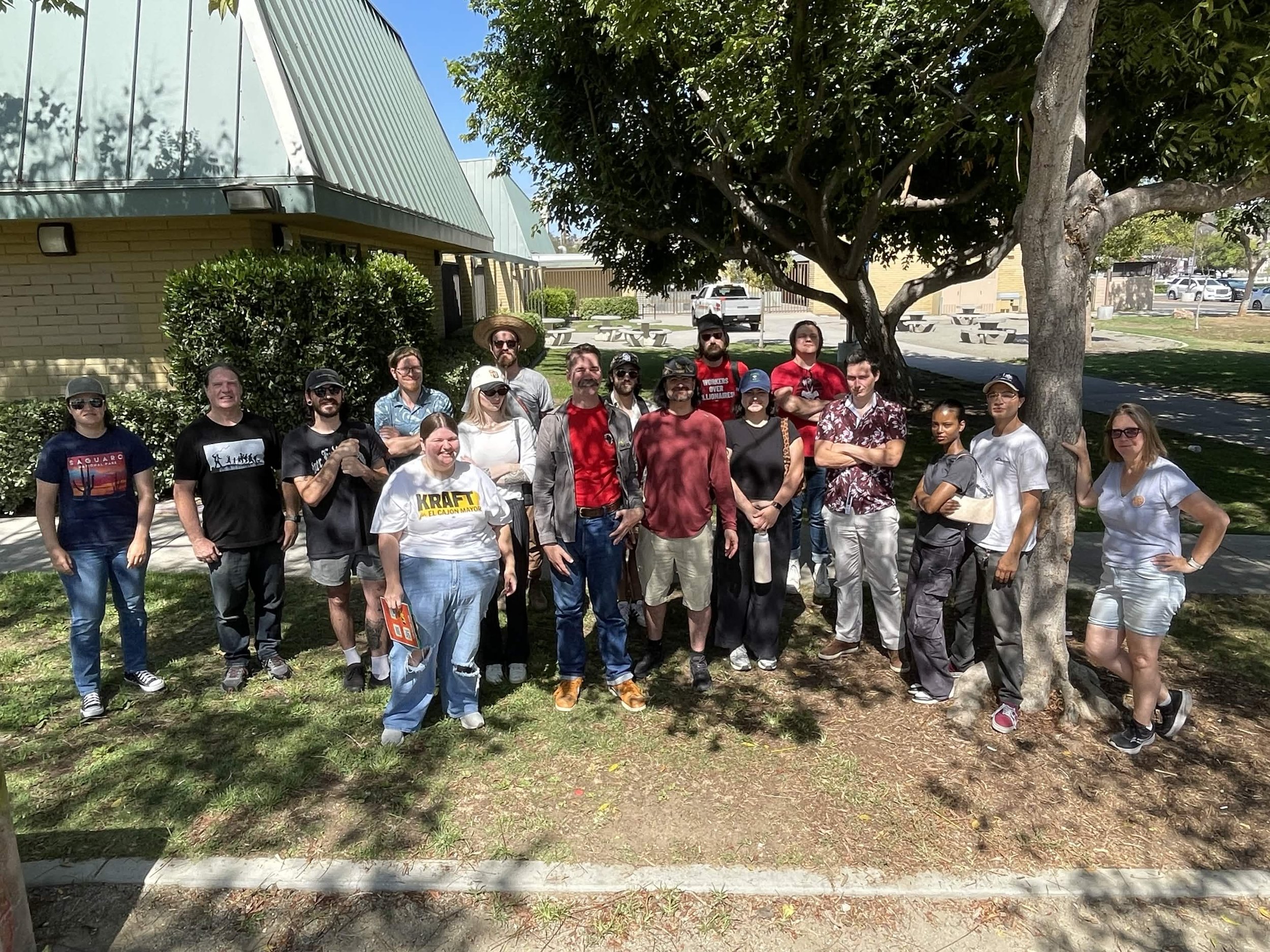
In 2026, DSA San Diego’s electoral work was focused on two spring campaigns and three campaigns during the General Election. Our electoral efforts were focused on base-building in central San Diego while hammering out wins in farther flung cities within the county where working people are being stretched thin at the gas pump and by politics centered around corporate greed. The movement has found its foothold in North County San Diego, with two endorsed candidates winning their races in the region: Joey Aszterbaum for Trustee of MiraCosta Community College Area 6 and Kenneth Zuniga for Mayor of Vista!
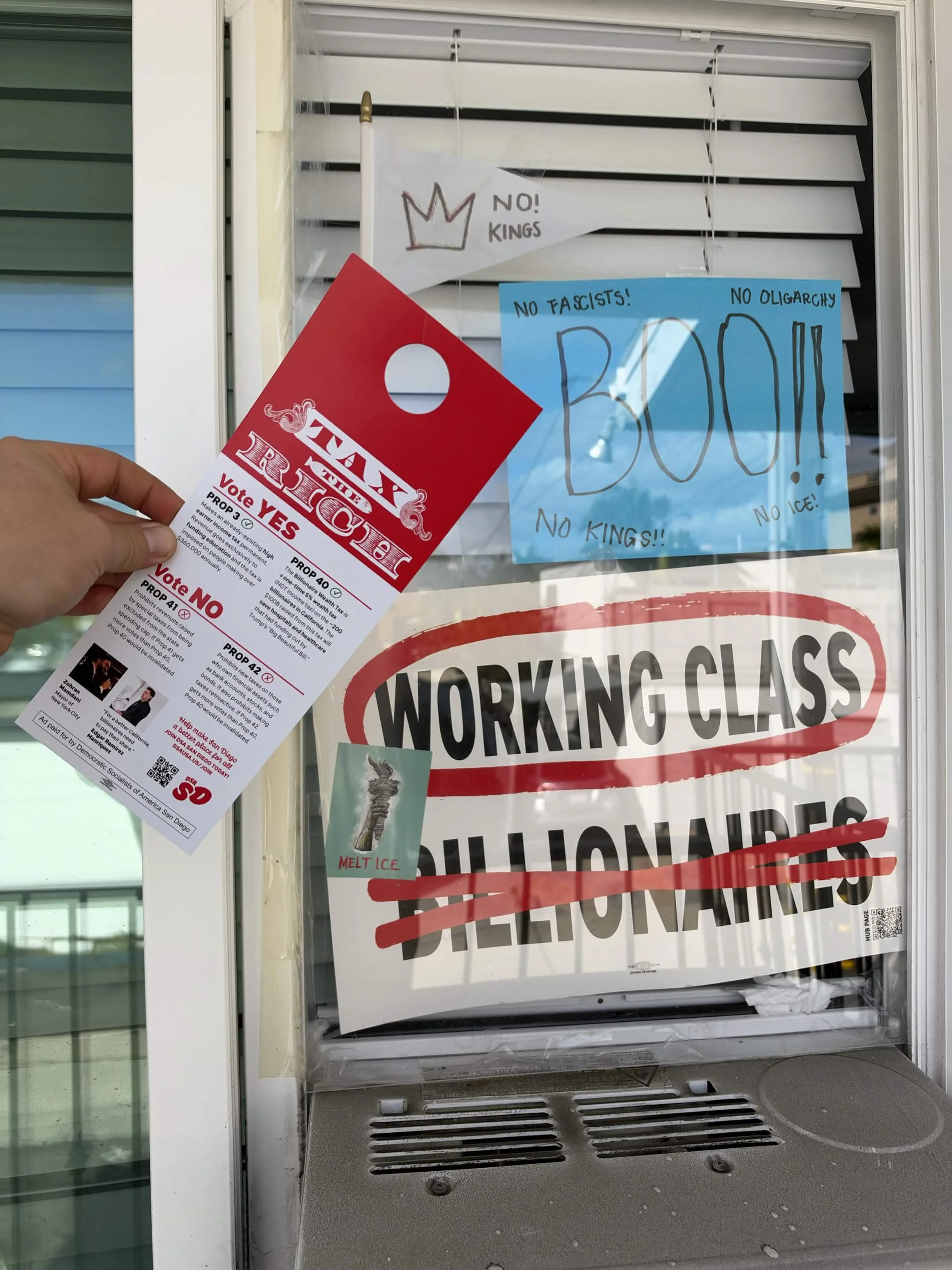
DSA San Diego's membership initially focused on two ballot measures—one local and one statewide. We initially canvassed in support of Measure A, a local measure that aimed to tax vacant homes in an effort to encourage more housing to be put on the market and to collect revenue to help combat homelessness. While it failed at the ballot, we mobilized 100 people to reach 2,831 doors. We then collected signatures to get the Billionaire Tax on our November ballot; we reached over 1,200 doors and collected 115 signatures at the door.
During the General Election, we ramped up our efforts and focused on bringing home wins for one consolidated statewide ballot proposition campaign and two candidate campaigns. Our proposition campaign to Tax the Rich (TTR) advocated for constituents to vote YES on Propositions 3 and 40 and also vote NO on Propositions 41 and 42.
Prop 3’s passage continued a tax first put in place in 2012 on high-income earners to fund education, while Prop 40 advocated for a tax on individuals with a net worth of more than $1 billion to fund healthcare as well as education and food-assistance programs; the latter failed to pass. Propositions 41 and 42 were put on the ballot to nullify the Billionaire Tax if it passed; Prop 42 passed. DSA San Diego’s TTR campaign was primarily based in the City of San Diego with some broader outreach to the southwestern region both inside and bordering the City. TTR saw the chapter’s largest walks on average with each canvass seeing just over 20 volunteers and the largest seeing 32 volunteers. Over the course of seven canvasses for TTR, 144 people knocked 3,486 doors. Prop 3 passed and Prop 40 failed.
Our candidate campaigns were focused on two cities in the County of San Diego: El Cajon and Vista. Alexander Kraft ran as a third-party socialist candidate to unseat incumbent Republican Bill Wells in the City of El Cajon. DSA San Diego mobilized 115 people to knock 2,996 doors across 11 canvases. Kraft outperformed Wells’ previous Democratic challenger by more than 14 percent, receiving 43.64% of the vote in a city where Wells had previously won with 70% of the vote., Although Kraft lost his race, the incumbent won by tighter margins than previously seen.
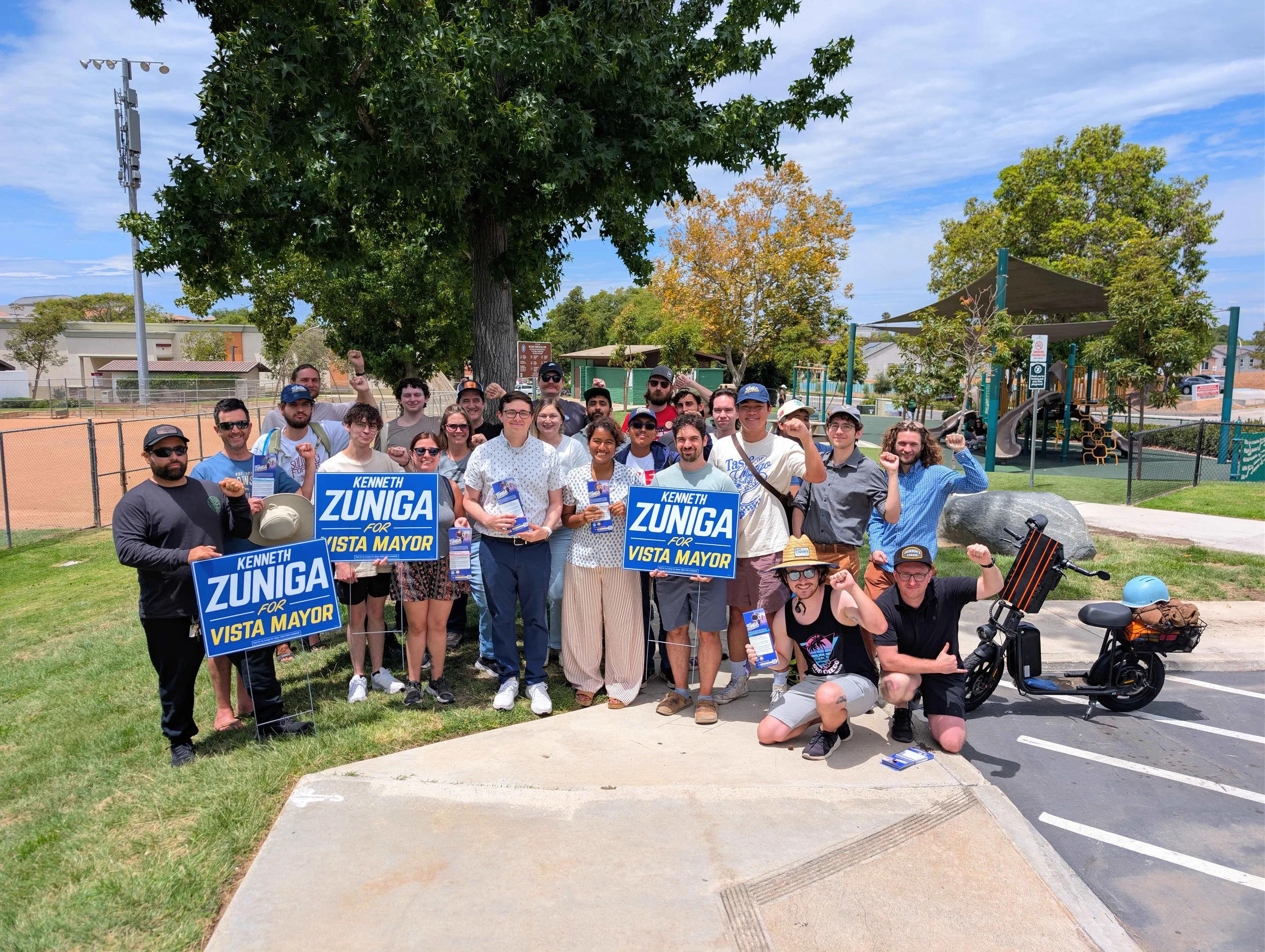
While registered Republicans edge out registered Democrats among El Cajon’s electorate, DSA San Diego’s endorsed race in the City of Vista was playing out in a city with more registered Democrats despite having a Republican mayor. DSA member Kenneth Zuniga ran against former Vista Councilmember Joe Green. Across the 12 canvasses co-hosted by DSA San Diego, 110 canvassers were mobilized to knock 5,481 doors. Zuniga won his mayorship, becoming the first democratic socialist mayor in the County of San Diego!