
On January 1, 2026, DSA’s most visible and astonishing electoral success story to date, Zohran Kwame Mamdani, was inaugurated as mayor of the largest, most culturally iconic city in America. Much media hay has been made of Mamdani’s long-shot run, incredibly well-organized and executed campaign, and the long-theorized but seldom-achieved mass mobilization of untapped voter blocs that underlay Bernie Sanders’ two runs at the White House in 2016 and 2020.
In the immediate aftermath of Zohran’s victory, hundreds of thinkpieces from The Guardian to the LA Times asked: who’s the next Zohran? Will there be one in Los Angeles? Mayor Karen Bass is up for reelection in 2026, facing a narrow set of challengers now that her 2022 opponent, crypto-Republican real estate billionaire Rick Caruso, has declined a rematch. Likely opponents will include Rae Huang, occupying a progressive-nonprofit-activist lane that Bass herself is aligned with, and former LAUSD superintendent Austin Buetner, a candidate in the mold of a post-Obama technocrat.
The question betrays a misunderstanding of how socialist electoral power is built in practice, both confusing running candidates with movement-building, and trying to map New York City’s political context onto Los Angeles. A Mamdani mayoralty will challenge NYC-DSA in uncountable ways as they seek to realign city and state politics around a democratic socialist pole, with DSA as a proto-party organization amassing institutional power alongside its electeds by way of establishing a regional electoral machine.
DSA’s Los Angeles chapter is ramping up to support our own six endorsed candidates for 2026: two incumbents on city council, one school board incumbent, and challengers for two new city councilor seats and for city attorney. These races continue the chapter’s pursuit of a very similar realignment under different conditions than NYC. On this front, DSA-LA’s electoral program has a strong track record, demonstrably shifting the political calculus among elected officials, operatives, labor unions, allies and class enemies alike. Once grounded in an uneasy multiracial “Status Quo Coalition” tying capital and labor together into ethnic blocs of interest, the shape of LA politics has begun to shift, with big business, landlord, and police interests pouring money into crushing the fragile pro-tenant and pro-worker wins of the past few years.
In this first piece of a planned series, we offer an overview of the Los Angeles political landscape and DSA-LA’s recent electoral history to explain its similarities and differences from NYC, the power (or influence) DSA-LA does (and doesn’t yet) wield, the ongoing realignment of major political forces in Los Angeles, and what these all mean for the democratic socialist movement.
Structural Factors Shape Local Strategy
DSA-LA’s electoral program to date is distinguished by a significant focus on municipal city council offices. While NYC-DSA has elected two councilmembers and 9 state legislators (the tenth of whom left office to become Mayor), DSA-LA’s wins so far have been concentrated in the city of Los Angeles, with four elected Los Angeles City Councilmembers and two Los Angeles school board members.
The relative strength and weakness of mayors and city councils informs municipal electoral strategy. The city councils in the two other largest cities in America, NYC and Chicago, each have 50+ members. (Chicago’s mayor is weak in theory, strong in practice - though the current mayor is testing the limits of mayoral powerlessness.) In contrast, the mayor’s office in Los Angeles is relatively weak compared to city council, with each of our 15 city council offices functioning more as a midsize localized executive office than a legislator in an assembly.
A California Red article during the 2024 campaign cycle as well as our chapter’s Democratic Socialist Program provide a good overview of the political interests that oppose or support our candidates, which are largely similar for DSA candidates across the country. We describe below some of the most salient factors a DSA-LA candidate faces in mounting a winning campaign.
Election System & Scale
The sheer scale of LA politics creates the most formidable obstacles. Assembly districts contain 485,000 people and city council districts 260,000—compared to New York's 120,000 and 170,000 respectively. For example, in the 2022 primary, DSA-LA’s Hugo Soto-Martinez won the most votes in the primary against incumbent Mitch O’Farrell with just over 19,000 votes to O’Farrell’s 15,000. Meanwhile, only about 17,000 votes in total were cast in Zohran’s first primary race for New York State assembly in 2020. In NYC, the general election is typically a guaranteed victory for the Democratic-line candidate. In 2022 Los Angeles, Soto-Martinez needed to win another bruising run-off against O’Farrell which he won 38,069 to 27,797.
The chapter has attempted endorsements in state legislative seats in the past, and those results further illustrate the overwhelming scale of Los Angeles electoral campaigns: former Culver City councilor Daniel Lee badly lost a special election for State Senate District 30 in 2021 against a chair of the “Women for Mike Bloomberg 2020” campaign – despite winning more votes than Zohran Mamdani did in his Assembly victory that same year. DSA-endorsed candidate Fatima Iqbal-Zubair lost twice in bids to unseat oil-money Democrat Assembly District 65 incumbent Mike Gipson in 2020 and 2022, despite receiving over 50,000 votes in her first race.
California's "top-two" jungle primary system compounds the challenge, requiring candidates to appeal beyond partisan activist bases to a broader electorate regardless of party affiliation. This primary system is in many ways more “small-d democratic” than a system of closed party primaries like NYC’s. At the same time, it has largely accomplished the goal of the Republican state legislators who championed it: boosting moderate candidates over left-wing challengers. It has also inspired establishment Democrats to strategically fund the primary races of their desired opponents, as Senator Adam Schiff did in 2024 when he poured millions into boosting Republican Steve Garvey to avoid a runoff against a progressive.
Another factor is our system of neighborhood councils, LA’s smallest official unit of city government. The 15 absurdly large city council districts are paired with 99 hyper-local, citizen-led political institutions with elected leadership. The very small size of these races (with vote totals in the tens to hundreds) makes them attractive targets for activists; neighborhood councils were swept by grassroots progressives in recent years. (DSA-LA ran some neighborhood council races in 2020 and 2021.) Unfortunately for these progressives, each council is funded to the tune of $25,000 and granted purely advisory powers, while being subject to many state laws applicable to regular governing bodies; in practice, more of a timesink for NIMBY home- and business-owners than a venue for collective power.
DSA-LA has additionally endorsed candidates for some of the county’s 87 smaller jurisdictions: Ricardo Martinez for the City of La Puente, Mike van Gorder for Burbank Council, and recently re-elected Burbank councilor Konstantine Anthony. But the chapter has generally struggled to develop both candidates and membership outside the overwhelming gravity of LA city. LA city electeds are simply much more powerful than our comrade councilor from Burbank, so their seats are more hotly contested; their districts are more densely populated with DSA members, and their races eat up more attention and resources.
Constituencies and their Property
DSA-LA's core constituency is well-established through years of electoral experience: highly educated, mostly white voters facing downward mobility relative to their parents, alongside an upwardly mobile, educated multiracial working and middle class often experiencing greater prosperity than their immigrant parents. In Los Angeles—a majority-renter city where median home prices have long exceeded $1 million—housing scarcity sharpens these class dynamics. Decades of intentional underdevelopment have turbocharged homeowners' political power, creating conditions where DSA candidates perform well in dense, renter-heavy neighborhoods where the housing crisis hits hardest.
The statewide albatross of Prop 13 has also fed this dynamic. The 50-year-old constitutional amendment, as the state Board of Equalization puts it, “converted the market value-based property tax system to an acquisition value-based system.” Among other effects, it functionally ensures new homeowners pay proportionally more for local services relative to established homeowners, driving an increasingly obvious generational divide. The components of California’s property tax system remain incredibly difficult to dislodge even as vast disparities in taxable property values impact education funding, state and local budget stability, and class and housing mobility.
Left-Labor Landscape
Every city has its own system of NGOs carving up the turf of its left-electoral and donor- or grant-funded movement landscape. Candidates for office must contend with this network of interpersonal and institutional relationships. In Los Angeles, Karen Bass herself serves as an exemplar. Once a member of the US Communist Party (CPUSA) and linked to Cuba through the Venceremos Brigade, Bass followed the path of much of the 20th century’s New Left. Like many who spent their younger years in SDS or adjacent social justice movement organizations, Bass rose to prominence in LA channeling her political energy into the nonprofit world as the founder of Community Coalition (CoCo) to exercise influence and achieve elected office.
Like many “blue” electoral strongholds, durable one-party rule has shaped the Democratic Party in California into a very large tent. While there is a corporate wing of Democrats courted by everyone from Chamber of Commerce lobbyists to crypto shills, there is also room for what we might call multi-racial liberal democracy blocs. Compared to New York, these blocs have been fairly adaptive and responsive to working class politics. Case in point: in the 1990s, a Latino-labor bloc emerged in LA that is still very powerful today. (In 2025 DSA-LA ran a political education series on Labor’s place in the power politics of LA— essential reading.) These leaders were considered quite progressive, and there are few outright terrible Democratic legislators in DSA’s best-performing neighborhoods. But wedges do open up within these coalitions, which gives a less well-connected candidate room for an upset victory.
In 2022, city politics was thrown into chaos after the release of leaked audio recordings of city officials scheming to turn redistricting to their favor at the LA County of Federation of Labor. All four officials lost their positions - three city council members, two of whom have since been replaced by DSA-LA endorsed candidates, plus Ron Herrera, Teamster and former president of the LA Fed. The “Fed Tapes” exposed politicians explicitly pitting racial groups against each other, an ugly display of the pursuit of raw power in which the highest levels of organized labor were implicated.
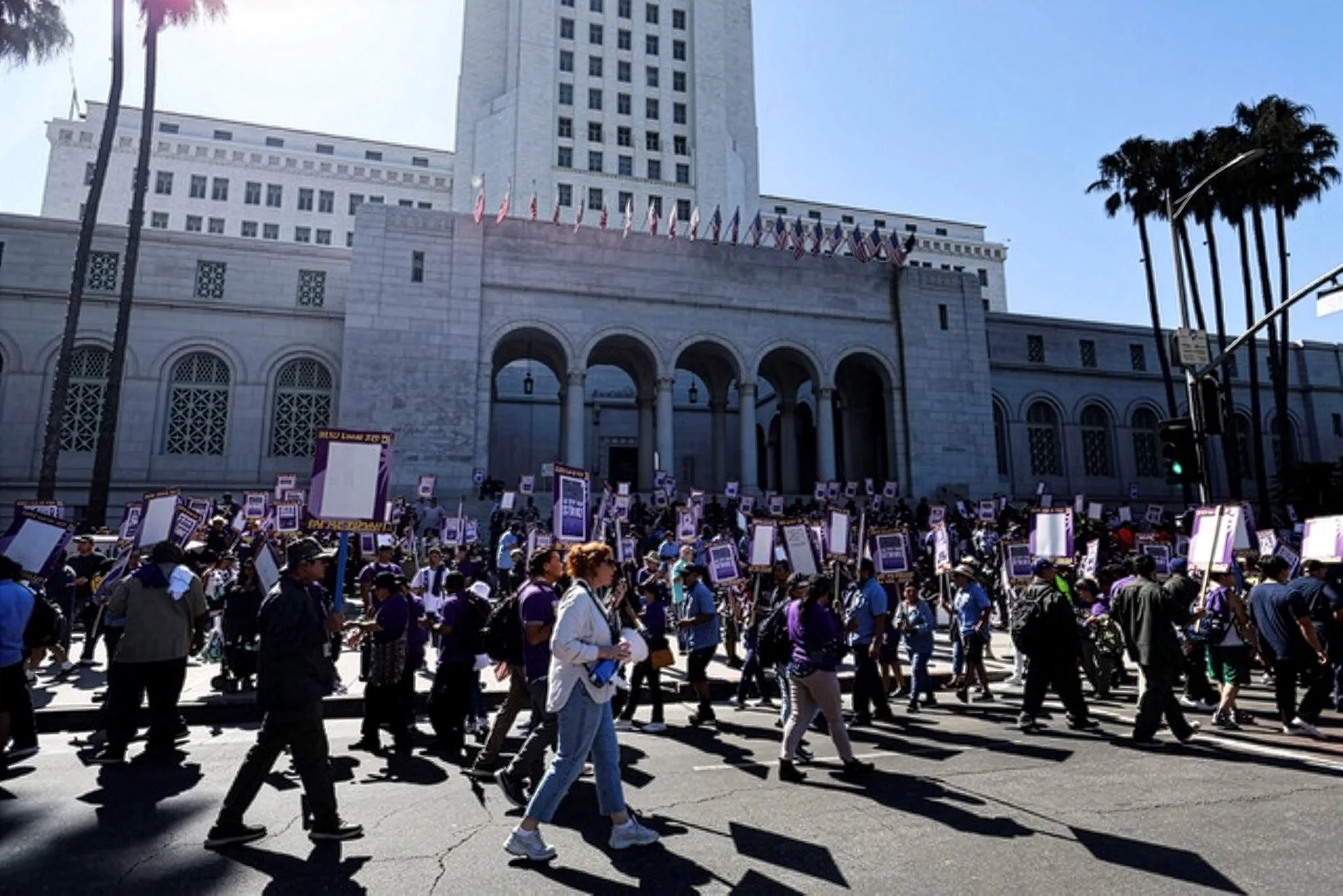
The Fed’s deep historical roots, transformational ties with immigrant communities, and 800,000 represented workers constitute a dominant force in LA politics. Unions with high profiles in the city include the building trades and longshoremen working the ports, healthcare unions like NUHW (whose six-month strike against Kaiser ended in 2025), SEIU’s public sector workforces, including some of the 100,000 SoCal members of SEIU 721, and UNITE HERE Local 11. UTLA, among other unions in public and higher education, remains a powerful progressive force within the Fed. Meanwhile Hollywood labor has been stretched thin by years of receding industry tides, with the disruption of Covid and 2023’s prolonged strikes giving way to sectoral contraction, erosion by AI, and a corrupt federal administration eager to extort favors for mega-merger approval, driving further monopoly consolidation among media companies.
Next time, we consider how DSA-LA’s endorsements have evolved in response to these factors.