Why we need to use the “F” word
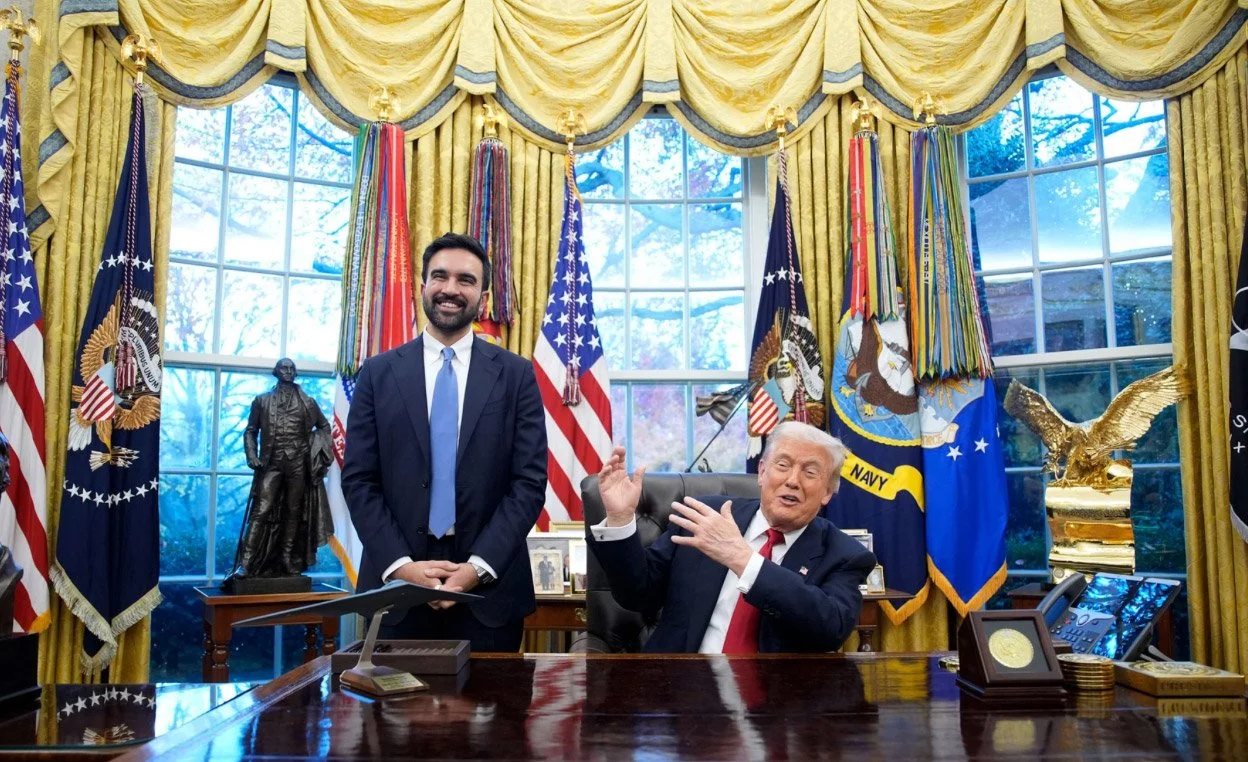
Beneath the surface of the lovefest, reassurance to Trump’s fascist base.
There’s no good reason to believe Donald Trump, a serial liar of the first magnitude, any time he opens his mouth. His propensity to evade the truth, fudge, misdirect and outright lie is well documented. Yet a recent moment in the bright light of national media exposure may be an exception to that rule.
I’m referring to the fascinating press event shortly after Zohran Mamdani was elected Mayor of New York and he and Trump chatted in the Oval Office in front of reporters. As reported by the New York Times, a troublemaking Fox News reporter attempted a gotcha, asking if Mamdani still thought that Trump was a fascist.
“That’s OK, you could just say, ‘Yes,’” Mr. Trump said, looking highly amused by the whole thing. He waved his hand, as if being called the worst term in the political dictionary was no big deal.
“OK, all right,” Mr. Mamdani said with a smile.
“It’s easier,” Mr. Trump said. “It’s easier than explaining it.” Chuckling good-naturedly, he reached up and gave Mr. Mamdani a pat on the arm. “I don’t mind,” he added.
Of course, just because Trump agreed with that description of his politics doesn’t necessarily mean anything. He says one thing one day and contradicts it the next all the time. But one interpretation of this oddball encounter—and many have been offered—is that Trump took the opportunity to reassure the hard core of his movement base that he was still exactly who they thought he was. He may have framed the event as one old time powerbroker New Yorker talking with the new one, but don’t you worry: beneath the smiles and arm-patting ‘I’m still the old blood and soil’.
Why might Trump feel he needed to do this? Perhaps because after his pardon of the January 6 conspirators in his first day of his second presidency he has paid relatively little attention to the movement that voted him back into office. And why would he? He has been too busy—expanding executive and federal overreach, bombing boats and countries, lying about ICE murders and conspiring with fellow billionaire oligarchs to loot government—to bother with the rabble, some of whom however may finally be growing restive over their lack of tangible benefits, stonewalling on the Epstein files and now, horrors, a democratic socialist elected in New York.
It’s monstrous
Last spring I wrote a response in Jacobin to an article that made a case against calling what’s happening in the United States “fascism”. The author and I did agree that whatever we call it—authoritarianism, oligarchy, despotism, plutocracy etc.—it’s monstrous, needs to be fought and defeated, and the conditions in the country that brought it into being must be transformed.
But drawing on the thinking and definition developed by Robert Paxton in his Anatomy of Fascism, I was and remain convinced that we are at the very least well along the path of ‘fascisization’ (the somewhat ugly neologism coined by Richard Seymour in his thoughtful Disaster Nationalism) if not fully arrived at the end of that treacherous road. I’m advocating here that it’s important for all of us involved in the resistance to be talking about it in this precise way.
I’ve laid out the main arguments elsewhere. Here’s another consideration, relating to popular perception rather than categorical discussion. So far the majority of the population has not been suffering beneath some iron heel, which in the cultural imagination is what fascism is about: the universal knock on the door at midnight; neighbors spying on neighbors and reporting them to the authorities, etc. People do see armed thugs in masks taking people away in unmarked cars to undisclosed locations—and more recently executing them—but that’s on the news. It’s not them it’s happening to.
One way of viewing this: the fact that the majority of us is not in the manacles of ICE, or among the quarter million or so federal employees who no longer have jobs, or amid the millions of poorest Americans dependent on the social services that federal workers once provided, simply means there hasn’t yet been time enough in twelve months to extend these abuses to more people. They keep coming. An alternative perspective: in countries that have gone full on fascist the worst impacts weren’t felt directly by the majority of the population—at least not until the warmongering part led to disastrous defeat. And with an imperialist war machine boasting a budget dwarfing all other countries’, that may never happen in our particular fascism variant.
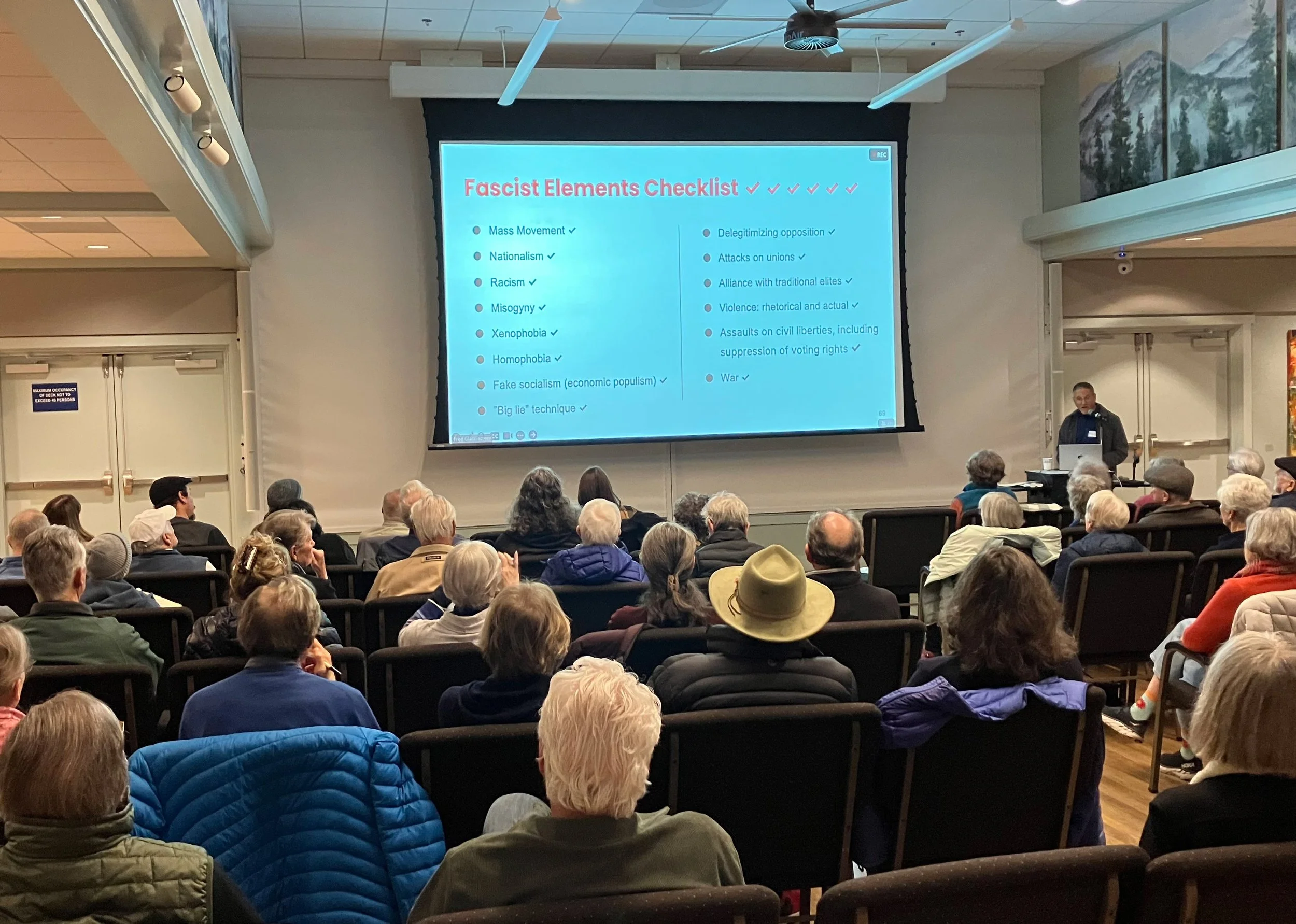
“American Fascism: What it is, what to do about it” presentation to the Oakmont Democratic Alliance earlier this month. Marty Bennett photo.
The essential question
But let’s set aside quibbles over definition and go with a more practical approach. The essential question remains: “Is labeling the assault on American democracy ‘fascism’ helpful or not in fighting it?” I believe that if I’m talking with someone scared of what’s happening and looking for action to prevent things from getting worse, using the “F” word provides a common — and accurate — understanding of what we’re up against and basis for next steps.
I admit I haven’t seen any studies or opinion research in the last year that can quantify my assertion that calling it ‘fascism’ is persuasive to people not yet ready to jump into the streets. It would be helpful if a pollster were to ask, “Is this fascism?” and see how the demographics broke down in the responses. I have been relying on my gut instinct, the many conversations I have had with people, and informal scans across the media landscape as the population has attempted to metabolize events since Trump was elected for the second time. But recently I have gathered some new data.
As a result of writing several articles on the topic I was asked to make a public presentation for DSA-LA in September. Seventy members turned out. We had a good discussion after my remarks and several comrades told me they were going to get more active than they had been.
Since then I’ve delivered this slide/lecture five times, sponsored by DSA, Working Families Party and other political- and labor-adjacent organizations. The crowds have been averaging close to one hundred people, and they are still there wanting to talk more after the advertised closing time. I provide them with some modest amounts of usable analysis, history, and scary empirical detail, and leave them with some hope—drawn from movement history and present-day resistance activities—about how we might prevail.
Takeaway: You can do this too
I’m not famous. I’m retired, my last book came out ten years ago, I’m distributing my most recent video myself, and I am not so delusional as to think that it’s my name that has been bringing in the crowds. Rather, it’s the title of the talk (along with some good publicity by the sponsoring groups): “American Fascism: What it is, what to do about it.” (The one last week in Sonoma was recorded. Here it is.)
The people coming out clearly have a direct interest in the topic, but that’s the point: if you build it, they will come. At each of the presentations we make sure that various co-sponsoring organizations have tables and are given space to make brief presentations about the work they are doing (ICE defense, electoral efforts, affinity group formation, anti-war organizing, etc.) and a way to sign folks up.
The takeaway: you can do this too. Get a couple organizations together and have them sponsor a similar event. The lurid details and steady drip drip drip of information—this innocent person killed by ICE, that new war front being opened up by Trump for oil, this professor told they cannot teach Plato because he promotes “gender ideology” (to take just three items from today’s news)—can drown out the central reality that we should all be directly confronting every day. We need action, we need numbers, we need to stitch groups into coalitions, and we need these things now.
While differences around the definition of our problem might still trouble some of us, the proof is in the pudding: use of the term “fascism” gets attention and provides a platform for discussion, education and organizing. That’s useful. And besides—it is fascism.
[An earlier version of this article was published in The Jumping Off Place]
