
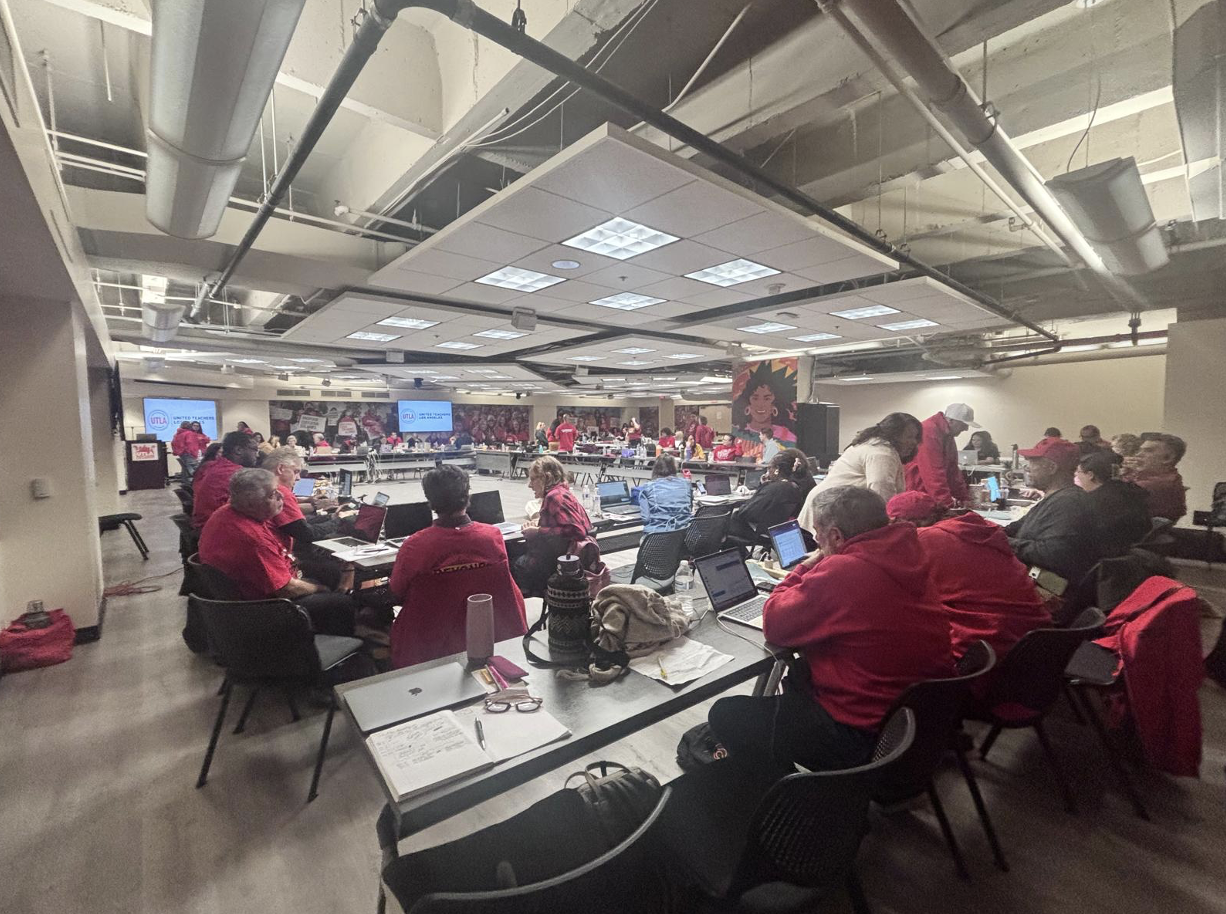
UTLA bargaining team members on 4/12/2026.
It’s become tradition in Los Angeles that when teachers strike, it rains. At 3 am on April 12th, 2026, the 150-member bargaining team of United Teachers Los Angeles (UTLA) was still negotiating with Los Angeles Unified School District (LAUSD), with only two days before the planned strike of 37,000 teachers in the second largest school district in the nation. They would be joined by Service Employees International Union (SEIU) Local 99, which represents custodians, bus drivers, and maintenance staff; Associated Administrators of Los Angeles (AALA), which represents middle management such as principals; and DSA-LA in solidarity. The three unions striking together would be more than 70,000 workers.
It is the 26th bargaining session for the 2025-2027 UTLA contract, and it is pitch-black outside in Los Angeles’ Koreatown neighborhood, with thousands awaiting news of whether their daily lives will be upended in just two days. The walkout would have been the union’s third strike in seven years, following a six-day strike in 2019 and a three-day solidarity strike with SEIU Local 99 in 2023. Before those two strikes, UTLA had not struck since 1989.
Just before 4 am on April 12th, the UTLA bargaining team came to a tentative agreement (TA) with the district administration after more than 14 months of negotiations. Later that day AALA followed suit with its own TA, and at 2 am on April 14th, just six hours before the planned three union strike, SEIU Local 99 reached its own TA with the district. By maintaining a credible strike threat, UTLA won a historic contract that fixed broken salary scales for the first time in decades; secured an average salary increase of 13.86%, with a minimum increase of 8%; established paid parental leave for the first time; protected workers against subcontracting; preserved Black Student Achievement Plan (BSAP) funding; and won breakthrough Special Education agreements, among many other gains—all without actually striking.
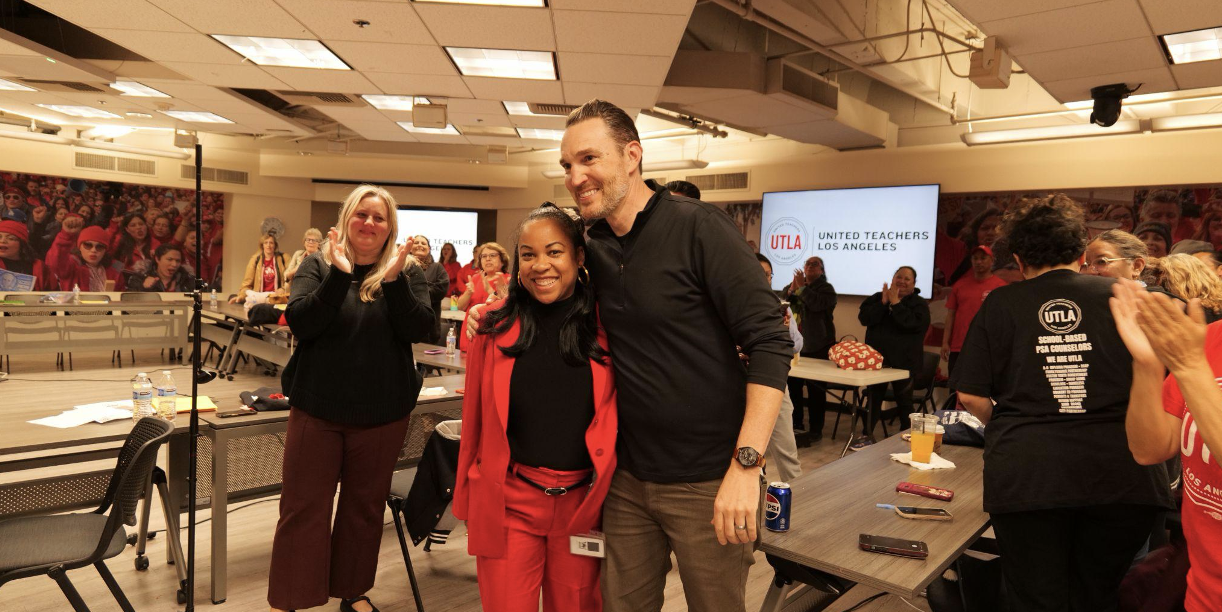
Moments after TA is reached on 4/12/2026, Meredith Schafer, UTLA Research Director (left), Cheryl Coney, UTLA Executive Director (center left), and Brian McNamara, UTLA Organizing and Representation Director (center).
“We averted a strike. We shot down the district's arguments with figures that backed up what we've been saying all along,” says Gloria Martinez, now UTLA president. (She was UTLA treasurer and a lead officer for the UTLA bargaining team during the 2025-2026 contract negotiations. She was also a DSA member and plans on rejoining, she says; she’s just been busy.)
What Martinez is speaking of is LAUSD’s narrative of austerity, used during every cycle of contract negotiations for years. Regardless of how good or bad the economics of the district are at the time, such as having over $5 billion dollars in unrestricted reserves as a “rainy day fund” at the end of the 2024-25 fiscal year equaling 35% of total spending, the CFOs of the district sow fear and doubt. They mainly do this through economic projections that in one year, two years, three years, the district will fall off a fiscal cliff, and so they claim their hands are tied. To be fiscally responsible, the district cannot spend another dollar more, if their economic projections are to be believed.
“When you have a multibillion-dollar organization like LAUSD who can invest in PR machines that use budget figures to scare off folks into believing they can't afford what workers are demanding, I think that it creates confusion and hesitancy and allows for that fear and uncertainty to creep in,” adds Martinez.
The figures UTLA mustered to combat the administration’s scarcity and austerity arguments came chiefly from the UTLA research team, UTLA staff members who were with the UTLA bargaining team during the contract negotiations. LAUSD administration argued it could not spend a dollar more because when it looks toward the future, it expects that it will not have enough money to afford what the union is demanding. The UTLA research team investigated how accurate LAUSD’s past financial predictions were. California school districts are required to do a three-year projection of their budget, and when you consider LAUSD’s projections for where they would be three years out, every year from the 2013-2014 school year through 2024-2025, a pattern emerges. Historically, on average, the difference between what the district projects and what they end up with one year later is off by 57 percent. Two years out they are off by 268 percent and three years out they are off by 888 percent.
This would be similar to a friend asking to borrow $2,000 from you because, they say, they are $2,000 in debt, only for you to later discover that they actually had $16,000 in the bank. They keep saying this to you every year. For 10 years. Understanding this track record deflated much of the fear and doubt the UTLA bargaining team first experienced when the district’s negotiation team began presenting how badly their finances would deteriorate over the next three years if it agreed to the union’s proposals.
Though the UTLA research team is essential for countering the administration’s claims of scarcity, it was not the only reason for UTLA’s victories.
“The main reason we were able to win without going on strike this time was that we had a credible strike threat. We've become an organizing and strike-ready union through the efforts of many people who have helped transform UTLA since 2014, including members of the Educators Organizing for Power (EOP) caucus and DSA members,” says Ryan Andrews, a UTLA bargaining team member, EOP member, and DSA member. “We talk with every member of the union, understand the issues they care most deeply about, and involve them in organizing. That's how we built the power to cut through the district's austerity narrative.”
A union which for 30 years before 2014 had become a low-participation organization is now a union which is known for winning its contract through being strike-ready, even without actually going on strike. This change began in 2014 when Alex Caputo-Pearl, a DSA member, and the Union Power caucus slate running with him were elected to leadership in UTLA. The new leadership’s years spent rank-and-file caucus organizing with Chicago’s Caucus of Rank-and-File Educators germinated a change in UTLA. Five years later in 2019, under Caputo-Pearl, UTLA would go on strike alone for 6 days in the rain and win pay increases, first-ever enforceable class size caps, more nurses and librarians, an LAUSD call for a moratorium on charter schools, a first-ever Community Schools initiative, and racial justice victories, among other gains.
Four years later in 2023, this change in the union proved durable as the next UTLA president, Cecily Myart-Cruz, led UTLA to strike in solidarity with SEIU Local 99 while UTLA was in its own negotiations with LAUSD. After striking for three days again in the rain, UTLA and SEIU Local 99 won their contracts, with UTLA winning significant pay raises, further lowering of class sizes, enshrining the Black Student Achievement Plan (BSAP), and an expansion of Community Schools initiatives into the UTLA contract, among other victories.
Three years later, UTLA has won again, and though there was no strike for teachers to march through a downpour, I and others in the bargaining team at 1 am got caught in the rain just hours before the TA, keeping the tradition alive and well.
“What we can learn from this contract is listening to what is felt throughout the city, the issues that impact the workers and our community,” Martinez says when I ask what lessons the union should carry into 2028, when UTLA and many other unions across the country will again negotiate contracts. “We have a system that is failing them. Standing up for the issues that are deeply felt allows us to consolidate that collective power, it allows us to change the narrative.”
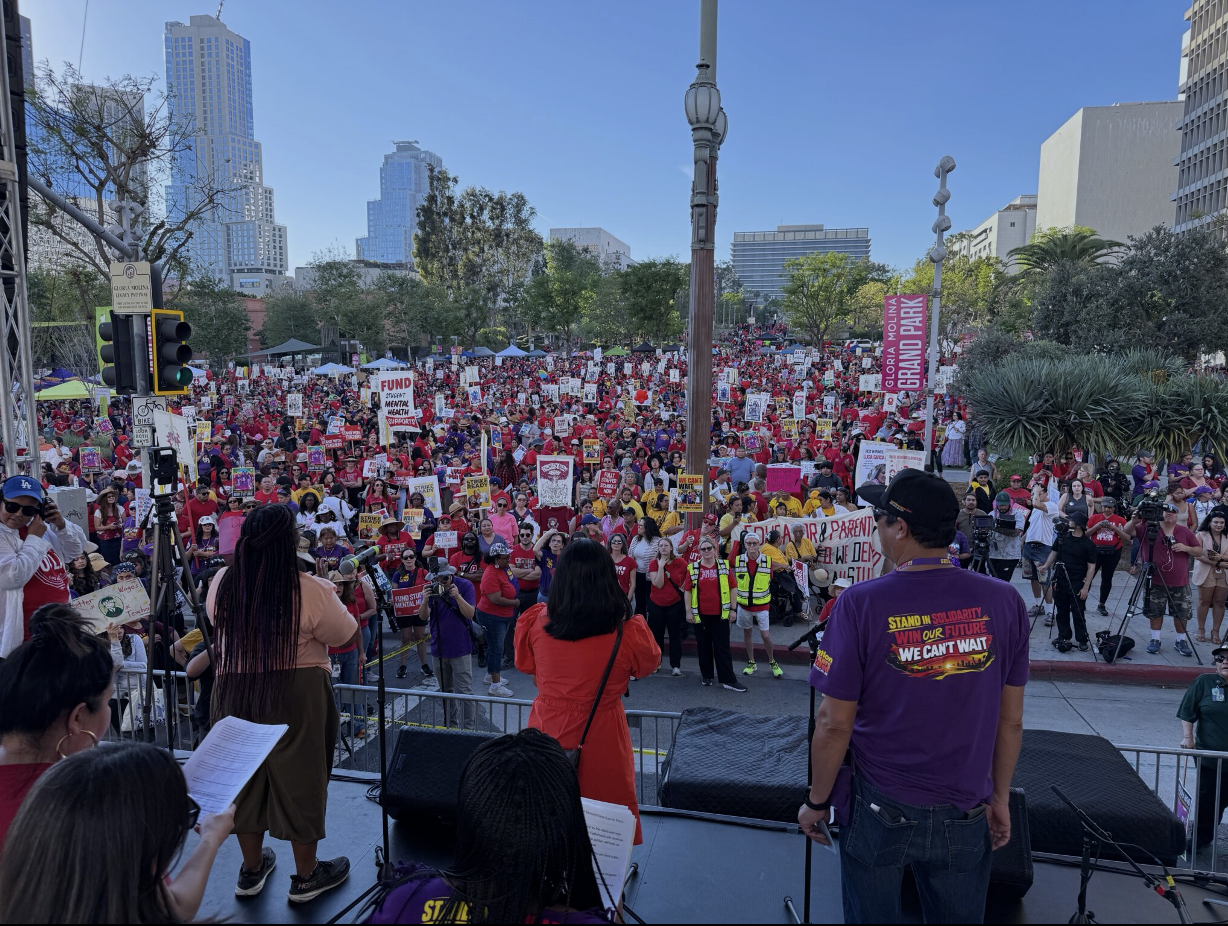
Over 30,000 for UTLA, SEIU Local 99, and AALA 3/28/2026 at Grand Park.