
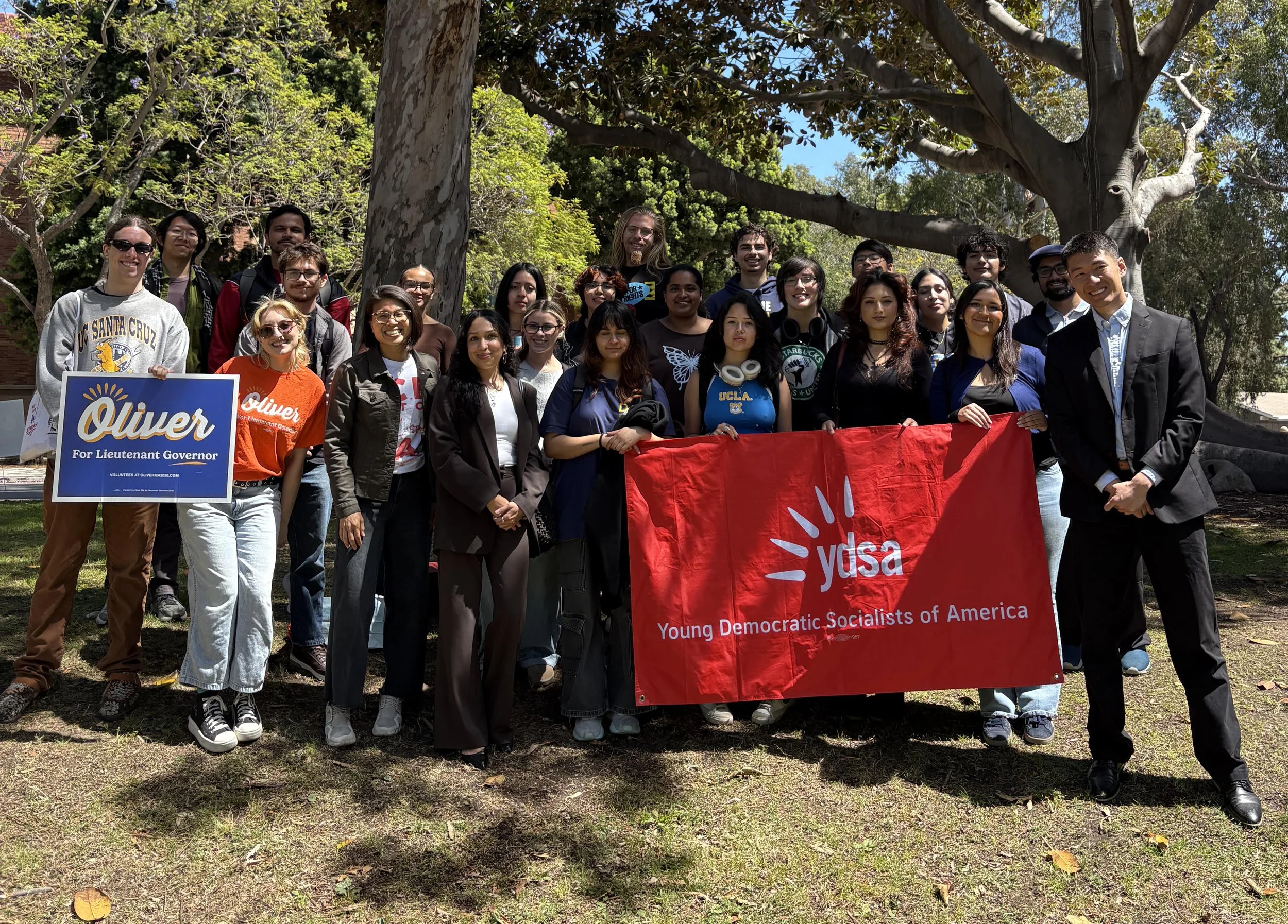
Canvassing in Irvine.
Brief overview
A candidate no one had heard of entered a statewide race no one really knew about and ended up with more than half a million votes. Oliver Ma’s campaign for Lieutenant Governor was California DSA’s first statewide candidate race and will not be the last.
Across the board, people were excited about Oliver and about his platform, too [see accompanying article with chapter campaign reports]. Affordable housing, free healthcare, abolishing ICE, ending the genocide in Palestine—a platform familiar to us as socialists, but one that many voters are just now warming up to.
This race was a familiar story: we were up against long-serving politicians and candidates with deep pockets; we needed a mass movement of organized people to challenge that.
With the support of DSA members, DSA chapters, and committed volunteers, this campaign showed that California voters, more than 620,000 of them, are supportive of Democratic Socialism and are ready for change.
Lessons Learned

Oliver’s campaign was heavy on social media.
Going viral on social media is not enough to win elections, but it can be an extremely valuable tool when used intentionally.
You may have seen Oliver on TikTok, Instagram, or even on one of your favorite streams talking boldly about Democratic Socialism and the importance of building a government that works for people, not corporations. Nearly every single volunteer I met or leader I trained certainly told me they had seen him online. And, of those people, many told me this was their very first time engaging politically. These volunteers helped us reach out to hundreds of thousands of voters across the state and they might not have ever even known about this race if it wasn’t for social media.
Motivating someone to turn out and vote, especially if they do not usually vote or if they feel abandoned by the current government, is often a more challenging task. It requires more than just seeing a few cool videos on the feed, so you can’t count only on social media if you want to build power (and win). Ultimately it was the conversations we had with voters in their communities, and on their phones, about the issues that matter most to them. Of course, those conversations are much easier if they have seen your candidate on social media before, but that alone is not enou

Crowd canvassing at No Kings in downtown Los Angeles.
The things we are fighting for as socialists are broadly popular, even if the term “socialism” is not. We talked to voters all across the state in all different communities, but we so often heard the same issues coming up. Housing costs are rising. Healthcare is unaffordable. Everything is unaffordable. People should be safe in their neighborhoods, at home and abroad. What we have going now really isn’t working for working people.
This gave us the chance to talk about how corporations and billionaires are often at the root of all these issues—and then about how Oliver was going to use the powers of this office to improve conditions for working people and tackle the issues impacting their daily life.
As socialists, we can diagnose that capitalism is broadly at the crux of nearly every problem, but it’s not always easy to have that conversation.

The author with Oliver at an “ICE Out” protest and march in L.A.
Running candidates who are Democratic Socialists allows us to talk about these broadly popular ideas. Then electing those candidates to positions of leadership, and power, can fundamentally change the lives of the working people in the communities they serve.
Mayor Zohran Mamdani’s New York is proof that it is possible, and those wins on the east coast have reverberated across the country.
When voters saw “DEMOCRATIC SOCIALIST”at the top of Oliver’s literature they often asked us, “Like Zohran?”. This easily opened the door for us to have a conversation about DSA and socialism that might have been more challenging or less explicit otherwise. If voters didn’t know Zohran, or even if they were not sure about the whole DSA thing, we were still able to have those important conversations with them about their struggles and our common enemies.
We might not have ever had these conversations with our community members if we did not show up in their neighborhood to knock on their door and talk about this election and this candidate.
The time to prepare for the next election cycle is now
Building and refining chapter infrastructure and process takes time, but time is always of the essence during an election year. Start having conversations now about your chapter’s endorsement timeline, process, and electoral program. Consider what it would take not only to endorse a candidate, but also to win. Does your chapter have tools you need? Do your members have the skills they need? If not, what can you do now to be prepared for the next electoral cycle?
Socialism continues to gain momentum. We have the opportunity to build power for working people at the local and federal level; but it will take an organized mass movement to win.