
East Bay Starting to Move Toward May Day
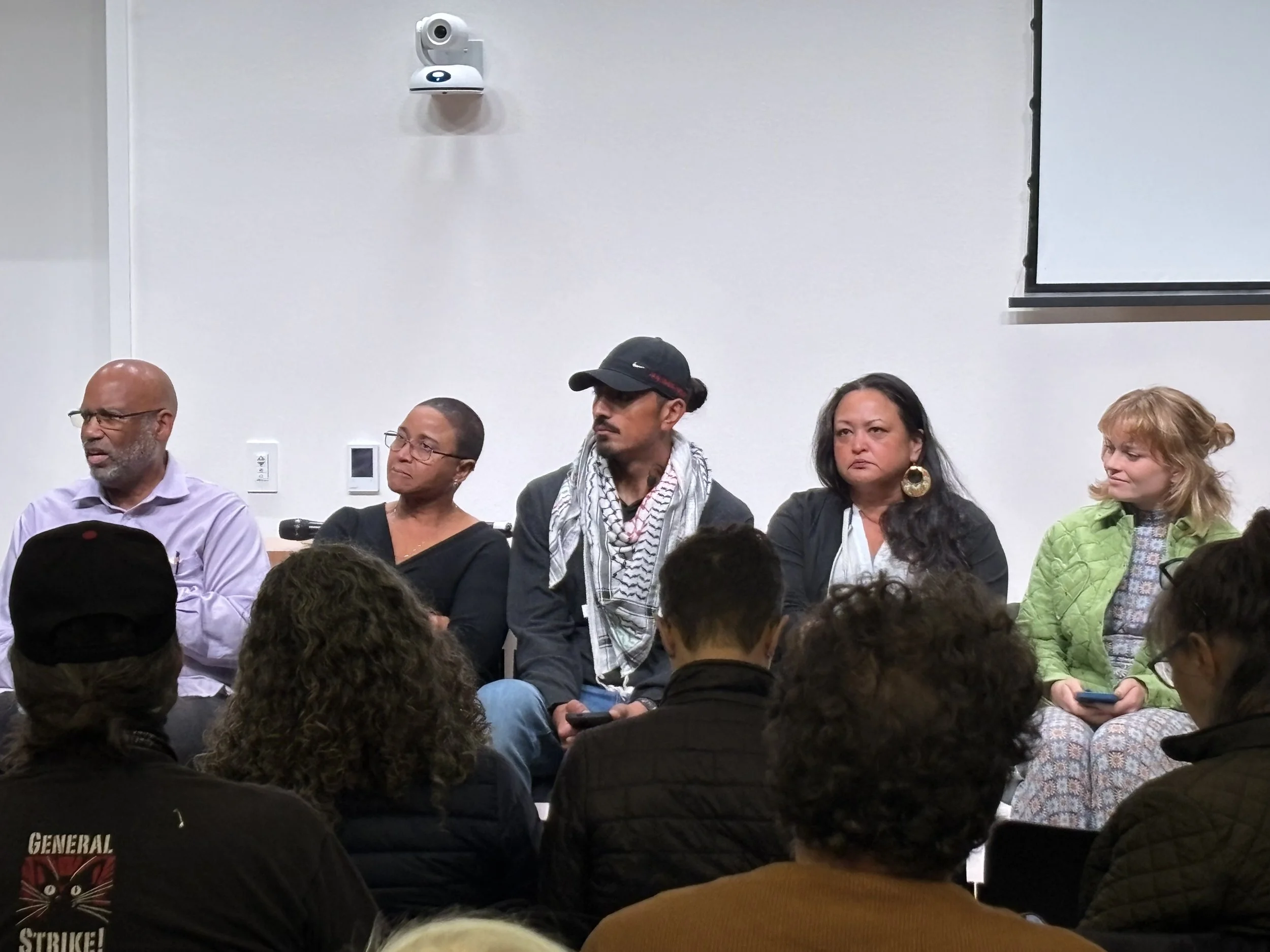
The panel of labor and community leaders, from left to right: Steven Pitts, moderator; Theresa Rutherford, SEIU 1021; Francisco Ortiz, United Teachers of Richmond; Grace Martinez, ACCE; and MT Snyder, FUN.
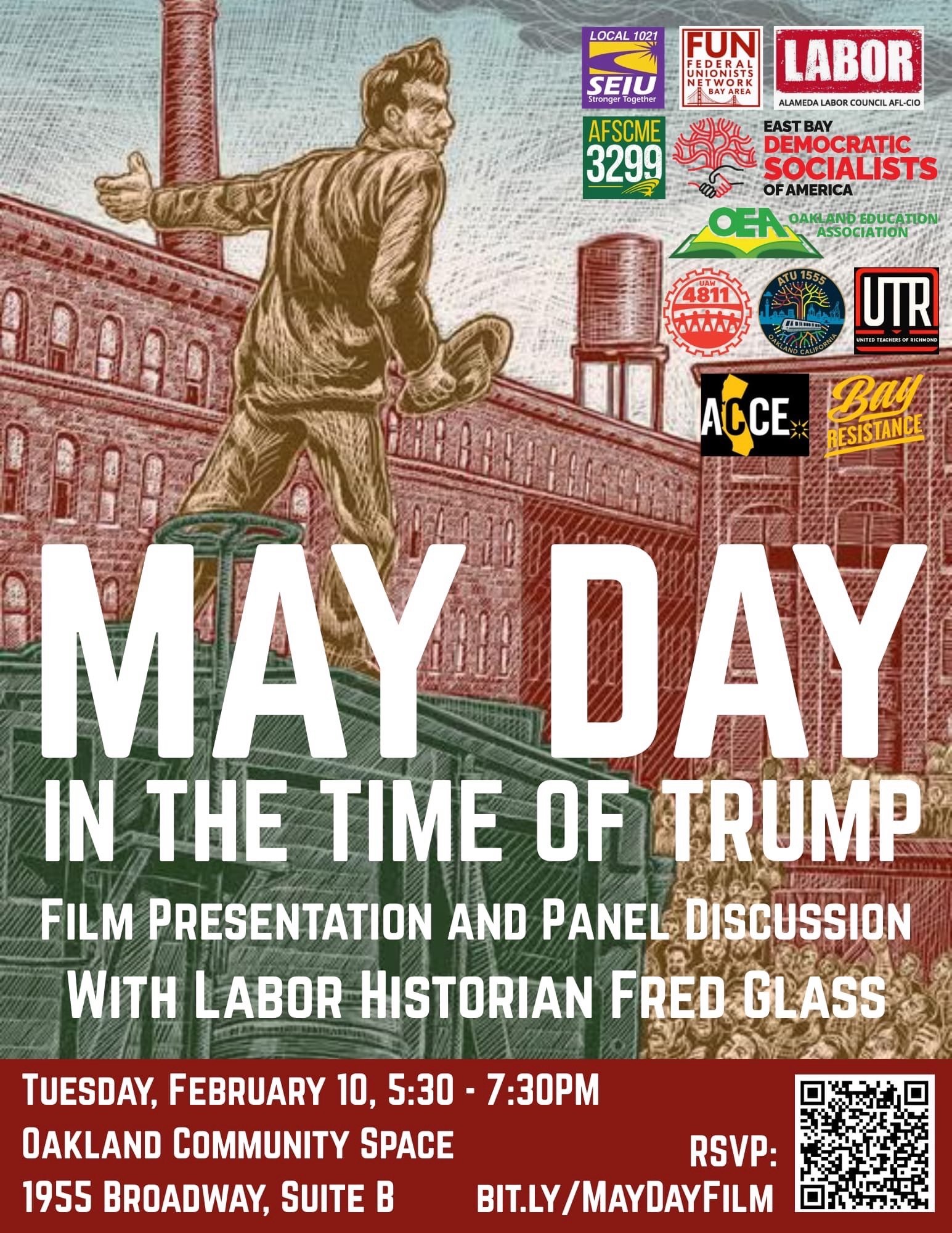
It was a dark and stormy night. Which caused some anxiety among the half dozen or so East Bay DSA organizers on Tuesday evening, February 10. They were concerned that their work over the previous couple months to build the “May Day in the Time of Trump” event might be dampened by a reduced turnout.
They needn’t have worried. Perhaps it was the promise in the publicity of “light supper will be served” that offset the threat of rain. But more likely the motivation for the 130 or so people who showed up came from anticipation they would receive some clear information about the state of the movement against Trump and MAGA in the East Bay, and what they might expect in the near future. In that they were not disappointed.
Push the conversation forward
According to the organizers, their goal was to help push the conversation among unions and progressive community organizations a step or two forward toward large May Day demonstrations in the Bay Area this year. They also hoped that the coalition of organizations co-hosting the event (Alameda Labor Council, SEIU 1021, ACCE, Bay Resistance, the Federal Unionists Network and several union locals) would reach out to their members and bring a diverse mix of folks to the meeting. Beyond that, they wanted the evening to help spread understanding that a previously missing factor in the growing movement against American fascism had dramatically appeared on January 23 in Minneapolis: revival of the general strike as an available tactic in the contemporary class struggle.
Alameda Labor Council leader Keith Brown opened the program with greetings to the audience and remarks on the inspiration provided by the people of Minnesota in their life and death struggle with ICE kidnappings and murders. He then introduced labor historian and filmmaker Fred Glass, who provided background on some of the key features of May Day history, including its long association with immigrant rights, red scares, general strikes, and the struggle for the eight-hour workday.
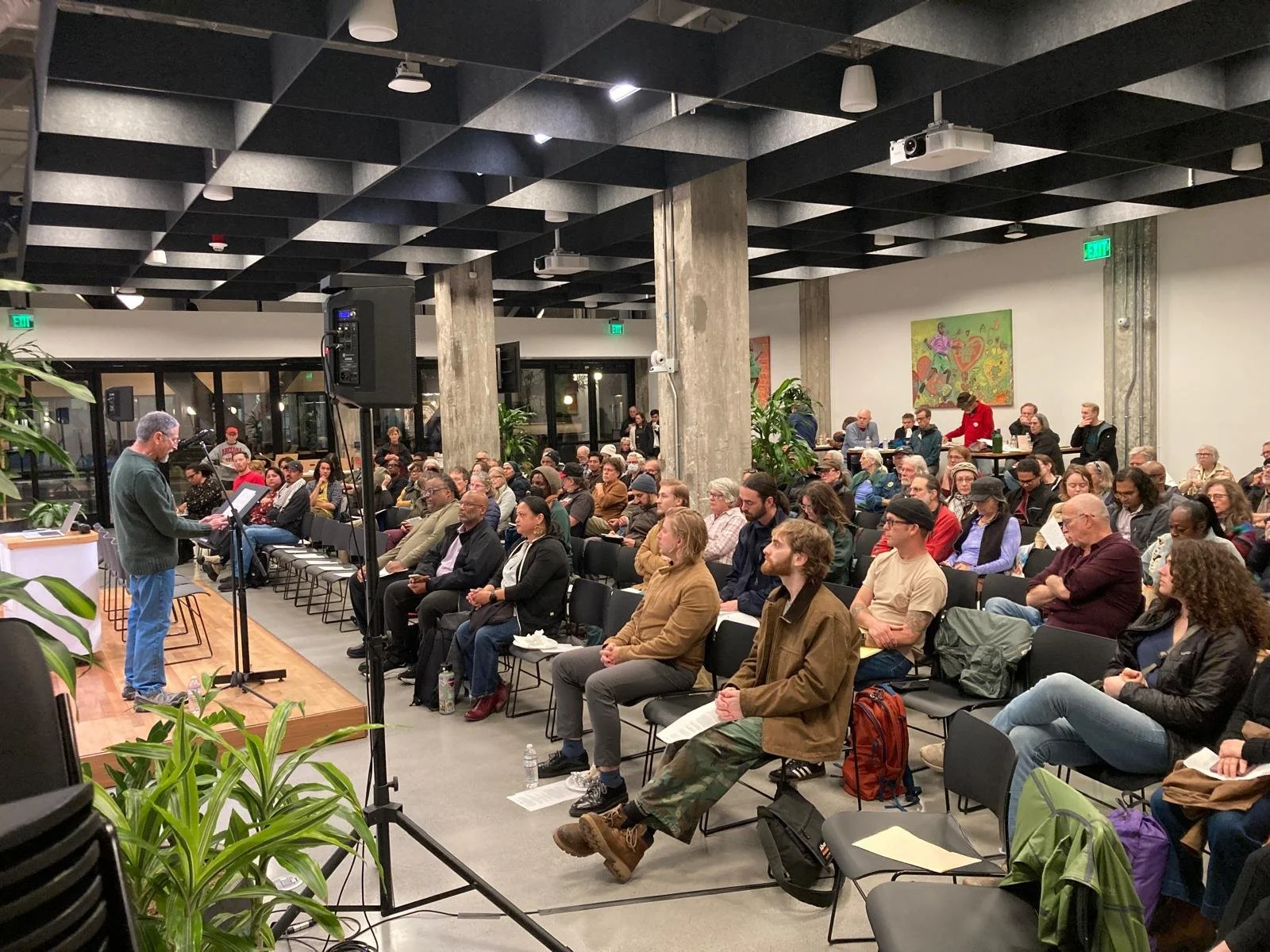
A crowd of 130 came out in the rain in downtown Oakland to hear about progress toward making May Day 2026 a memorable one and a stepping stone to May Day 2028.
After screening his 30-minute documentary, We Mean to Make Things Over: A History of May Day, Glass took a few questions from the crowd before turning things over to a panel of labor and community leaders. These included Theresa Rutherford, president of SEIU 1021; Francisco Ortiz, president of United Teachers of Richmond; Grace Martinez, Associate Director of the Alliance of Californians for Community Empowerment (ACCE); and MT Snyder, a Bay Area leader of the Federal Unionists Network (FUN). Retired UC Berkeley Labor Center associate chair Steven Pitts moderated, deftly putting the panel through its paces.
Pitts had his panelists address three questions: What did they think about the current state of preparedness of the East Bay community in building a movement to fight fascism, oligarchy and the billionaires and—most immediately—taking on ICE, should it arrive Minneapolis-style in force on our turf? What was their organization doing to prepare for mass action by May Day 2028? And how did they view the possibility of this year’s May Day as a steppingstone toward 2028?
Rutherford described the many fronts on which her local—largest in the Bay Area—operated. She underscored the challenges in coordinating the sprawling jurisdictions of the union, and pledged to work together to build the unity necessary for successfully pushing back against Trumpian fascism.
Ortiz recounted the patient steps taken by his union over the past few years as it built to running a successful four-day strike late last year, which resulted in an 8% salary increase, smaller class sizes, and protections for teachers on H-1B visas, among other negotiations issues. The West Contra Costa School District administration hadn’t agreed to any of these proposals before the strike. Ortiz noted the union’s consultation with parents prior to and during bargaining to ensure community support, and emphasized that the bargaining and strike occurred along the lines of a “bargaining for the common good” approach. Which, as in the Twin Cities, is an important part of building connections to do things like thwart ICE incursions.
Martinez spoke on behalf of ACCE and Bay Resistance, on whose board she represents ACCE. She recalled the organizing that went into the People Over Billionaires march in Pacific Heights in November, and told the audience about the community mutual aid efforts tracking ICE and building neighborhood relationships in which her groups were involved. She observed that in these coalitions labor, the partner with the most resources, didn’t always listen as well to the other partners as they might, and expressed the hope that that would change as we move forward.
Waking up
MT Snyder said that federal workers unions have been more or less asleep for decades, and the destruction raining down on government services and jobs in Trump’s second term has been a wakeup call. She reviewed the formation of FUN and noted the central role played by the rank and file in reaching across the unions’ boundaries to assert the need for common defense and begin to tie them together in action. She urged members of the audience involved in political work to talk and organize with the FUN members employed in federal agencies aligned with that work (e.g., climate justice and the Environmental Protection Agency).
Spirited group discussion, directed by Labor Notes staffer Keith Brower Brown, followed the panel presentations and revealed a wide range of political activities and experience, from a neighborhood Indivisible group formed by older women who had never been involved in politics before to veteran organizers enthusiastic about the rising possibilities for mass action.
According to the sign in sheets, just one fifth of the audience were DSA members, fulfilling the hope of the event organizers that the chapter wouldn’t simply be speaking with itself.
California Red readers interested in learning the history of May Day can view We Mean to Make Things Over. It can be found on the California Federation of Teachers’ website here, available to stream for free.