
Economic Inequality Means Income and Wealth: Why We Endorsed Both “Tax the Rich” Ballot Measures for November

Bernie Sanders came to Los Angeles to rally for the Billionaires Tax.
After a special zoom meeting on February 1 to hear arguments pro and con, California DSA State Council delegates voted unanimously to support “The Fair and Responsible Tax Plan for California’s Wealthy”. This statewide campaign embraces two ballot measure efforts: the Education and Healthcare Protection Act of 2026, and the Billionaires Tax, both of which are currently circulating petitions for signatures to place the measures on the November ballot. California DSA will now run a combined campaign to tax the state’s wealthy—both on their income and on their wealth, in order to fund schools and services.
Everyone’s heard of the billionaires tax. It’s been all over the mainstream press, mostly in the form of billionaires sobbing that if it passes they will have to leave their beloved California. Bernie Sanders recently came out to Los Angeles to rally on behalf of the measure. The tax would assess the state’s two hundred billionaires 5% of their hoard, er, wealth, and give them five years to pay up.
Below the radar
Mostly flying below the radar so far is the other progressive tax: the Education and Healthcare Protection Act of 2026. This tax already exists, originally as Prop 30 in 2012 and renewed in 2016 as Prop 55. But it’s a temporary tax and expires in 2030. This year’s measure aims to make it permanent.
Which is important. It brings in around $10 billion each year for schools and services – so far well over $100B over the last dozen years. It taxes the top two percent of California income earners—in other words, it doesn’t affect anyone reading this article; and on the slim chance that it does, I’m sure you know you can afford to pay it without any pain ($361K and above for single filers, $721K and up for joint filers).
The two measures do different things. The Billionaires wealth tax is meant to fill the hole of federal Medi-Cal cuts coming our way thanks to the fascist Trump regime’s Big Ugly Bill.
The Education and Healthcare Protection Act income tax supports all services in California. K-12 and community colleges together get 40% of the revenue with the rest split among higher ed, health care, transportation and other social services.
Prop 55 is a pure progressive tax; only the richest two percent of Californians pay it. It needs renewal because if it sunsets in 2030 the public sector will lose tens of thousands of jobs and have to slash services for millions of people, and the richest taxpayers, already way too rich for their own good, will get an unneeded multibillion dollar tax cut.
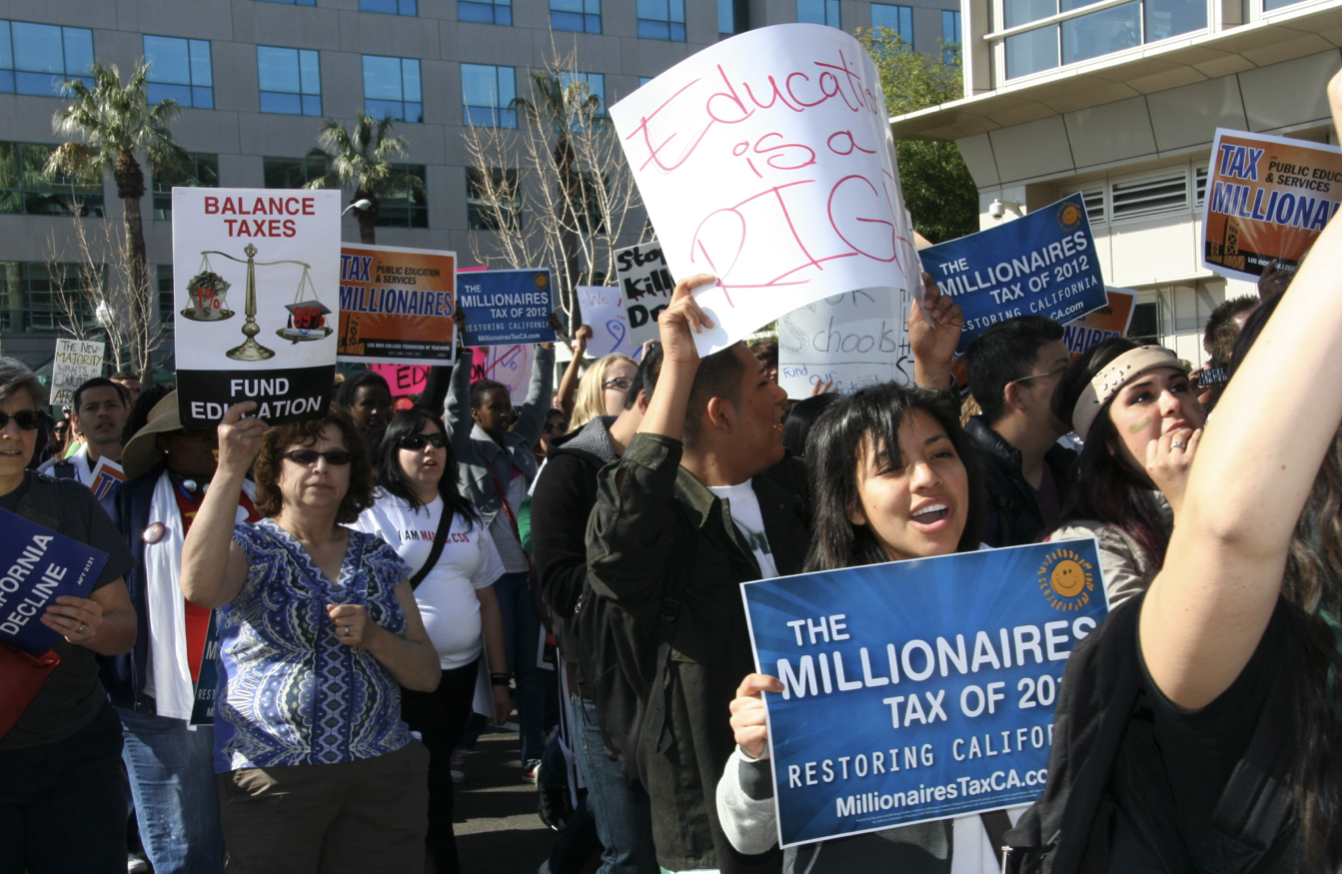
The Millionaires Tax campaign of 2011-2012 was a rowdy grassroots movement that forced Governor Brown to merge his ballot measure with theirs to create Proposition 30.
Historic achievement
Let me pause for a minute to celebrate what a historic achievement it was to pass this in the first place. Prior to 2012 it was common political wisdom in the golden state that a progressive tax couldn’t be passed. Why?
Prop 13, one of the key early signals of neoliberal austerity, got passed in 1978 by a two to one margin and for decades afterward was considered the untouchable so-called “third rail of California politics”. It was sold to voters as a solution, in a time of high inflation and quickly rising property taxes, to the problem of keeping Grandma in her home on her fixed income. It sharply limited residential property tax increases and put a raft of other restrictions on the state’s ability to raise revenue. Prior to Prop 13 California always ranked in the top ten states in per student funding. Post-Prop 13 we were more often in the bottom ten.
The campaign for it was a racist dog whistle, pointing a finger at lazy welfare cheaters—that is poor people of color—who received the hard-earned property tax dollars of virtuous homeowners—that is, middle class white people. Most people voting for it did not understand that its provisions also applied to commercial property; large corporations like Chevron and Disney made out like bandits, essentially stealing billions of dollars every year from schools and services to line the pockets of their shareholders instead.
Largely due to Prop 13, and until 2012, California was therefore understood to be an “anti-tax state”. We* changed all that with Props 30 and 55, which demonstrated that actually, some taxes, e.g., taxing the rich, were quite popular.
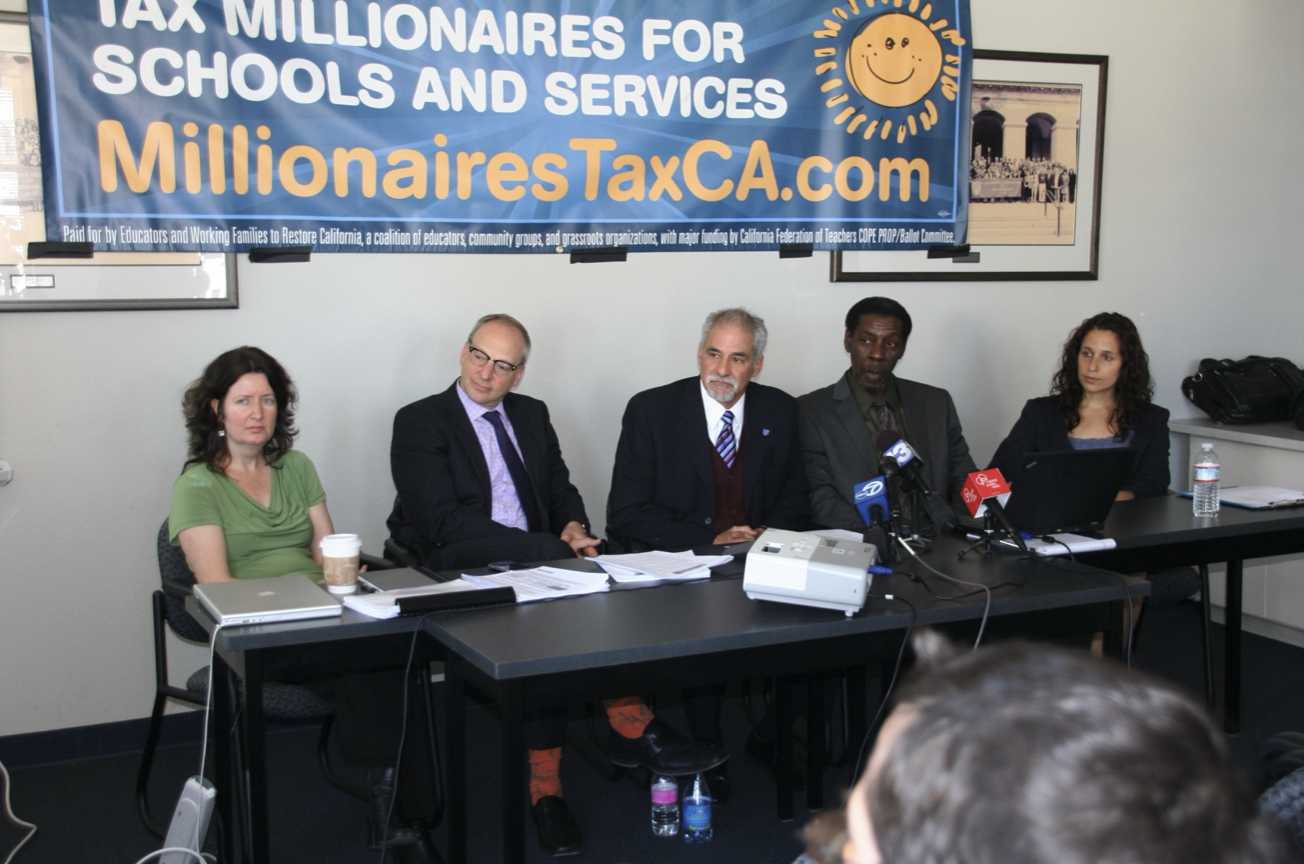
Millionaires Tax campaign leaders, 2012: (from left to right) Amy Schur of ACCE; Rick Jacobs, Courage Campaign; Joshua Pechthalt, CFT; Anthony Thigpenn, California Calls; and pollster.
It is important to mention that we had to overcome the initial opposition of Governor Jerry Brown, who proposed a mix of progressive and regressive taxes to fill the massive state budget hole created by the Great Recession in 2012. The California Federation of Teachers and its Reclaim California’s Future coalition (California Calls, ACCE, and Courage Campaign) asked him to join forces on a straight-ahead millionaires income tax. For months he refused, trashing us in public and peeling the unions in our coalition away by telling them if they didn’t drop us and come over to him, he wouldn’t sign any legislation they supported.
We call this “blackmail”, and it worked for a while; CFT became the only union aboard our campaign. But together with our community coalition partners we built a rowdy grassroots movement in the streets. We had clear, simple and persuasive messaging — “Tax the rich for schools and services” and beat his measure in five straight opinion polls. Our campaign culminated with a march of ten thousand outside his Capitol window, every other marcher holding a “Millionaires Tax” sign. For good measure, just to put a point on it, we occupied the Capitol rotunda for six hours.
So then he sued for peace. Brown came to CFT president Josh Pechthalt’s house to negotiate the deal (and in the process help Pechthalt’s daughter with her math homework). The compromise measure, which became Prop 30, actually raised more money than our Millionaires Tax would have. But the Millionaires Tax was going to be permanent, and Brown insisted on a five-year temporary tax. He wanted to add a one-cent sales tax increase, which we opposed and negotiated down to a one quarter of one cent increase. We also negotiated a shorter four-year term of the sales tax, and a longer seven-year term for the progressive income tax.
With the other unions back in a reunited coalition, Prop 30 sailed to victory against major opposition spending; and with this 2012 win we set up Prop 55 in 2016, when we eliminated the sales tax piece (which only raised an eighth of the revenue), making Prop 55 a pure progressive tax, and extended it to the year 2030.
That’s four years away. Why do it now, you might ask? Now we get into the politics behind these two measures, and why California DSA has a rare opportunity to lead by example in the Golden State’s progressive political realm.
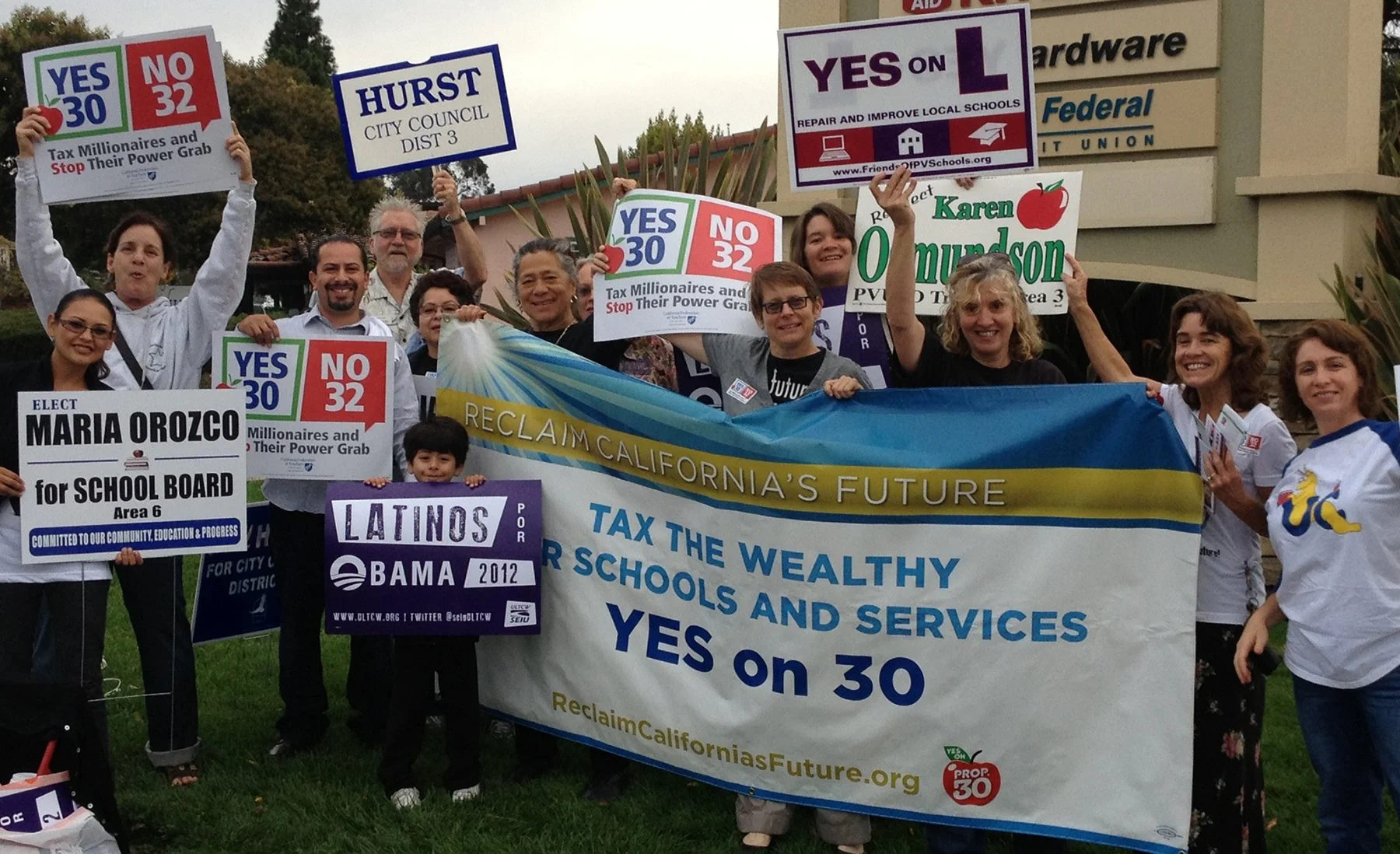
The temporary Proposition 30, passed in 2012, was renewed as Prop 55 in 2016, and needs to be made permanent.
Coalition politics
The Education and Healthcare Act of 2026 is the product of the labor/community progressive tax coalition that emerged from Prop 30. This coalition has gone by different names over the fifteen years of its existence, but involves the same core group behind Props 30 and 55, and a 2020 effort, Prop 15, to raise taxes on big commercial property. Many California DSA members worked on the latter campaign. In the end we lost that one 52-48. Had it not been for the pandemic, which prevented us from running a field campaign, no one doubts we would have won. It would have brought in an estimated additional $10 – 12 billion to state service revenues each year, and reformed an important piece of Prop 13.
UHW, the lead organization of the current Billionaires tax, did not succeed in its consultation with the progressive tax coalition before launching. It is at this point unclear whether the two ballot measure groups will do what is obviously needed, which is coordinate the campaigns so that at the very least they don’t get in each other’s way. And better, combine their efforts and messaging so that voters understand why we need two progressive taxes addressing overlapping but separate issues.
UHW belongs to the SEIU State Council. That’s the largest single-union federation in California. SEIU State Council and the California Teachers Association (CTA) are the two big dogs in union politics in California. When they work together they are a real counterweight to big business. Right now CTA and the California Federation of Teachers (CFT) are backing the effort to make Prop 55 permanent and not backing the billionaires tax.
You would think that since it belongs to the SEIU council, UHW would have secured its endorsement. But SEIU State Council will not make a decision about the billionaires tax until it qualifies for the ballot, which won’t be known until May. Why does UHW lack the support of its own state council? Because, as with the progressive tax coalition, UHW did not have a successful conversation with its council before going ahead with its campaign.
There are now a couple more unions on board the billionaires tax—UNITE HERE Local 11 in LA (which supports both taxes) and California Teamsters Council. Along with California DSA and the Bay Area’s Federal Unionists Network hub, that will help. But this is not a sizeable coalition as of yet. It’s not clear one will emerge—not because the cause isn’t worthy, or because the tax isn’t desperately needed, which it is, but because UHW hasn’t persuaded other organizations to come aboard—especially with the group that knows best how to do this. The UHW potentially upset the applecart of the coalition’s longterm strategy, which was to first make sure that we solidified the Prop 55 revenue stream and then go after an additional progressive tax in 2028.
There are of course no guarantees that either measure is going to pass. Given the animus toward the ultrarich right now, and increasing public awareness of economic inequality and the connections between billionaires and fascism at the federal level, both measures should make it. But the insane current wealth of the billionaire class means they could dump five hundred million dollars against the two measures to forestall paying future taxes totaling much more than that. They have already been putting together tens of millions in opposition spending. If the two campaigns are not united in message and tactics billionaire opposition could prove deadly.
California DSA can lead by example
It doesn’t have to be that way. California DSA has a great opportunity here to lead by example. If we create a good set of messages that work for both campaigns and collect signatures and canvass and create earned media for both, we can show the two groups the importance of a united campaign. We should be under no illusion that we can directly influence the campaign decision-making tables where the price of a seat is a lot higher than we democratic socialists can afford. But by cooperating with both groups and showing that we can bridge the siloes in the labor movement, we can simultaneously advance these necessary progressive tax measures and the democratic socialist cause in California.

The Education and Health Care Protection Act proposes to make Prop 55 a permanent tax on the top two percent of California income earners.
How you can help
By now you’re wondering, “What can I do to help?” Glad you asked. There are two things you can do right away.
One: get petitions and collect signatures. We will have a one-stop shop soon for both petitions. But in the interim, you will have to get them from two places. Click here to fill in a form and get sent petitions for the Billionaires Tax. Click here to fill in a form and get sent petition for the Education and Health Care Act.
Never collected signatures before? You’d be surprised how easy it is. Start with your own household; call on your friends and neighbors; circulate among co-workers. If you get ambitious, go out to a mall or set up a table with a student or faculty organization at a college.
Two: Click here to download a template resolution for your DSA chapter to endorse the joint campaign. Follow your local chapter bylaws regarding submission of such resolutions and adjust the template as necessary. Our campaign for the two taxes will be much more powerful as our chapters officially come on board.
As the lopsided economic inequality in California is exacerbated by the Trump administration’s federal funding cuts, the multiracial working class will need these two revenue streams to keep the state—already one of the most expensive places to live in the nation—livable. Time to get to work.
*I was communications director for the CFT at the time.
