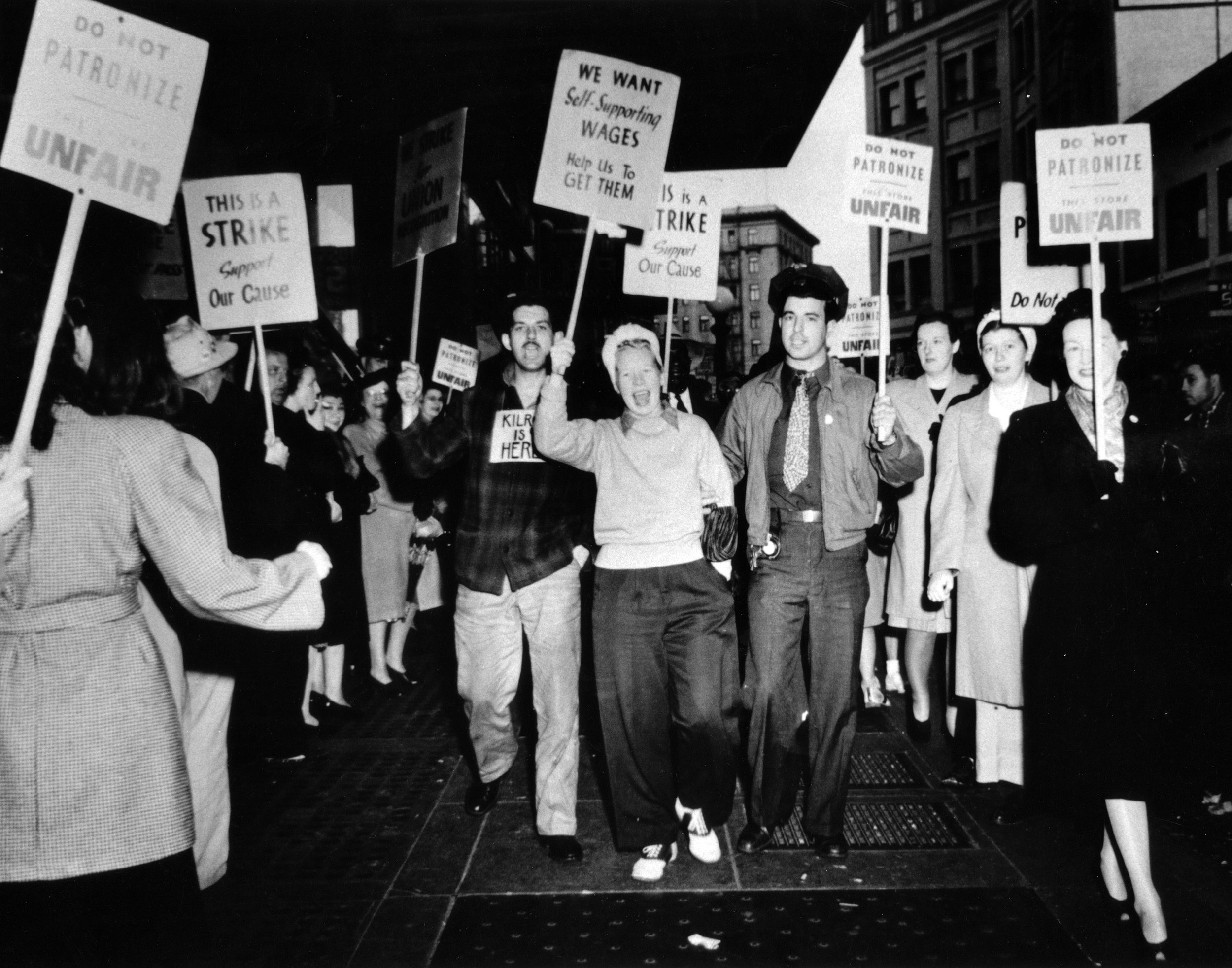
The 1946 Oakland General Strike was the last city-wide general strike before Minneapolis-St. Paul’s this year.
For many years I taught labor history at night to working students at City College of San Francisco. Since Bay Area workers and their unions had carried out two consequential general strikes (San Francisco in 1934, and Oakland in 1946), each semester I assigned my pupils an essay question: Is it possible—or even desirable—for our region’s workers, if faced with oppressive circumstances, to replicate those feats today?
My students’ essays appeared along a range of responses between two poles. On one end, no, not possible, even if desirable, due to changed conditions like suburban distances between home and workplace, along with the decline of union density. On the other, yes, both desirable and possible, because new communications technologies allow ideas and organizing to spread rapidly online, and labor’s steep decline means that workers are angry enough to make it happen. Few students in either camp thought it would be an easy lift, reflecting a general sense of limited horizons for labor-led progressive change in the late twentieth and early twenty first centuries.
The 1946 Oakland General Strike was the very last one American workers had managed to put together, literally a lifetime ago. But metaphorically, post-January 23, 2026, we might now be onto a new calendar. In the wake of the powerful “No Work, No School, No Shopping” day that erupted in the Twin Cities, alongside a steady drumbeat of growing demonstrations and electoral successes against the Trump regime, there’s wind in the sails for mass action on May Day 2026.
Just in my neck of the woods many events have already taken place, and more are on the boards, combining planning, training and coalition building for that once-unpopular holiday, officially observed in one hundred or so nations across the globe but not in the country that birthed it. I hear from a friend in Minneapolis that he’s been going to meetings attended by hundreds of people dedicated in a serious way to making May 1 another day of action.
We shouldn’t underestimate the significance of what happened January 23. In the midst of a brutal occupation by poorly trained, heavily armed troops operating with seeming impunity on behalf of their fascist mission of ethnic cleansing, the ordinary people of Minneapolis organized themselves to defend their streets, their democratic rights, their immigrant neighbors, and their idea of a decent society to demand “ICE out!”. Somewhere around 75,000 people showed up on a cold Minnesota winter day to freeze the gears of the local economy and the occupation.
It was pretty close to a general strike, and unlike all the other dozen-plus city-wide general strikes in American history it was waged not around an economic struggle between workers and bosses, but on behalf of a political idea, more like what happens every so often in other countries. Which is very much in the spirit of May Day.
Tools are there to be found
Doing such things will not suddenly become easier. The Minnesota circumstances are unique, with an unprecedented level of assault running into a recent baseline increase in labor-community alliance and activism. The ICE invasion reignited the embers of powerful alliance-building and union contract victories that peaked in 2024. But every city has its own local history, culture and traditions of collective action, and despite the diminished capacities of the labor movement, the tools are there to be found—providing they are sought out seriously.
One hurdle is the legitimate fear of labor leadership over legal consequences for calling a general strike, forbidden by the anti-labor Taft-Hartley Act of 1947, a federal legislative backlash by the Republican-controlled Congress against the 1946 strike wave. Unions can be fined and labor leaders jailed for overtly calling for sympathy strikes. Thus while mostly supportive behind the scenes, unions were muted in their participation in the May 1 2006 “Day Without Immigrants” demonstrations and the November 2011 “Day of Action” in Oakland that shut down the docks and shuttered many businesses in support of Occupy Oakland’s call for a general strike.
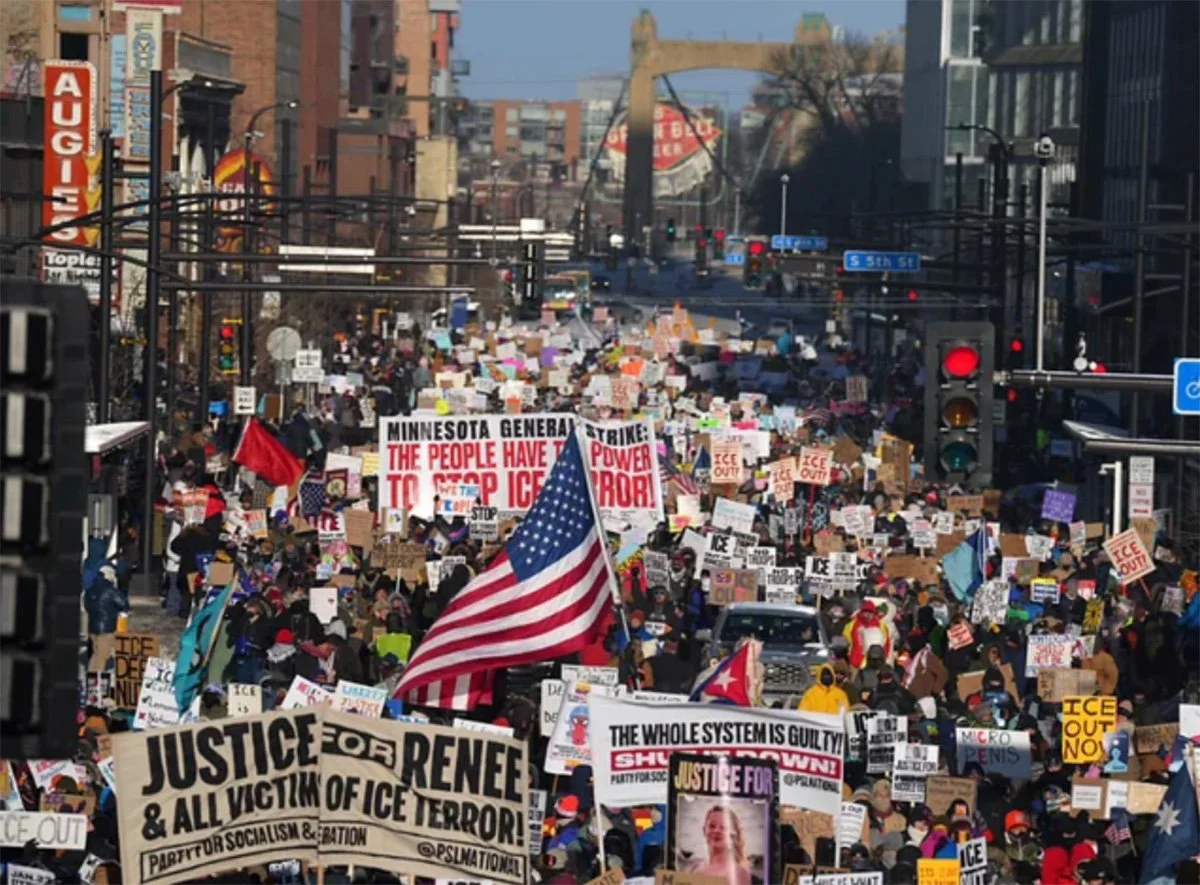
January 23 in Minneapolis-St. Paul showed the general strike tactic is no longer solely in the rear view mirror.
Making distinctions
In Minneapolis unions and labor federations advanced the ball down that field without quite uttering the words “general strike”, although everyone was pretty clear what “No Work, No School, No Shopping” meant. Which brings us to the distinction between what Marxist philosopher Ernst Bloch termed ‘abstract’ and ‘concrete’ utopias. Both contain the hope for something better than what we’ve got, and both can propose action to get us from here to there. But an abstract utopia fails to marshal full consideration of the many-sided realities that need to be navigated in order to arrive at a successful endpoint. A concrete utopia pays attention to what Marx was getting at in his Introduction to the Grundrisse when he noted that “The truth is concrete; hence, unity of the diverse.”
What didn’t do that? The cry immediately after January 23 by various individuals and organizations to replicate “No work, no school, no shopping” nation-wide a week later on January 30, which predictably fizzled, absent the hard work of analysis and organizing that produced January 23.
What did do that? In the background, helping to set the stage for Minneapolis, was United Auto Workers president Shawn Fain’s call—issued in 2023—for unions across the country to line up their contracts for common expiration on May 1 2028. Here was a call not to have a general strike, but to organize one. A concrete utopia is one that bridges the gap between the current unsatisfactory situation and the desired outcome with appropriate tactics, strategies, and inspiration—and above all, with a cleareyed picture of and willingness to do the work needed in the timeframe needed to do it.
We may be learning that there is nothing like a dose of fascism to clarify the minds of labor and other progressive movement leaders. Besides all-but-calling a general strike, and getting onto the May Day train, unions around the country have been stepping up ‘tax the rich’ efforts at the state and local levels and signing onto coalitions supporting socialists running for office. Not everywhere, but you’ve got to start somewhere, and it seems to be starting. There are some 250 democratic socialists in office today in the United States, the most since the heyday of the Socialist Party in the early twentieth century, nearly all elected with union support. The imagination of the labor movement, perhaps not coincidentally mostly slumbering since the 1946 strike wave, is waking up.
The direct confrontation with fascism experienced in places like the streets of Los Angeles, Chicago, Minneapolis and elsewhere is not everywhere. Where it’s happening it’s real and deadly serious, on the wrong end of weapons wielded by our government against its own citizens. Fascists are occupying the federal government apparatus, and as they are wont to do, they are stripping it of its helping functions and shifting resources to the repressive functions. But the occupation is being contested. Civil society is the playing field, and democracy is still in play.
Mayhaps
May Day has always been about collective imagination—to be precise, workers imagining a new world, one in which they will be in charge. This act of collective imagining involves another pairing, not the same as but rhyming with the concrete/abstract utopias distinction: individual imagination and fantasy. In psychoanalytic terms, fantasy is a regressive and often self-destructive escape from reality, a defensive flight toward would-be omnipotent control, but only in one’s head. The ultraleft posturing that goes into a call for a general strike without regard to material circumstances is a good example. Imagination, by contrast, actively and creatively engages the work necessary to move from internal conception to making something actually happen—like lining up our contracts to expire on the same day, May Day 2028, with a timeline matched to the magnitude of the task.
Fain’s concrete utopia also rhymes with how May Day began. Following the execution of the Haymarket martyrs in Chicago, the Socialist International declared a day of commemoration, with demonstrations in every country for the eight-hour work-day, the cause for which the Chicago labor leaders were put to death. Wisely, the call did not impose a one-size-fits-all set of instructions, but instead suggested that each country assess its situation and determine what sort of demonstrations made sense in their own context. The results ranged from weekend marches to general strikes. In some places, over the years, the marches became general strikes, May First became a workers’ holiday, and the labor movement achieved the shorter workday.
For eight decades in this country we’ve done the weekend marches, not the general strikes, the door to which has been shut tight. The people of Minneapolis showed us something remarkable on January 23—that with the work that accompanies imagination, it just might be possible to crack the door open and let the light through. Minneapolis isn’t everywhere, nor should we expect it to be—like Mamdani’s victory could happen because it happened in New York, and New York also isn’t everywhere. But both events show us that something different is possible when collective imagination is fired by the vision of a better world, and the vision is matched with the work it takes to get there.
On May 1 2026 we’ll be testing how far along we are on the path to the mass actions necessary to push back the fascist tide. We should expect the results to be uneven, but we can learn from them and thus be stronger as we head toward the next rounds of struggle.
