Richard Hofstader, drawing from sociologist Max Weber, distinguished in Anti-Intellectualism in American Life (1964) between the “intellectual” and the “professional”: the former a free critic of our ideas and social fabric; the latter living off his skills, not for them. At the turn of the 21st century, however, academia—the primary site of the siloed away “intellectual”—resembled little of what it did only decades earlier. No longer was the University of California free to all residents of the state as it had been for over 100 years. With decreased state funding for university operating budgets, public (and nonprofit) universities had become less and less of a public good: transformed instead into an increasingly premiumized hazing ritual imposed on working people seeking mythologized class mobility: “degree mills.” Fittingly, university academics simultaneously featured more specialized contingency in an increased reliance on residual low-wage intellectual labor. The minting of ever more of these graduate and non-professorial workers has, naturally, led to the rise of unions through which they fight to represent their interests.
Universities today are increasingly research-oriented and produce important advancements in fields such as climate science and disease prevention—as well as continuing their educational missions (in an albeit ever more ancillary, impoverished form). After years without raises, and a 16-year legislative fight to win collective bargaining rights, graduate workers won a union at the University of California in 2000 with the United Auto Workers. Today, UAW represents over 60,000 workers across the UC system (and over 125,000 in higher education across the country) with jobs in various research, teaching, and staffing capacities—30,000 of whom at UC are currently fighting for a new contract, and 10,000 of whom are fighting for their first. The expansion of academic worker unions in the UC system and beyond isn’t only about ensuring equitable working conditions in higher education, but about fighting to protect and expand the University as a public service which produces public goods.
Statize or politicize
After the Janus v. AFSCME Supreme Court ruling in 2018 stripped public sector unions’ ability to collect fair-share fees and forced them to cultivate active membership, they were left with two paths, per Chris Maisano: statize, and become junior partners to government employers; or politicize, and fight “to put the level and quality of public services on the bargaining table.” UAW 4811, as well as its UAW Region 6 siblings at USC (Local 872), Cal State (Local 4123), CalTech (Local 2478), and beyond are doing exactly this politicizing effort by undertaking one of the biggest efforts to increase funding for public goods in California history: fighting to authorize Senate Bill 895, and through it $23 billion in grant funding from the state for public research.
UAW is leading the way in large part due to the fascist Trump regime’s attacks on higher education, and research in particular. As long ago as in Ancient Greece, the pursuit of knowledge for the public has been politically fraught. In The Apology, Socrates, facing the death penalty, defends himself from his accusers against charges of “corrupting” Athenians by leading them to criticize orthodoxy and thereby expand the knowledge of the public. Today, research workers are under siege in a similar manner—attacked by the climate-denying, anti-vax, anti-education regime for improving public knowledge about our world and lives through examination and experimentation. In the absence of funding from the state government, climate science has grown reliant on funding from the National Science Foundation, lifesaving health research likewise on funds from the National Institutes of Health. Rather than relegating these discoveries to the proprietary knowledge of capitalists in the oil industry or big pharma, respectively, federally funded research has still served the broader public by making scientific discoveries available to all for decades.
Hollowing out
That research, and the now union jobs which produce it, however, have been imperiled by Trump’s attacks. “The Trump administration’s attacks on research funding—cutting the budgets of funding agencies, firing staff responsible for reviewing proposals, withholding money for funded projects—are hollowing out this workforce,” says Ahmed A., a postdoctoral scholar at UC Irvine, financial secretary for UAW 4811, and member of DSA-LA. “Postdoctoral Scholar and Academic Researcher hiring has slowed down, and we’re seeing a massive uptick in layoffs. In 2025, the size of both bargaining units has decreased, and this trend shows no sign of stopping.” This decline in jobs will take another year to play out in the admission numbers for graduate workers who make up the bulk of the rest of research staff at UC.
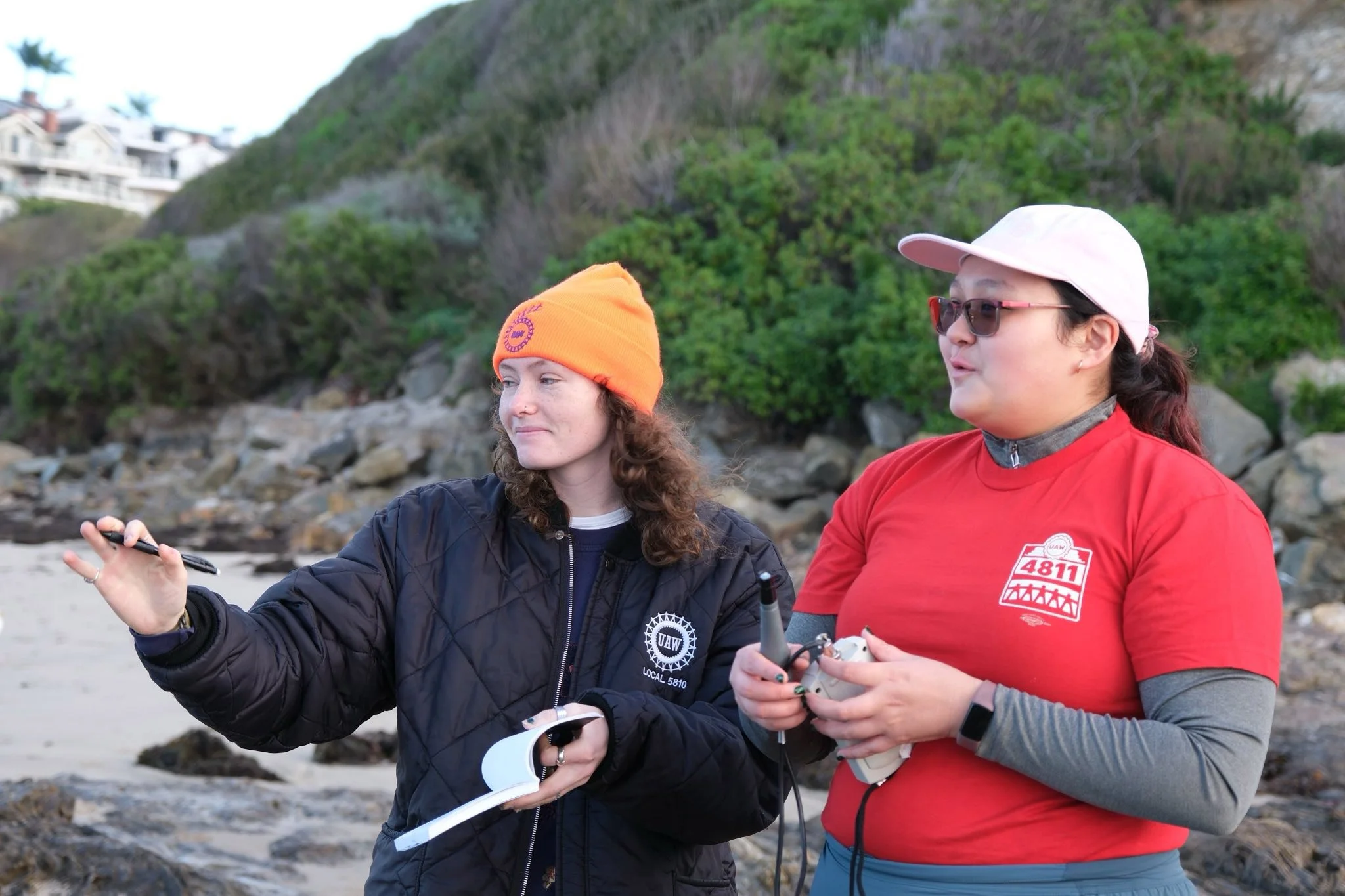
These cancellations have targeted health and science which runs contrary to reactionaries’ “MAHA” and climate denial narratives. At UC Irvine, the NSF grant which funded the Climate Justice Initiative (CJI)—a longstanding research project studying health effects of climate change and pollution on Southern California communities—was abruptly cut in 2025, resulting in the attempted layoff of eight UAW-represented researchers, which would have effectively ended the project. Because workers were able to fight through their union, these researchers were able to win their jobs back, and thus to continue this vital research. CJI demonstrates how the damage of these cuts extends even beyond research institutions, says Thi T., a Postdoctoral Scholar at UC Irvine and member of Orange County DSA who works on the project: “Our community partner organizations in OC broadly rely on a patchwork of their own federal grants that have gotten disrupted.”
Fighting for the future of public research and education
The decrease of funding (particularly policies like capping indirect cost rates for granting agencies, which pay for day-to-day operations and facilities maintenance) to institutions has also cut into the quality of instruction, while providing cover for administrators to keep raising tuition for students. Some departments have seen instructional budget cuts of 50% or more as management offsets operations (and ballooning executive compensation) costs onto instruction. “There aren’t enough courses offered for undergraduates to complete their degree requirements quickly, while graduate students still struggle to find work,” says Trevor S., a teaching assistant at UC Irvine, and officer for OC DSA. “There is a high demand for teaching and a high supply of qualified instructors, but everyone somehow still loses. Fewer and fewer courses are being offered and class sizes keep growing.”
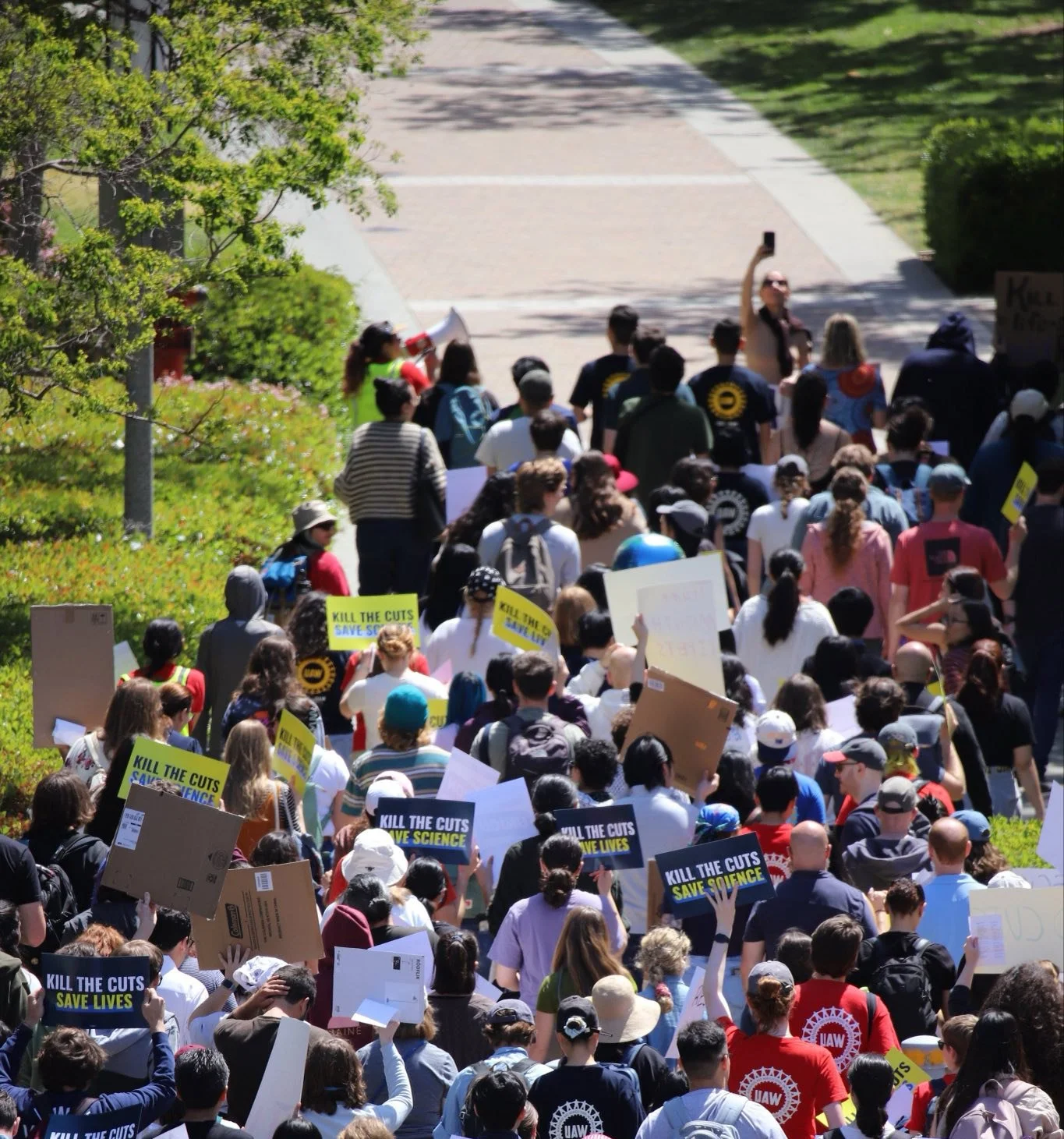
While UAW and others have successfully killed many grant cancellations in court, and the proposed federal budget for 2026 ended up restoring most funding for research—the targeted cancellation of federal grants which go against the Trump-prescribed narrative will persist for at least three more years, if not longer. This is why UAW is the primary sponsor of the California Health and Science Research Bond Act. SB 895 would put the largest bond in state history on the November 2026 ballot, $23 billion dollars over 10 years to fully fund public health and climate research. This funding would also take the pressure off of educators, caught in the University's targeted austerity which is driving down the quality of public education and forcing students to pay more. While funding at the federal level may never be truly secure again, UAW workers offer a model for how to win funding for the public good by organizing—one which DSA members can learn from and join because, as Thi T. puts it: “California communities face multi-billion dollar climate and environmental catastrophes every few months. We need multi-billion dollar solutions today.”
It’s going to be imperative that DSA members across California organize to protect and grow public research and education through every possible avenue as we move deeper into Trump’s second term. The passage by popular mandate of UAW’s bond this November will set the stage for public workers across the country to follow suit, safeguarding public goods and services when under siege by reactionaries at a national level. In 2026 California has the opportunity to lead the way in protecting the health and climate of all people, in the U.S. and around the world—as well as to strengthen and politicize the union of science, labor, and socialism!