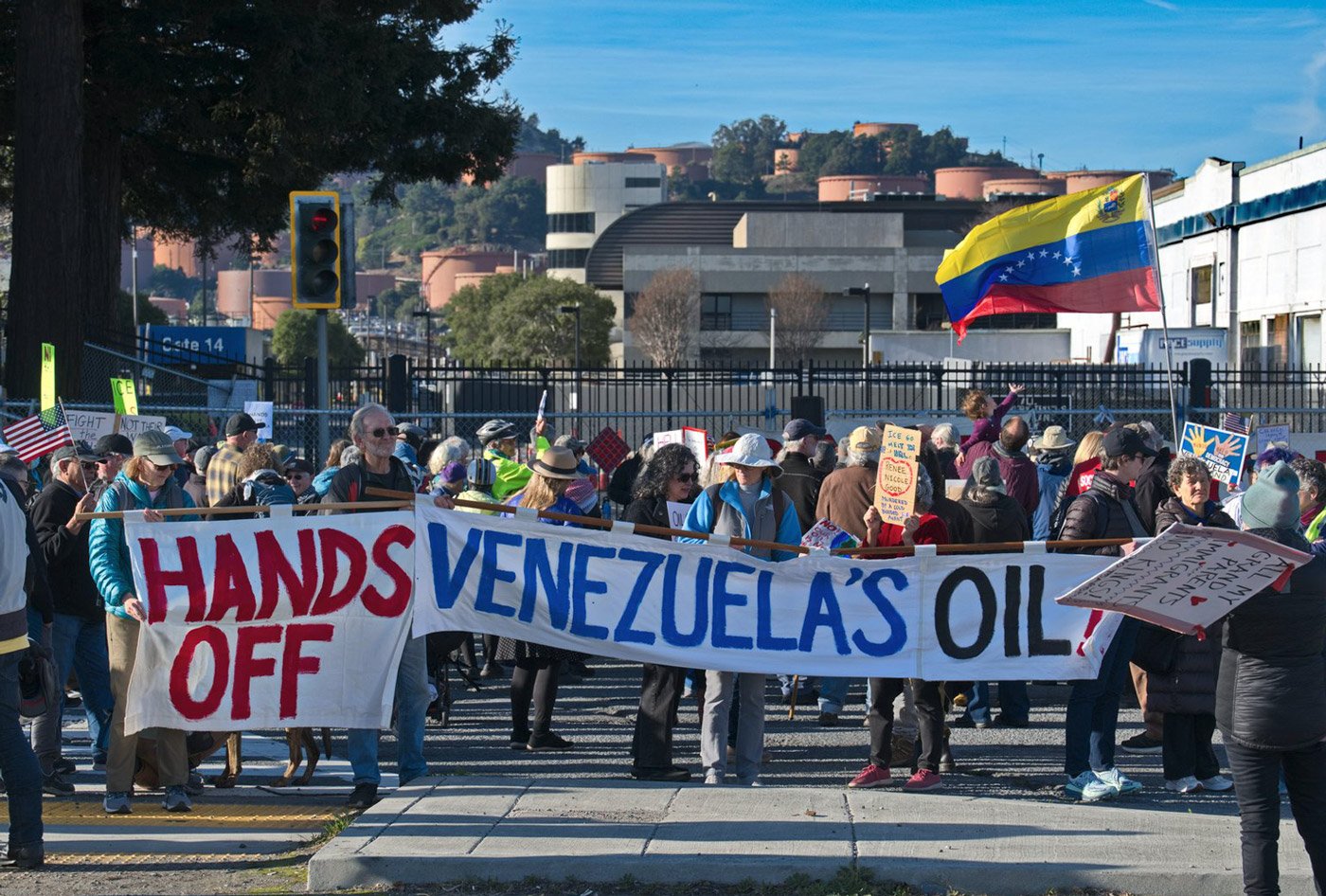
Demonstrators gather outside gate 14 of Chevron’s Richmond, California Refinery on January 10, 2026. Photo by Leon Kunstenaar. Used with Permission.
As Sabrina Fernandes, the Brazilian ecosocialist, puts it, “As much as the current situation is about Venezuela, it is clearly not just about Venezuela.” From the vantage of ecosocialism, the events underway in Venezuela are just the latest chapter in the centuries-long exercise of imperial extractivism that fueled the rise of global capitalism and remains its infernal combustion engine today.
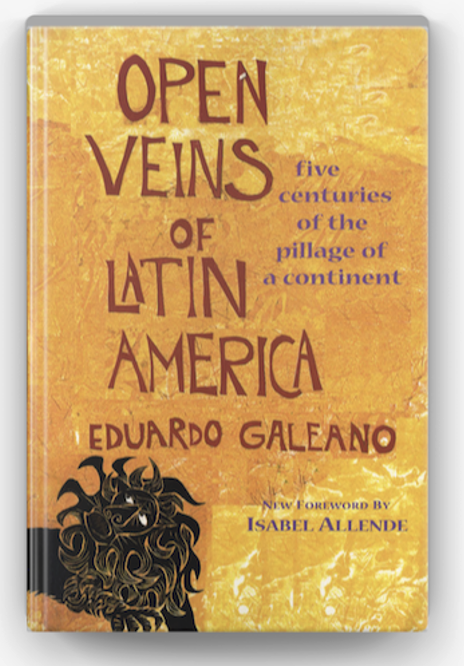
No better introduction to Latin America’s part in this pageant of plunder is Uruguayan Eduardo Galeano’s 1971 masterpiece, Open Veins of Latin America: Five Centuries of the Pillage of a Continent, which Venezuelan president Hugo Chavez gifted to president Barack Obama during his trip to meet with Latin American leaders in 2009. The book told in the clearest terms the violent history of European and then U.S. exploitation of Latin America’s riches: first, silver, mercury, and gold, then sugar, tobacco, coffee, tin, nitrates, bananas and oil.
The plunder didn’t stop in 1971, when the book came out, or in 2009, when Obama read it or, more likely, did not read it. And here we are, past the first quarter of the 21st century, writing a new chapter with Donald Trump’s strike on Caracas and seizure of oil tankers full of Venezuelan oil sanctioned on his imperial say-so.
Ecosocialists see the global threats and challenges posed by the ecological crisis as interwoven with and inseparable from the geopolitical and economic crises of late capitalism. Accordingly, we don’t spend much time speculating on the personal motives of Donald J. Trump. Nor do we dismiss him as an incompetent buffoon, a “malignant narcissist,” with delusions of grandeur and incipient dementia. The project he represents is deadly serious and backed by a powerful coalition of forces and will cause untold human suffering in the years ahead even if, in the best case, it is reversed by a future administration.
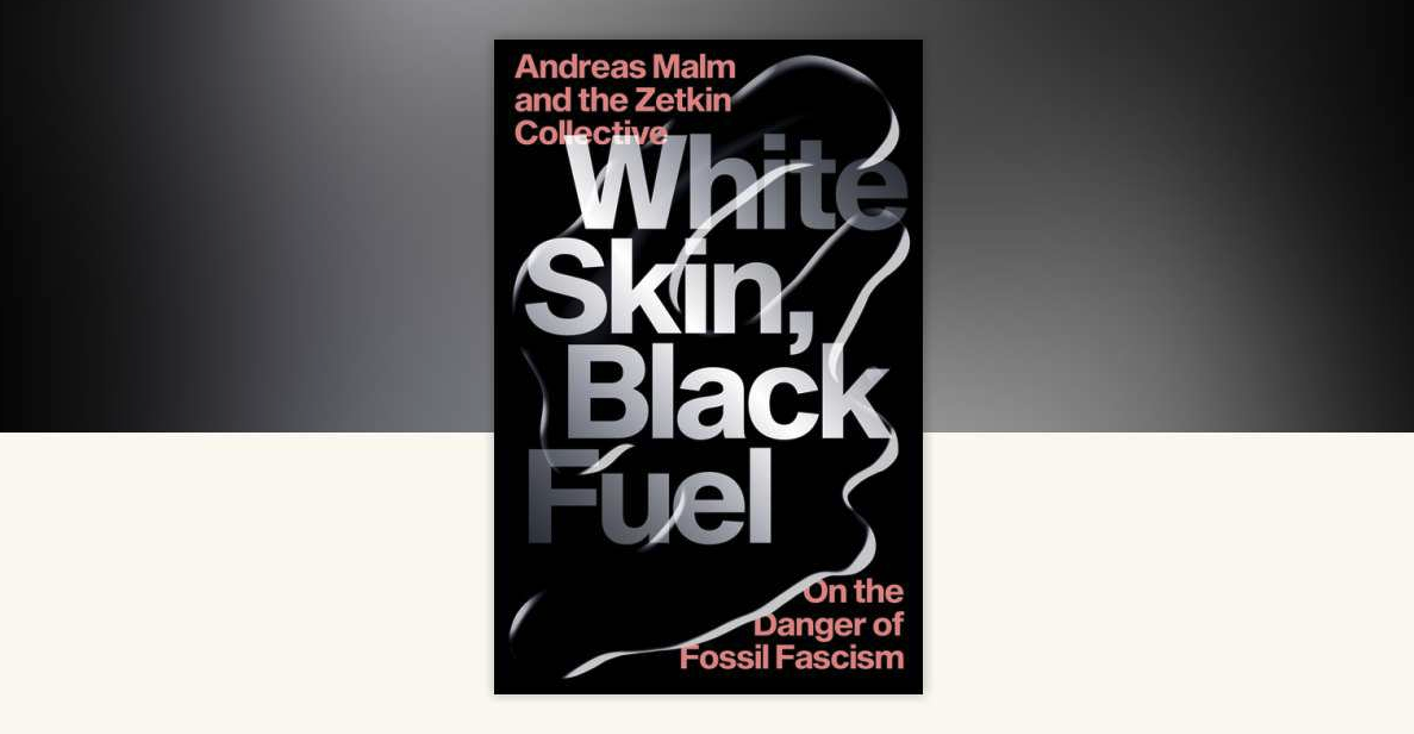
Trump represents a powerful coalition of forces that are doubling down on what Andreas Malm and the Zetkin Collective identify as “fossil fascism” in White Skin, Black Fuel, their panoramic 2021 survey of the rising international far right. White Skin, Black Fuel explores how the right’s traditional racism, nationalism, nativism, and militarism have been melded in our era with climate denialism and an undying commitment to fossil fuels.
To paraphrase Fernandes, as much as the current situation is about oil, it is clearly not just about oil.
A central goal of the Trump Administration is to lock us into a genocidal and ecocidal race in which corporations and oligarchs hope to come out on top. They know that large majorities do not want what they offer so they are ready to bring conflict, chaos, and war, an environment in which believe they can thrive. In support of this dystopian vision, Trump seeks to “move quickly and break things,” in the jargon of his Silicon Valley tech-bro allies.
This means stamping out any effort to mitigate the impact of laissez-faire capitalism on the ecology of planet Earth. Trump has made no secret of his devotion to the fossil fuel, aiming to thwart any efforts in the United States to move towards renewable energy. Shortly after he took office in 2025, Trump issued an executive order declaring a “national energy emergency.” The strategic goal is to fast-track expansion of oil, gas, coal, and nuclear infrastructure. The U.S. is departing from international climate efforts that include every other nation in the world. He is dismantling the U.S. scientific effort to study climate change. The Trump Environmental Protection Agency plans to reverse that agency’s finding that ever-increasing carbon dioxide levels in the atmosphere endanger human health – the legal foundation for all government efforts to limit carbon emissions.
“Oil we should’ve taken back a long time ago”
Even though the United States is now the leading producer and leading exporter of oil, Trump has suggested that boosting oil production in Venezuela is a U.S. priority, and he is expecting U.S. oil companies to follow his lead.
“The oil companies are going to go in, they are going to spend money, we are going to take back the oil, frankly, we should’ve taken back a long time ago,” Trump declared at his press conference announcing the abduction of Nicolás Maduro. “A lot of money is coming out of the ground, we are going to be reimbursed for everything we spend.”
There’s a lot to unpack here. Trump makes no attempt to dress up his scheme to exploit Venezuela’s oil industry in any language suggesting a nobler purpose such as spreading democracy. Trump’s claim that Venezuela’s oil belongs to the United States is imperialism without apology. “What is mine is mine and what is yours is mine, too.”
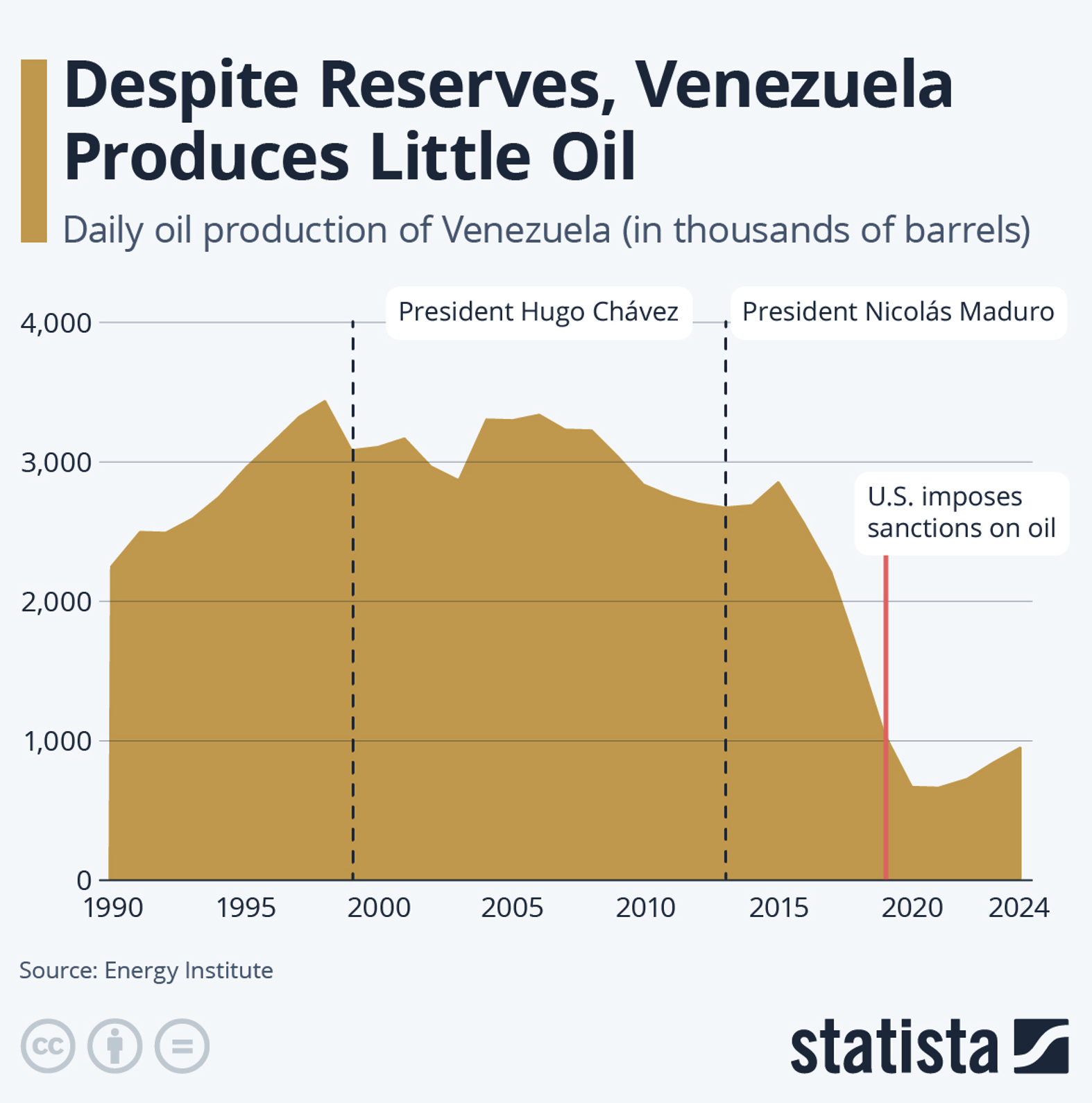
But despite Venezuela’s impressive reserves, the amount of oil produced by Venezuela is relatively minor – less than a million barrels compared to U.S. production of nearly 14 million barrels per day. It will take a Herculean effort to rebuild the petroleum industry in the challenging topography and economics of the Orinoco Oil Belt.
Oil industry experts scoff at the idea that Venezuelan crude will experience a sudden resurgence. Despite some enthusiasm from Chevron execs, U.S. oil companies are not ready to play the grand role assigned to them by Trump. Not only is there currently an oversupply of oil on world markets, but the potential for prolonged political instability makes Venezuela “uninvestable” in the eyes of ExxonMobil. the largest U.S. oil company. Fossil fuel infrastructure to bring Venezuelan oil production back to its peak during the Chavez years when upwards of 3.5 million tons flowed daily could take a decade to build and cost as much as a trillion dollars. Return on investment would need to play out over a secure 35 or more years of production. Political stability is sine qua non.
Although the Maduro government without Maduro may be ready to cut a deal with Trump, it seems certain that political stability is not coming any time soon. The Trump Administration has little real interest in, nor is it capable of, running the country. Marco Rubio and Pete Hegseth are not ready to squeeze in duties as Venezuela’s proconsuls, reprising Paul Bremer’s disastrous stint in Iraq after the U.S. “victory.” Trump jazzed up his biography on his TruthSocial to give himself the title of “Acting President of Venezuela,” but, he, too, is likely to be otherwise occupied. Rather, the administration will probably let political struggles within Venezuela play out however they will with the U.S. bullying whoever is in power to orchestrate concessions that include cutting off Cuba’s supply of oil and generally allowing the U.S. to dictate terms and conditions for sale of Venezuela’s oil to the rest of the world. Trump’s rhetoric has suggested that the U.S. will simply help itself to some of the oil Venezuela “stole” from us.
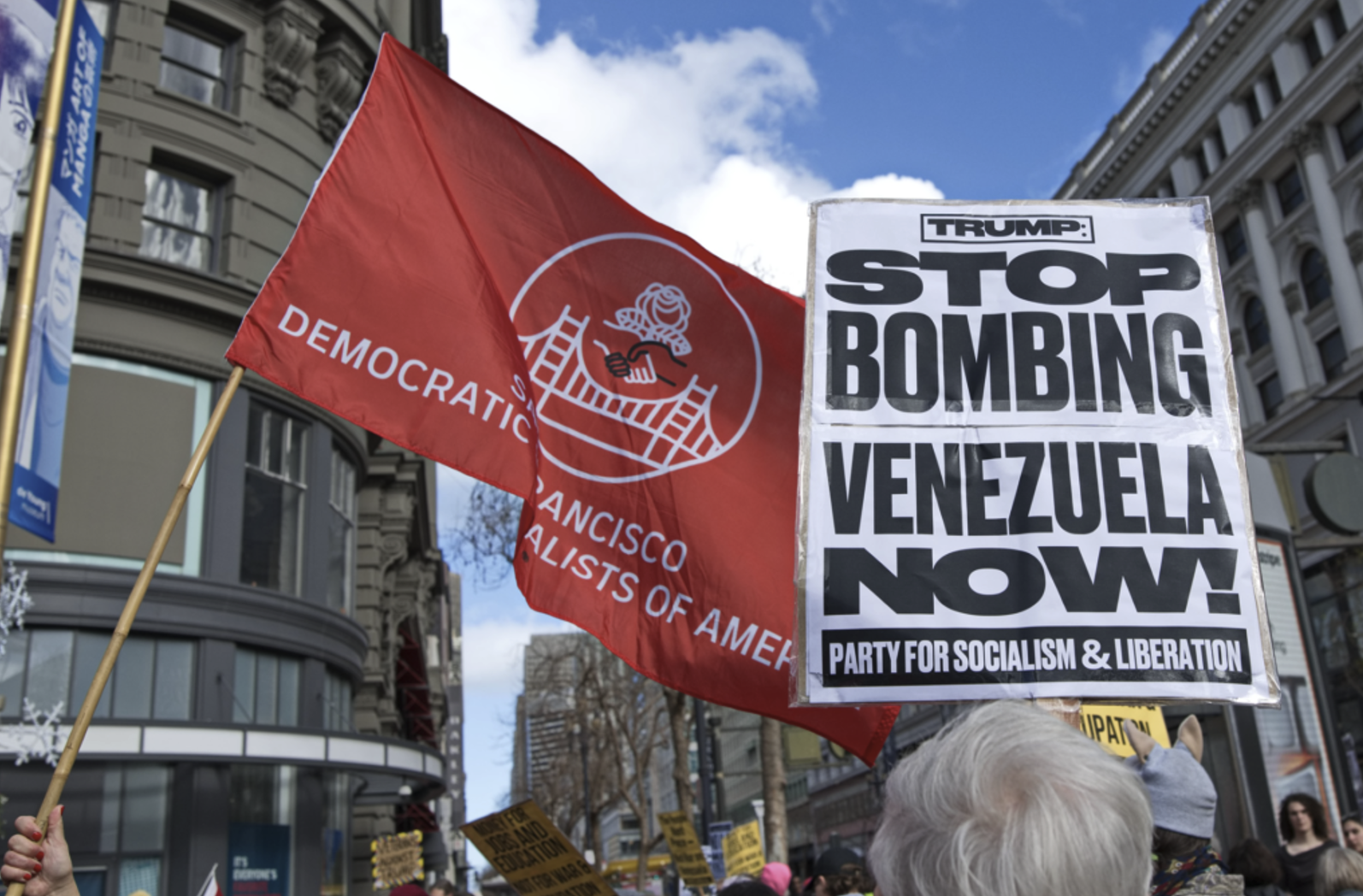
In the streets of San Francisco DSA and PSL joined forces. Photo by Leon Kunstenaar. Used with Permission.
DSA Responds
California DSA chapters have been quick to respond to the attack on Venezuela and kidnapping of President Nicolás Maduro and First Lady Cilia Flores. DSA issued a call for chapters across the country to stage demonstrations on January 10 “to protest th[e] illegal war and stand in solidarity with the sovereign people of Venezuela.” DSA raised demands including freedom for President Maduro and First Lady Flores, passage of the War Powers Resolution, impeachment of Trump for war crimes, no war for oil, and an end to all sanctions against Venezuela. San Francisco and East Bay DSA joined with the Party for Socialism and Liberation to co-lead a rally and march in San Francisco. Silicon Valley DSA rallied with a coalition of partners and Los Angeles DSA also hit the streets.
On January 10, while many of our comrades were rallying in San Francisco, East Bay DSA members who have been active in confronting Chevron over the years also gathered with hundreds of other community, labor, climate, environmental, and anti-imperialist activists at the gates of the Chevron refinery in Richmond to protest the company’s presence in Venezuela. Chevron is the second largest U.S. oil company and the largest oil refiner and distributor in California. The labor alliance May Day Strong and Indivisible also called for nationwide actions on January 10 to protest the attack on Venezuela and the murder of Renee Good by ICE agents in Minneapolis. May Day Strong urged demonstrators to target Chevron and Citgo, companies set to benefit most by the U.S. assault on Venezuela.
Over the years, East Bay DSA members have repeatedly engaged with Chevron—picketing in support of the 2022 refinery workers’ strike, canvassing in support of the Richmond Progressive Alliance (which has moved the former company town sharply to the left), demonstrating against Chevron’s pollution (which has robbed local residents of healthy air for more than a century), and protesting Chevron’s infamous global record of ecocide, genocide, and corruption.
Most recently, DSA ecosocialists have been active in local organizing around the international Palestinian-led Chevron Boycott. Chevron’s natural gas extraction in the Eastern Mediterranean powers most of Israel’s electricity generation, its war machine, prisons, and illegal settlements. In early 2025, responding to a call by the Palestinian-led BDS National Committee, the DSA International Committee initiated a national campaign to demand that Chevron get out of Palestine. The East Bay DSA Climate Action Committee has been very active in organizing the Chevron Boycott, deepening our ties with other climate activsts through picketing of Chevron gas stations and freeway banner drops, so it was a natural for us to join with activists from the Oil and Gas Action Network and other long-term climate and community allies in organizing a protest at Chevron’s Bay Area outpost on January 10.
As intended by the BDS National Committee, the intersectional campaign demanding that Chevron get out of Palestine has united activists from several movements that find themselves increasingly aligned around the role of oil and gas in fueling genocide in Palestine and the U.S. war machine everywhere. The experience of the East Bay DSA Climate Action Committee is that the broader climate movement is embracing anti-imperialism, if not yet socialism.
Every anti-imperialist, socialist, and climate activist would do well to become familiar with the 29-page National Security Strategy adopted in November 2025 by the Trump Administration. The document is dressed in fluff designed to satisfy Donald Trump’s insatiable ego (“President Trump has cemented his legacy as The President of Peace”). But underneath the fluff, there is a clear outline of the Trump Administration’s project to reshape the world.
The post-World War II era of multilateral agreements and institutions designed and promoted by the U.S. to serve its interests is over. The U.S. “will assert and enforce a ‘Trump Corollary’ to the Monroe Doctrine.” This explains the attack on Venezuela as part of a much larger project. Trump’s threats to Canada, Greenland, Mexico, Panama, and Columbia are not random outbursts, but the overt expression of what Patrick Bigger of the Climate & Community Institute calls “unilateralist imperialism for the twenty-first century, a foreign policy of might-makes-right where the U.S. can cajole, bully, and depose governments to seize resources and attempt to claim dominion over the entire Western Hemisphere.”
As for dealing with the energy transition necessary to stave off ecological collapse, the National Security Strategy commits the U.S. to achieving total energy dominance through oil, gas, coal, and nuclear expansion, rejecting “the disastrous ‘climate change’ and ‘Net Zero’ ideologies that have so greatly harmed Europe, threaten the United States, and subsidize our adversaries.”
As the title of one chapter of Malm and the Zetkin Collective’s study of fossil fascism warns, “Death Grips the Steering Wheel.”
-----------------------
Help us build power for a world #beyondchevron!
If you want to help pry Death’s hand from the steering wheel, there’s no better place to build the campaign than California. Chevron poisons communities from Richmond to El Segundo, pollutes our politics with massive lobbying at the state and local level, and fuels the climate crisis that threatens our homes and health with fires, floods, and extreme heat. We are building a working-class struggle to challenge Chevron’s nefarious role from Palestine to Venezuela to California.
To learn more about DSA’s Stop Fueling Genocide campaign and to join the West Coast Boycott Chevron coalition, contact climate-action@eastbaydsa.org or fill out this interest form: https://bit.ly/chevboycott
Come and work with us! We have tool kits, experience, and inspiration to share with comrades around the state.