
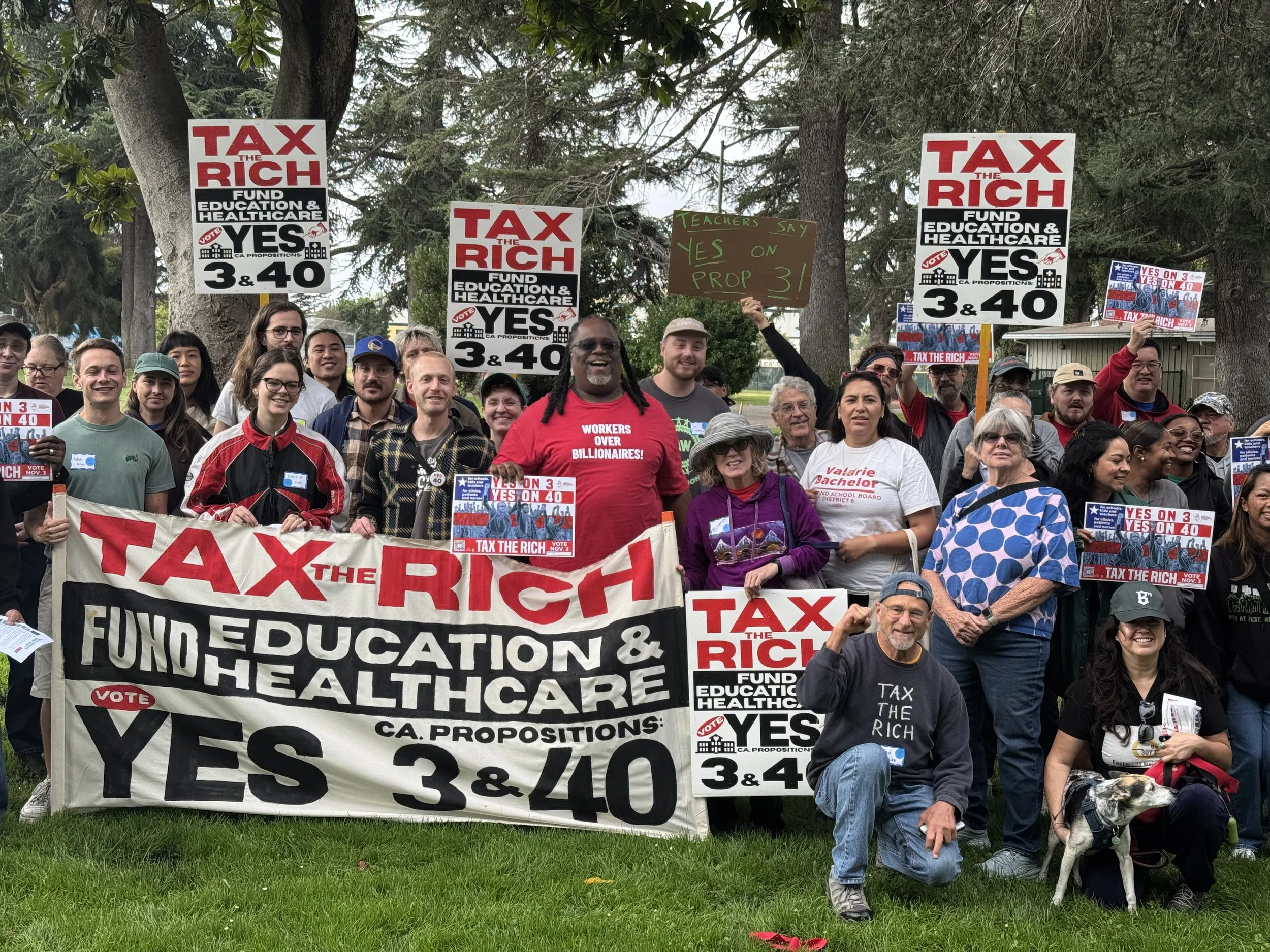
Don’t throw away your pitchforks. You will have more chances to use them in the near future.
With the loss of Proposition 40, the Billionaire Tax, by a slim statewide margin of 52.1–47.9%, California DSA’s 2026 “Tax the Rich” campaign went one for two. The other progressive tax on the ballot, Proposition 3, the Education and Health Care Act, won handily, 61-39%. Any attempt to spin the SEIU/United Health Workers-backed Prop 40 defeat as an indicator that California’s electorate doesn’t want to tax the rich—billionaires included—is either uninformed or deliberately misleading. So an obvious question arises: what made the difference in outcomes for the two measures?

400 million dollars from sociopathic billionaires sent a flood of paid advertising sewage across the state
A couple dozen of the richest far-right Californians spent close to $400 million to defeat Prop 40—a historic record sum in a ballot measure campaign. Their effort featured scaremongering ads that were outright lies, such as “this is a tax on you” and “Sacramento politicians want to take your retirement savings”. It creatively disguised pure conjecture as expert opinion: “This will end up costing the state more than it takes in”; “All the billionaires will leave”; “Business innovation will be crushed”. Riffing on Pastor Martin Niemoller, we found that first they come for billionaires, and then they come for “you”. These deceitful messages were everywhere throughout September and October—television, radio, digital popups, social media, and in our mailboxes. They buried the purpose of the tax—to prevent three million low-income Californians from losing their health care coverage—beneath a pile of disinformation sufficient to defeat it.
The firehose of spending and wall-to-wall advertising moved the needle of public opinion from close to 60% in favor in the spring to just under 50% by November 3. But what exactly did that slight majority of voters vote against? Despite the result, many were not casting a vote against taxing billionaires. Even leading anti-40 voices like Governor Gavin Newsom felt compelled to say that billionaires should be paying more taxes.
But in a common dodge for the “No” side of a ballot measure, the messages were “not this one”, because it is “fatally flawed”; and plausible sounding but misleading barbs like “we need such a tax to be permanent and federal, not temporary and assessed at the state level”. And these were the ads that actually mentioned the billionaire tax; most just said “No on 40”, aware that any insertion of the title would remind voters that they hated billionaires.
The billionaires’ PAC, “Building a Better California”, threw everything that $400 million would buy at the electorate, betting that with gigantic scale and volume turned up high—and the United Health Workers’ bank account unable to mount an adequate media response—enough of the media sludge would stick to the wall to defeat the measure through stoking fear and confusion. And they were right.
On the wrong side
Let’s be clear that the billionaires didn’t achieve this result entirely by themselves. Several nominally progressive organizations—the California Teachers Association, Building and Construction Trades Council, and Planned Parenthood—vocally opposed Prop 40, along with Governor Gavin Newsom, steering mainstream news coverage to meekly accept billionaire talking points in endlessly repeating that labor was split, “teachers” (insinuating all teachers) were against the tax, and “progressive groups” were worried that all the billionaires would leave.
One thing that didn’t appear anywhere in the mainstream news stories was this angle: CTA, the BTC and Planned Parenthood leadership were opposed to the tax on billionaires. None of these organizations offered a plebiscite to its members, some of whom—like CTA affiliates United Teachers Los Angeles and United Educators of San Francisco—took matters into their own hands and came out in favor of Prop 40 in defiance of their parent organization’s stance.
Likewise, the California Federation of Teachers, traditionally the more democratic and progressive of the two statewide education unions, initially neutral through a leadership vote, reversed itself and went pro-40 in September after an internal rebellion at its state council meeting.
The California DSA campaign
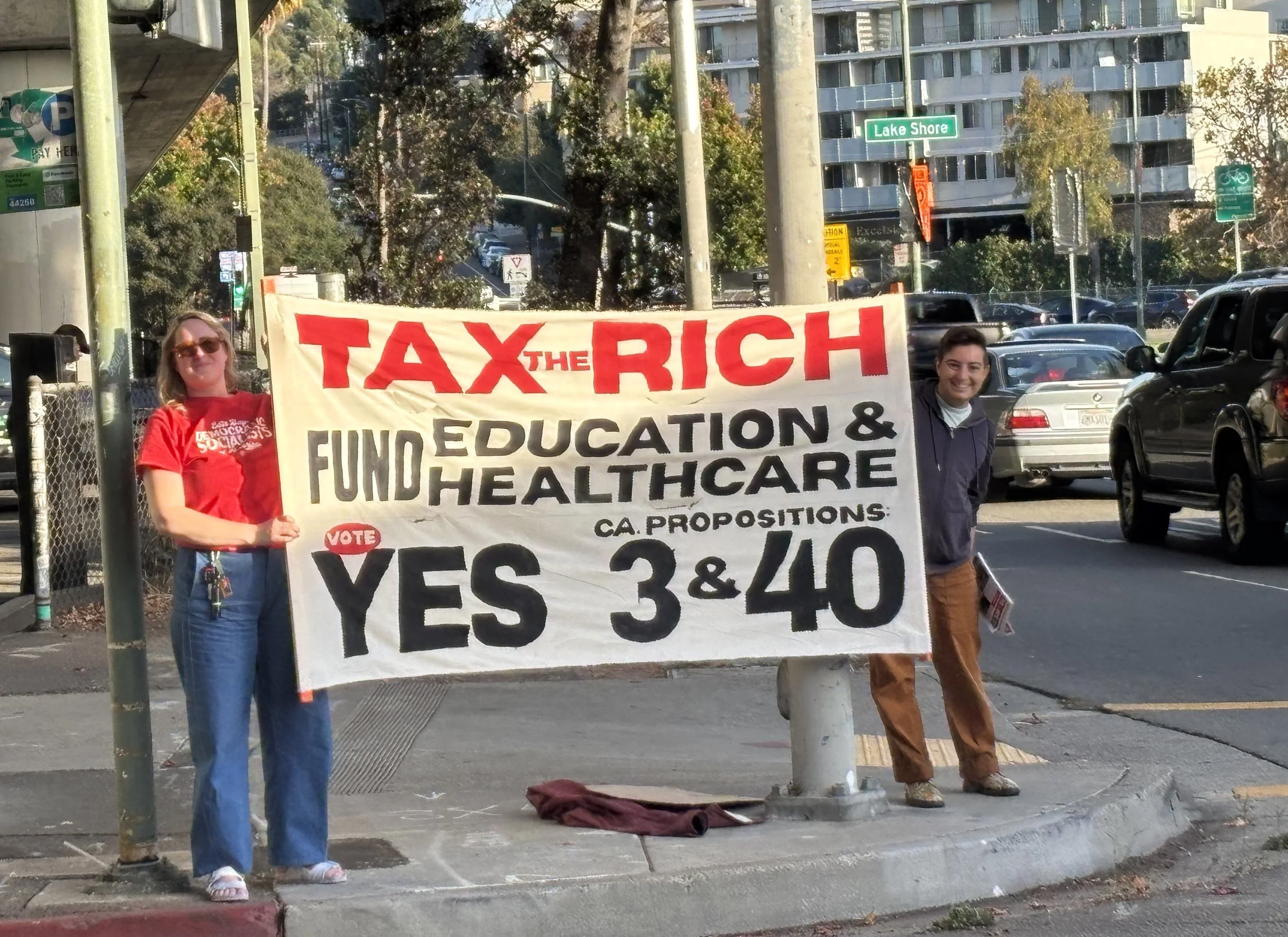
From the moment California DSA passed its resolution in January to support the Education and Health Care Act along with the Billionaire Tax, putting together a statewide tax the rich working group, democratic socialists stood virtually alone in running a united campaign for both measures. The reasons for this have been explained in earlier issues of California Red (see here and here). Although many of our chapters worked hard to promote both and build a bridge between the two campaigns, it wasn’t until August that we were joined in common cause by powerful players like the California Federation of Labor Unions and the state Democratic Party.
In that eight-month stretch we held state and local educational meetings on progressive tax policy in person and on zoom, and trainings on how to effectively hold house meetings and gain organizational endorsements for our dual campaign. We ran articles in every issue of California Red; created flyers for the joint campaign in four languages and posted them on a one-stop shop “tax the rich” campaign page on our website, ready to download, as well as an FAQ (Frequently Asked Questions) and progressive tax bibliography.
Our chapters chartered their own tax the rich working groups. We invited guest speakers to our meetings like Vanessa Williamson, author of The Price of Democracy: The Revolutionary Power of Taxation in American History. We worked with artist Jos Sances to create a beautiful campaign poster and printed thousands at a union print shop and distributed them to the chapters that wanted them. David Solnit led an art build that produced picket signs and banners. San Diego DSA printed “tax the rich” doorhangers for canvassing.
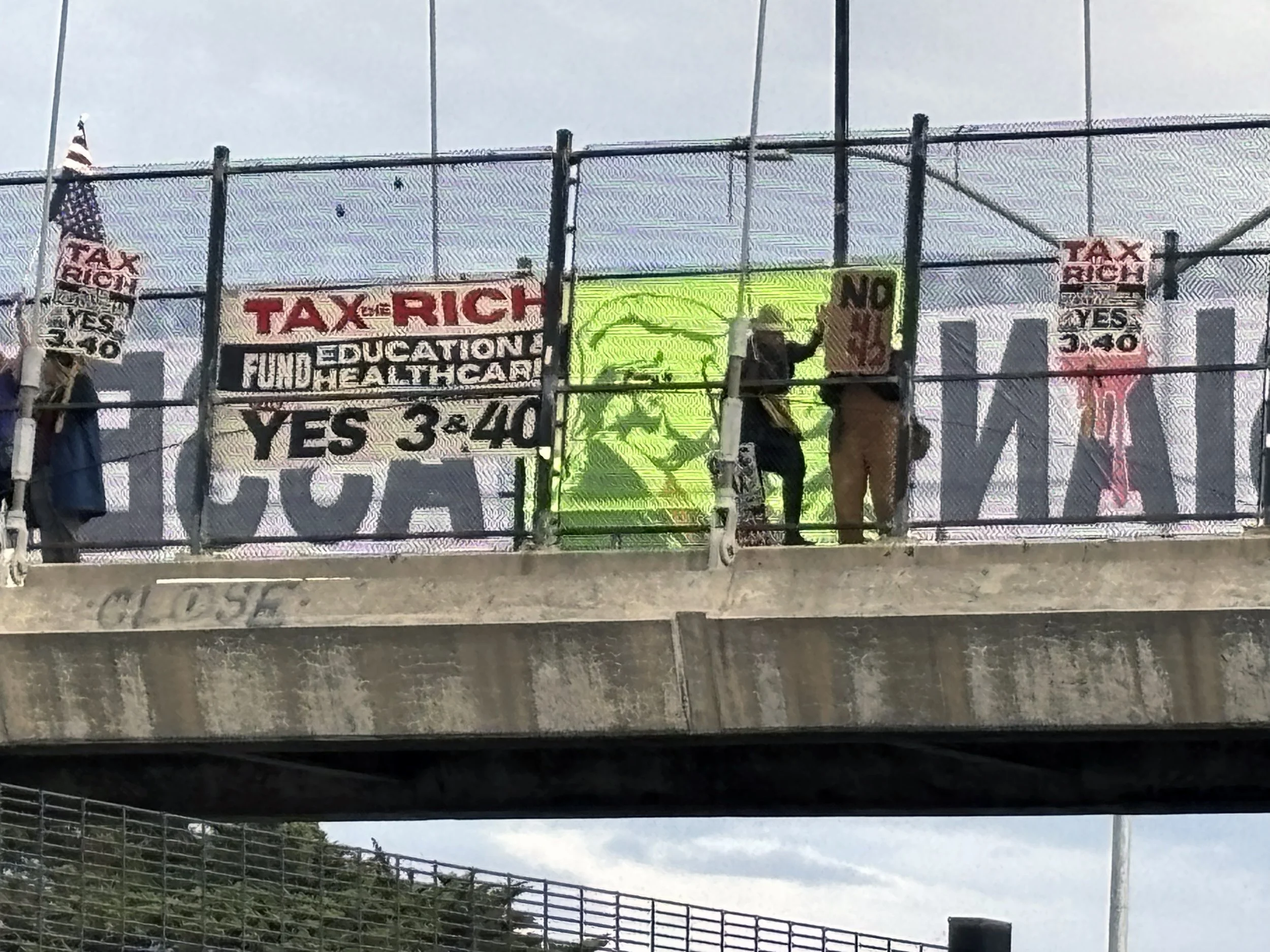
After the California Federation of Labor Unions voted at its convention in early August to support both measures, we initiated a collaboration with the state federation to make October 10 “Tax the Rich Day”, with joint rallies and canvassing in eight cities. And over the final weeks before Election Day East Bay DSA staged human billboarding at busy intersections in Oakland and banner drops on freeway overpasses in Berkeley and Santa Cruz.
Too late
Despite the hard work of DSA members from San Diego to Sacramento, the campaigns for Prop 3 and Prop 40 grew no closer together, and things looked bad for Prop 40 until the beginning of August. At that point SEIU-UHW organizing within two of the major institutions of California progressive politics paid off. First the state Democratic Party leadership, diverging from the governor, voted narrowly to endorse the Billionaire Tax. The next day, with President Lorena Gonzalez leading the charge, the California Federation of Labor Unions at its annual convention came overwhelmingly on board. As icing on the cake, the California Nurses Association joined the newly expanding coalition the following day.
But this represented the high point of the campaign. In reality, the labor federation and Democratic Party endorsements came too late to translate into effective support structures and funding. Sporadic earned media emanating from such events as enthusiastic rallies featuring Bernie Sanders and Ro Khanna and cheerleading by Nobel-prizewinning economists turned out to be no match for the record-setting spending avalanche of the other side.
A progressive tax campaign needs to hold three cards to have a reasonable shot at winning the game: the right message at the right time; the largest coalition possible, which avoids internal dissension and enables a massive field campaign; and sufficient cash for at least a modicum of paid advertising to augment the ground effort and earned media against the most well-funded opposition imaginable. Prop 40 had but the first one out of three, and it wasn’t enough. With a relatively popular governor actively opposed, and putatively progressive organizations and individuals gravely restating the false messages that billionaires would not have been able to convince the public to believe on their own, the Billionaire Tax had too big a mountain to climb.
Compare and contrast with Prop 3’s advantages. Built on a long-standing, extensive coalition of unions and community organizations, with the full backing of the Democratic political establishment (including Newsom, who otherwise never met a progressive tax he liked), and with a bank account supported by the biggest labor political contributor (CTA) in the state, and facing virtually no opposition spending, it offered a free lunch to the public (“not a tax increase”—technically true, just making permanent an already existing tax) along with modestly progressive tax messaging (“if it fails rich people will get a completely unnecessary tax cut”).
California DSA can be justly proud of its work to bring together the two campaigns under one roof. But until all parties within organized labor fully absorb and act upon the oldest lesson of labor history—when we are united on issues of common interest for the working class we win, and when we are divided, we lose—campaigns like the Billionaire Tax will find success elusive.
Keep the pitchforks handy
As for those pitchforks, we can look to two possibilities. Corporate tax increases and/or tax loophole closures could be legislated, and result in enough revenue to reverse the loss of health care for millions of California residents caused by the cruel actions of Trump and the federal government. It’s within the power of incoming Governor Becerra and the legislature to do this. Such tax increases (on income, since thanks to passage of the billionaires’ deceptive Prop 42, wealth taxes are off the table for the time being) would simply require a legislative supermajority of two thirds. If the “blue wave” of November 3 should mean anything to the legislators, it’s that now is the time to act without fear of electoral retribution.
The other direction to point your pitchfork is 2028. Already there are rumblings in some quarters about reviving some form of a tax on billionaires. And others are proposing a renewed shot at the split roll tax that narrowly failed in 2020, removing Prop 13 protections for commercial property. Whether early in the new year in Sacramento, or a couple years down the road, your pitchfork will come in handy. Keep its points sharp.
[For a longer version of this article, including a history of progressive tax policy in California, go to Jacobin here.]
